Every business that depends on software eventually faces a choice: keep assembling a series of freelancers and contractors for individual tasks, or build a lasting relationship with a technical partner who knows the systems, the business and the goals. The one-off approach looks attractive: pay only for what you need, choose the cheapest option each time. But software is not a series of independent purchases; it is a living system in which every change interacts with all the others. Over time, the partnership model usually wins on quality, speed, security and total cost. This article makes the case, and shows how to structure one that works.

Software has a memory
The most valuable asset a technical team builds is not code; it is understanding. Why the checkout has a strange rule for one customer type. Which integration breaks when the supplier changes its file format. Which part of the database must not be touched during month-end. This knowledge lives in people's heads and in documentation. When a new one-off coder arrives, they must rediscover it, at your expense, and often make mistakes while doing so. A long-term partner accumulates that context, so each change is faster, safer and better informed. See how it plays out in our legacy modernisation case study, where undocumented rules were the biggest hazard.

The hidden costs of the one-off model
- Re-learning tax. Every new person spends hours or days reading code and asking questions before being productive.
- Inconsistent quality. Each developer brings their own style, tools and shortcuts. Over years the codebase becomes a patchwork that is expensive to change; see our architecture article.
- Unowned problems. Nobody is responsible for security updates, performance, backups, certificates and monitoring between tasks. They are exactly the things that fail quietly; see DNS and SSL, backups and security.
- Emergency premiums. When something breaks, you scramble to find someone available, paying urgent rates for someone who does not know the system.
- Key-person and availability risk. The freelancer who knows the code disappears, and you are left with something nobody can safely change; see our red flags article.
- Short-term thinking. A contractor paid to finish a task has no incentive to make the system easier to maintain next year.
What a long-term partnership offers
- Continuity and speed. A team that knows your system can estimate accurately, spot risks early and ship changes quickly. Over a year the difference in delivery speed is often dramatic.
- Consistent standards. Shared coding practices, code review, automated testing and deployment pipelines (CI/CD) keep quality high as the system grows.
- Proactive care. Scheduled patching, monitoring, backups, dependency updates and performance reviews prevent incidents instead of reacting to them; see the value of a retainer.
- Strategic input. A partner who understands your business can challenge ideas, suggest simpler alternatives, warn about risks and connect technology to your goals, such as pointing out where AI would help (generative AI) and where it would not.
- Breadth of skills on demand. Design, back end, front end, infrastructure, security and data expertise available as needed without hiring each role.
- Predictable budgeting. Retainers and phased plans replace surprise invoices; see our pricing models article.
- Accountability. The partner's reputation depends on the ongoing outcome, not just a delivered task.
When one-off engagements still make sense
Partnerships are not always the answer. A one-off project fits a self-contained deliverable with no ongoing life, such as a small marketing microsite, a data migration or a specific prototype. Specialist short-term help is also legitimate for a narrow skill, like a security penetration test or a performance audit. The mistake is treating the core systems your business runs on as one-off purchases. If the software matters to revenue or operations, it needs an owner.
Partner, in-house or hybrid?
Hiring an in-house developer gives dedication and deep product knowledge, but a single hire is expensive, is a key-person risk and rarely covers all needed skills. Many businesses do best with a hybrid: an external partner that provides breadth, process, operations and continuity, working alongside an internal product owner or a small internal team who own priorities and domain knowledge. As you grow, the mix can shift. What matters is that somebody, inside or outside, is accountable for the health of the software over time; see what to look for when hiring.
How to structure a healthy partnership
- Start small and prove it. Begin with a discovery or a defined first project (our discovery phase article), so both sides experience how the other works.
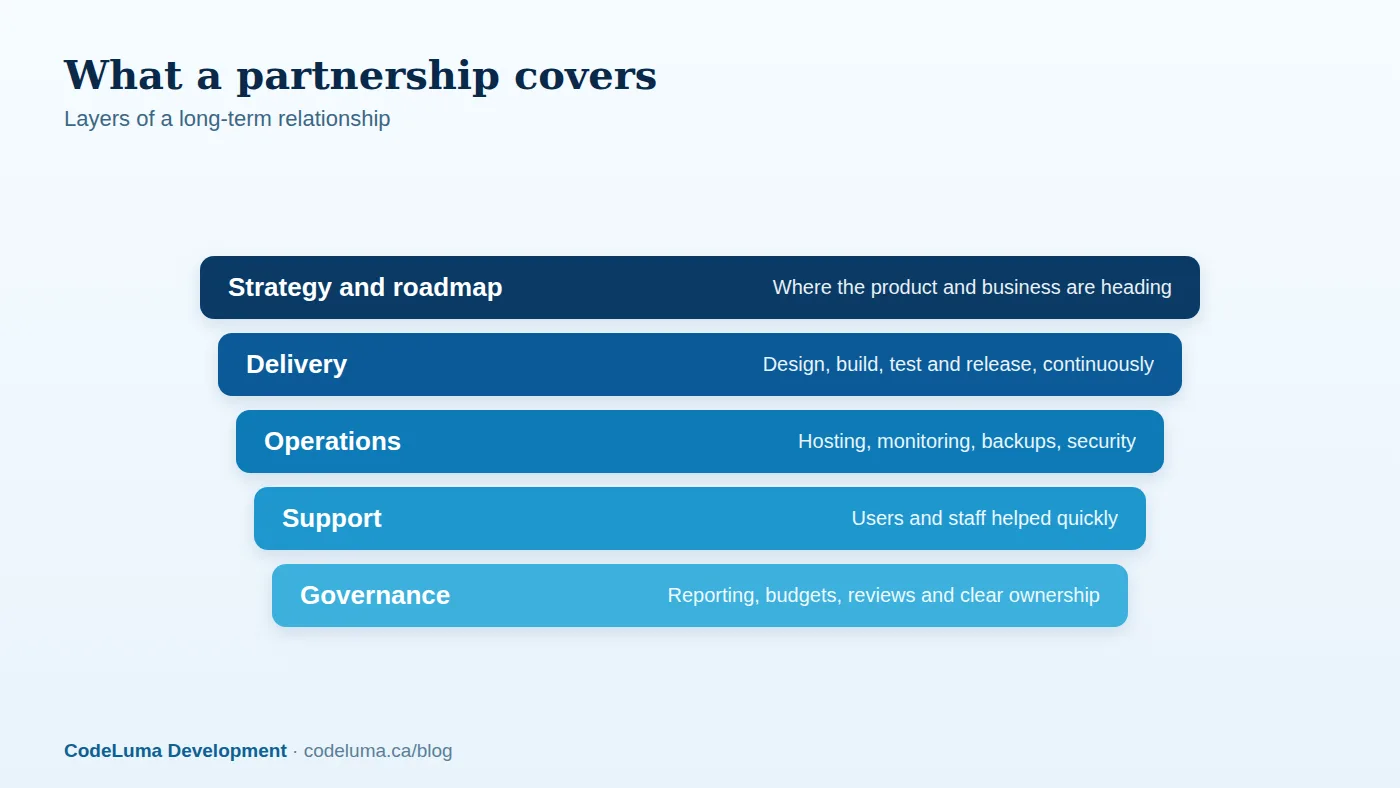
- Define the scope of the relationship: strategy, delivery, operations, support; what is included in a monthly plan, and what is billed separately.
- Agree service levels: response and resolution times by severity, coverage hours and escalation paths; see our communication article.
- Insist on transparency: monthly reports on work done, time and budget, incidents, upcoming risks and recommendations.
- Keep ownership with you: repositories, hosting, domains, accounts, documentation and data; the partner should be replaceable, and good ones welcome that.
- Review regularly: quarterly reviews of the roadmap, results and the relationship itself, with the freedom to adjust or exit gracefully with a handover.
- Fair terms: reasonable notice periods and no lock-in through proprietary tooling.
How to keep a partner honest
Long relationships can drift into complacency on either side. Guard against it with visible metrics: uptime, incident response times, patch currency, delivery against plan, page speed and error rates, business outcomes such as conversion and support volume. Request demonstrations, not just reports. Benchmark occasionally by asking an independent expert to review the architecture or a sample of the work. Encourage your partner to say no, to push back on ideas that will not pay off, and to tell you when a simpler option exists. The best partners see it as part of the job.
The economics over time
A simple thought experiment: imagine ten changes a year, each needing a new contractor to re-learn the system for a day at a substantial rate, plus an occasional emergency, plus a major upgrade every few years that has been deferred until it is painful. Compare this with a steady retainer that covers proactive maintenance and a monthly allowance of changes from people who already know the system. The retainer often costs less overall, and the software is healthier, more secure and more capable. Actual numbers depend on your situation, so ask potential partners to model both options honestly against your history; see how we estimate projects and the cloud cost guide for the discipline of measuring.
What a good partner does not do
- Create dependence through secrecy or obscure technology.
- Upsell features that do not serve your goals.
- Hide problems until they are crises.
- Treat maintenance as invisible, unreported work.
A note on our own approach
This is how we try to work at CodeLuma. We begin with a paid discovery, deliver in visible increments, host and monitor what we build (see what happens after launch), and stay involved through maintenance and improvement plans, with reporting you can read in five minutes. You own the code, the accounts and the data. If at any point you want to take the system elsewhere, we will help you do it properly.
If your software matters to your business, it deserves a partner rather than a series of strangers. Start a conversation with CodeLuma, explore our software development, hosting, maintenance and support services, and let us show you what a long-term partnership can do for your product.
Put this into practice with CodeLuma
CodeLuma works as a long-term technical partner: we learn your business, own the details so you do not have to, and keep improving your software month after month with transparent reporting.
- Custom software development - tailored systems, integrations and internal tools.
- Maintenance and support plans - updates, monitoring and ongoing improvement.
- CodeLuma support - help from a real team when you need it.
- Managed hosting - monitored, backed-up, Canadian-friendly hosting.
Start a conversation. Tell us about your project and we will reply with practical next steps, or browse all CodeLuma services. CodeLuma Development Inc. is based in Nova Scotia and works with teams across Canada and remotely.