If you are building a software business, the code, designs and data you create are among your most valuable assets. Yet many founders discover too late that they do not fully own what they paid for, that a contractor still has the keys, or that a secret key committed to a public repository has been sitting there for months. Protecting intellectual property (IP) is not only a legal matter; it is a mix of contracts, technical controls and everyday habits. This guide covers the essentials. It is general information, not legal advice, so involve a lawyer for your specific situation.
Who owns the code?
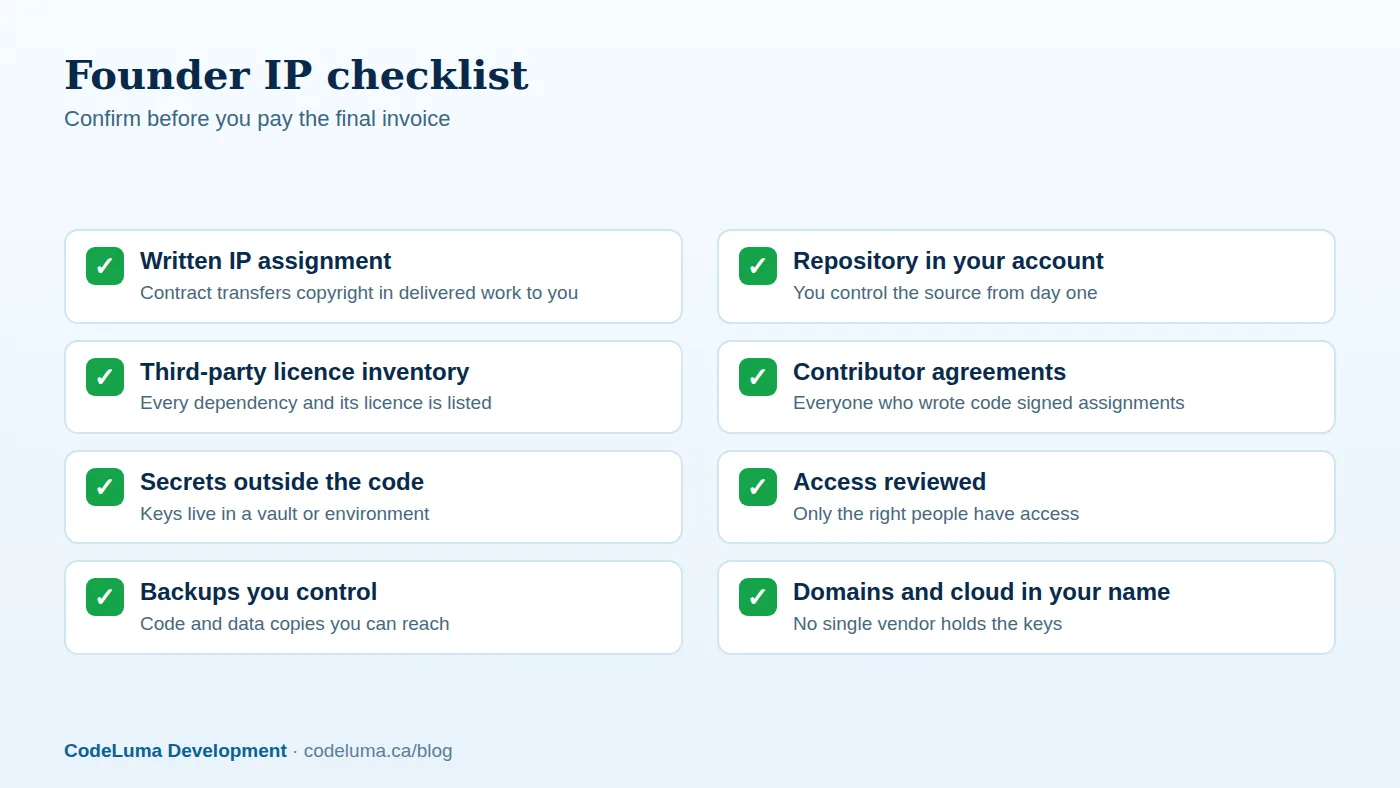
In many jurisdictions, the person who writes code is its author and initial owner, even if you paid them. Unless there is a written agreement that assigns the rights to you, your contractor may retain copyright and merely give you a licence to use the work. That is a very different thing from ownership. Employees typically create work for their employer by default, but contractors and agencies do not, which is why a clear contract matters.
What to insist on in every development agreement:
- A clear IP assignment clause that transfers copyright and related rights in the delivered work to you, effective on payment or on creation.
- Moral rights waivers where applicable, as they are recognised in Canada and some other countries.
- Warranties that the contractor has the right to assign the work and has not knowingly copied protected material.
- Confidentiality obligations for both parties.
- Treatment of pre-existing tools: reusable libraries and frameworks the agency owns may be licensed rather than assigned. Make sure the licence is perpetual, irrevocable and sufficient to run and modify your product.

Track your third-party and open-source code
Modern software is mostly other people's code. Open-source libraries speed development enormously, but each has a licence with obligations. Permissive licences such as MIT and Apache 2.0 are generally business-friendly. Copyleft licences such as the GPL family can require you to share your own source code under certain conditions, particularly if you distribute the software. Keep a software bill of materials, an inventory of every dependency with its version and licence, and use tools that scan for licence and vulnerability issues automatically. Do this early: cleaning up a licence problem before a funding round or acquisition is far cheaper than during due diligence.
Keep control of the repository
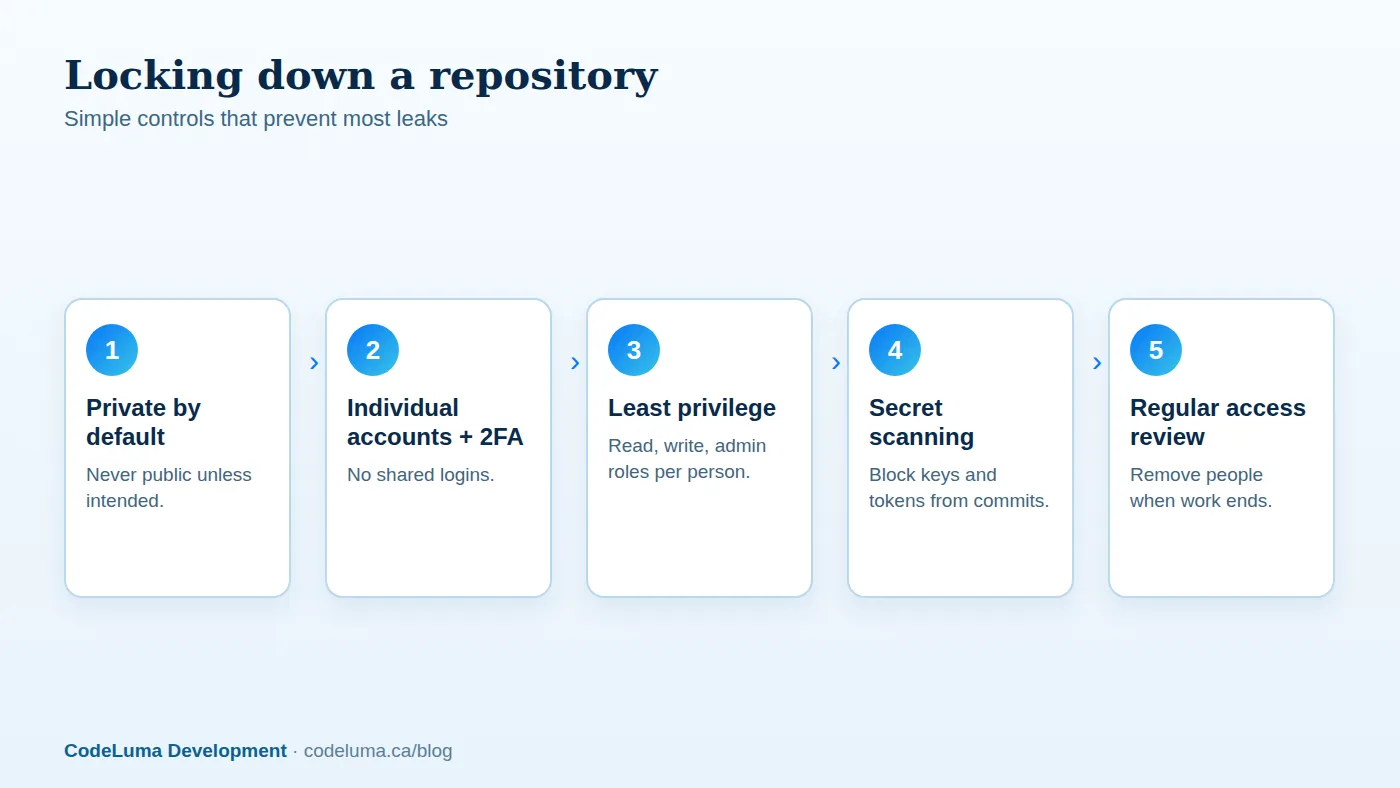
The source code should live in a repository under your organisation's account on a service such as GitHub, GitLab or Bitbucket, not in a contractor's personal account. Give developers access as collaborators and revoke it when the work ends. This alone eliminates the most common IP nightmare: a vendor who holds your code hostage in a dispute.
Never commit secrets
API keys, database passwords, private keys and tokens should never be stored in source code. Automated bots scan public repositories constantly, and leaked cloud keys have led to huge bills and data breaches within minutes of being pushed. Use environment variables or a secrets manager, add secret-scanning to your repository, and rotate any credential that might have been exposed. If a secret does leak, deleting the commit is not enough; the key must be revoked and replaced.
Apply least privilege everywhere
Every person and system should have only the access needed to do their job. Use separate roles for reading, writing and administering repositories, cloud accounts and databases. Turn on multi-factor authentication for all accounts, and prefer individual logins over shared ones so actions can be traced. Review access quarterly and after every change in team or vendor. Departing contractors should lose access the same day.

Protect the data and the environments
- Separate environments. Development and testing should not use real customer data. Use anonymised or synthetic data.
- Own your infrastructure accounts. Domain registrar, DNS, hosting, email and payment accounts should be in your name, with vendors given delegated access.
- Encrypt data in transit and at rest, and manage keys carefully.
- Keep backups in a separate account that you control and test restores regularly.
- Log and monitor administrative actions so unusual activity is visible.
Protect your ideas as well as your code
Depending on your product, other protections may apply: trademarks for your name and logo, patents for genuinely novel technical inventions (a specialised area where professional advice is essential), and trade-secret protection for confidential know-how and algorithms. Trade secrets rely on reasonable efforts to keep information secret, which means NDAs, access control and clear internal policies. Register your domain names and key social handles early so nobody else can.
Prepare for due diligence
Investors and acquirers will ask who owns the code, whether contributors signed assignments, what open-source is used, and how secrets and access are managed. Being able to answer confidently, with documents, can speed a deal and protect valuation. A short IP audit, covering contracts, repositories, dependencies, accounts and access, is often worth doing before any fundraising.
A five-minute self-check
- Can you clone your repository right now using your own account?
- Do you hold a signed assignment from every contributor?
- Do you know your dependencies' licences?
- Are your secrets out of the code and rotated?
- Are your domain, hosting and cloud accounts in your name?
If any answer is "no" or "I am not sure," that is your to-do list. A development partner who works transparently in your repositories, documents the system and hands over cleanly makes this much easier from the start.
Put this into practice with CodeLuma
CodeLuma delivers full code and data ownership to clients, works in repositories under your account, and follows secure development practices so your intellectual property stays yours.
- Custom software development - tailored systems, integrations and internal tools.
- Managed hosting - monitored, backed-up, Canadian-friendly hosting.
- Maintenance and support plans - updates, monitoring and ongoing improvement.
Start a conversation. Tell us about your project and we will reply with practical next steps, or browse all CodeLuma services. CodeLuma Development Inc. is a Canadian company that works with teams in Windsor, Essex, London, Toronto, Mississauga and across Ontario, throughout Canada and remotely.