The most common complaint from clients of software teams is not the code; it is the silence. Weeks pass, a demo finally arrives, and it is not what anyone expected. The most common complaint from developers is the opposite: endless meetings, scattered messages and contradictory feedback that make focused work impossible. Good communication solves both. This article explains how we keep remote clients, in any time zone, informed and in control while giving the team room to build.
Principles
- Visibility by default. Progress should be visible without asking. Boards, updates and demos come to you.
- Write things down. Decisions, requirements and feedback live in shared documents and tickets, not in memory or scattered chats.
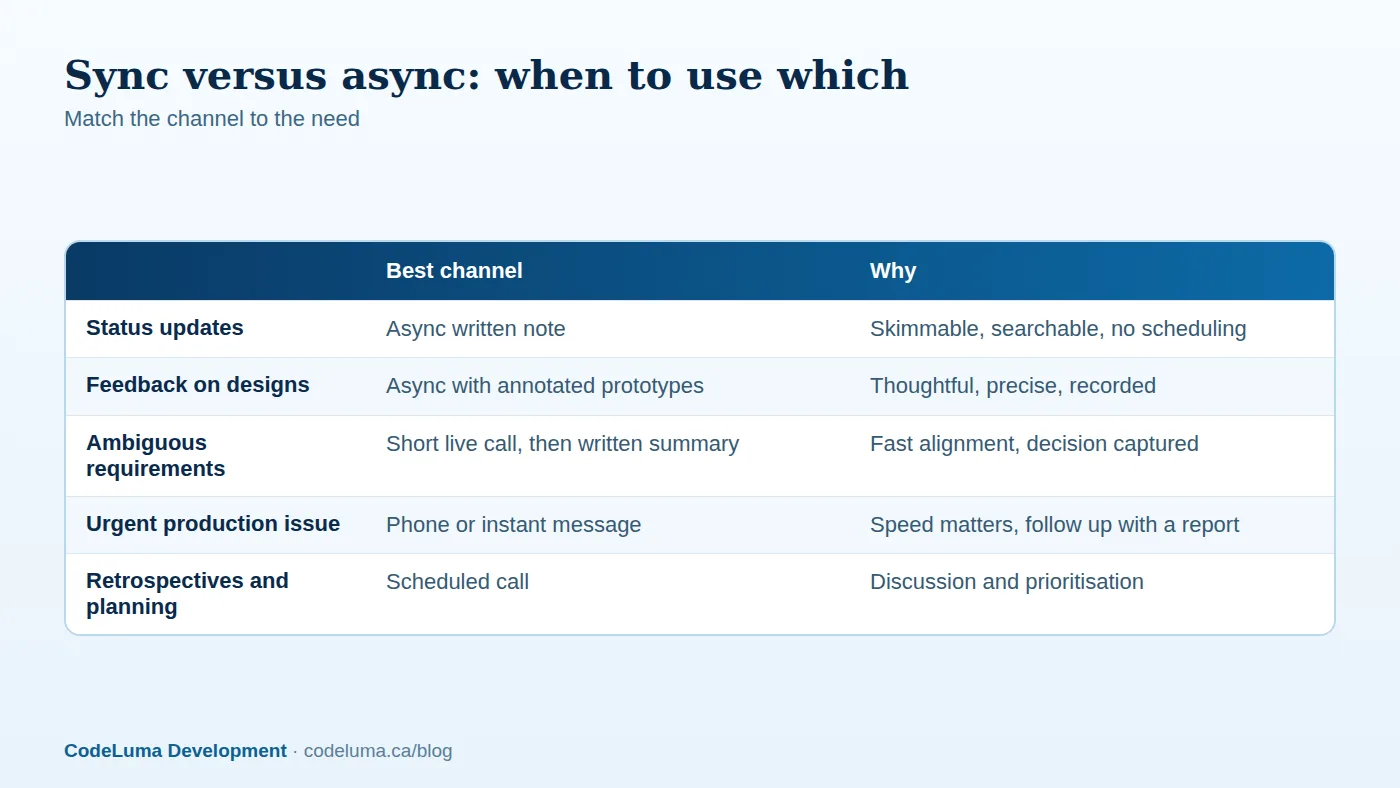
- Async first, live when it helps. Written updates work across time zones and respect everyone's focus; calls are for discussion and relationships.
- Short cycles. Small increments demonstrated often make misunderstandings cheap to fix.
- No surprises. Bad news is shared early, with options.
Onboarding the communication plan
During kickoff (our discovery phase article) we agree who the client's decision-maker is, who else needs updates, which channels we use (a shared project space, email for formal items, a chat channel for quick questions), response-time expectations, working hours and overlap windows, and the escalation path for urgent issues. We also agree what needs your approval: budget changes, priority shifts, releases to production and anything affecting brand or legal exposure. Clarity here prevents most friction.
The weekly rhythm
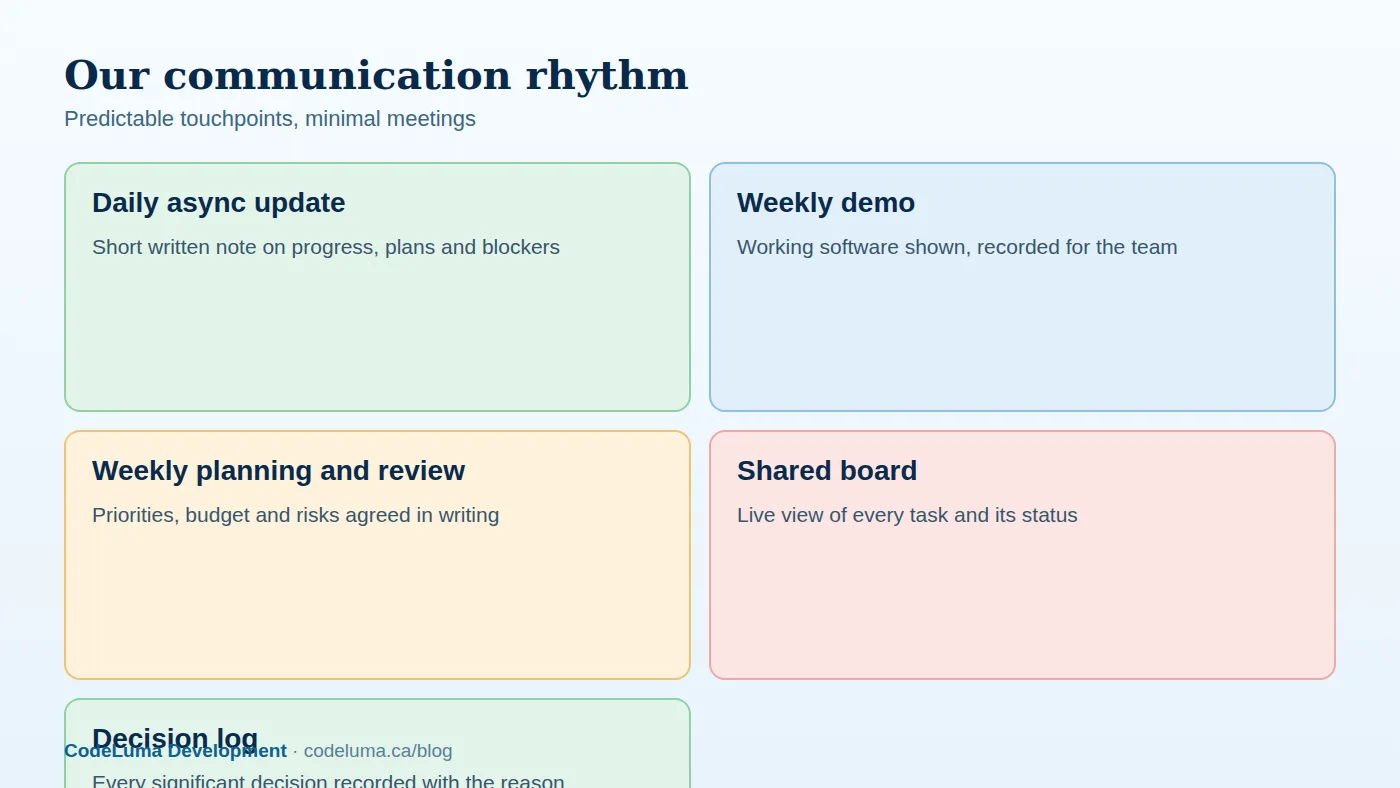
- Planning (start of the week or sprint). We agree what will be done, in priority order, based on the backlog. Anything new is sized and either fits or swaps with something else; see our pricing models article for how budgets interact with change.
- Daily written updates. A brief note: what was completed, what is next, what is blocked, and any questions that need answers. Readable in a minute, it replaces most status meetings.
- Demo (end of the week). We show working software in a staging environment, walk through what changed, and record it so stakeholders who cannot attend can watch later at their convenience. You give feedback directly on what you see.
- Review and retrospective. A short discussion of what went well, what is at risk, budget and timeline against plan, and adjustments; see how we estimate projects for the tracking approach.
Tools we use, and why
- A shared board showing every task: backlog, in progress, in review, testing, done. You can open it at any time to see exactly where things stand.
- Chat for quick questions with threads, so answers attach to the topic; not for decisions, which go in the decision log.
- Video calls with recordings and written summaries.
- A staging site where each finished piece can be tried, updated automatically by the pipeline described in our CI/CD article.
- Annotated prototypes and screenshots for design feedback, so comments point to precise spots.
- Shared documentation and a decision log that survives staff changes on either side.
We adapt to your tools where sensible. What matters is that information has one home and is easy to find.
Giving and receiving feedback well
Feedback is the fuel of a project, and vague feedback wastes it. The most useful comments say what you see, what you expected and why it matters: "The invoice total does not include the discount, which will confuse customers" rather than "the numbers look wrong." Consolidate feedback from several people before sending it, and mark priority: blocker, important, nice to have. When opinions conflict inside your team, the designated decision-maker resolves it. We in turn report back on how each comment was handled and, if we disagree, explain why with options.
Working across time zones
Async communication makes time zones an advantage: work continues while you sleep, and questions asked at the end of your day may be answered by the start of the next. We keep an overlap window for live discussion, publish holidays and availability in advance, and write updates so they stand alone without requiring context from a previous call. For urgent production incidents, we maintain an escalation route with defined response times, as part of our support and maintenance arrangements; see our retainer article.
Managing scope, risks and decisions
- Change requests are visible. New ideas go into the backlog with an estimate; you decide whether to add them, swap them or defer them.
- A risk register lists known risks, owners and mitigations, reviewed weekly. Common ones include third-party dependencies (our integration guide), delayed content or feedback, and data quality issues.
- A decision log records what was decided, by whom, when and why. Months later it answers "why did we do it this way?" in seconds.
- Definition of done: each task has agreed acceptance criteria, including testing and security checks; see our security audit guide.
Releases and communication around them
Releases are planned events with clear communication: what is included, when it will go live, whether downtime is expected (rarely, with the approach in zero-downtime deployments), how to verify it and how to roll back. We use staged rollouts and feature flags for riskier changes (our feature flags guide), and monitoring watches the release afterwards (our monitoring guide).
Keeping stakeholders engaged
Different people need different information. Executives want a one-paragraph summary: status, budget, risks, decisions needed. Product owners want the board and demos. Staff who will use the system want previews and training. We produce short summaries for each audience and invite the right people to the right sessions, so nobody drowns in detail or is left out.
What you can do to help
- Nominate a decision-maker with authority and availability.
- Respond to questions within the agreed time, since waiting for answers is the most common cause of delay.
- Provide content, data and access early.
- Attend or watch the weekly demo and give consolidated feedback.
- Raise concerns early, even if they are only feelings; they are often correct.
Signs of healthy communication
- You never have to ask "where are we?" because you can see it.
- Meetings are short, purposeful and followed by written notes.
- Problems arrive with options, not excuses.
- Budget and timeline are discussed openly.
- Both sides can explain the last three decisions and why they were made.
Warning signs, such as long silences, vague updates and reluctance to show work, are covered in our red flags article. If communication is what you want to get right, talk to us about how we would run your project. Our software team runs every engagement this way, and our support team keeps the channel open after launch.
Put this into practice with CodeLuma
CodeLuma runs projects with a predictable rhythm, written decisions and weekly demos, so you always know where things stand without sitting through endless meetings.
- Custom software development - tailored systems, integrations and internal tools.
- Website and web application development - fast, accessible, search-friendly builds.
- CodeLuma support - help from a real team when you need it.
Start a conversation. Tell us about your project and we will reply with practical next steps, or browse all CodeLuma services. CodeLuma Development Inc. is a Canadian company that works with teams in Windsor, Essex, London, Toronto, Mississauga and across Ontario, throughout Canada and remotely.