Please note: this is a composite, illustrative case study. It combines patterns from the kinds of projects we build and the scaling problems that recur across them. It does not describe a single named client, and the numbers are illustrative. We share it because the sequence of decisions is more useful to founders than a list of impressive statistics.
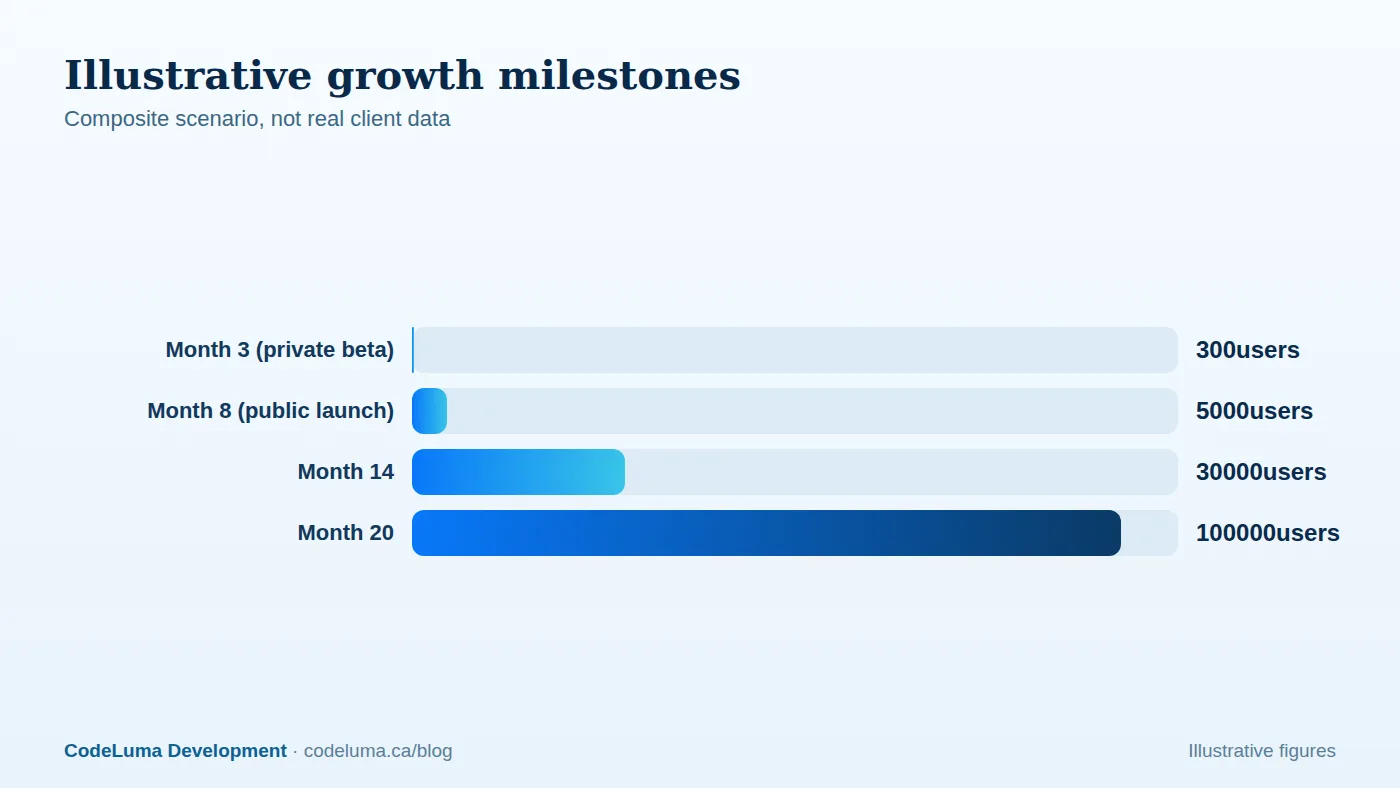
The scenario
A founder wanted to launch an online membership platform for a professional community: subscription access to a library of courses and templates, a members' forum, live event registration and a simple dashboard showing progress. The founder had an audience but no software, a modest budget and a target of reaching six figures of active users over roughly two years if the concept worked. The main risk was not technology; it was whether members would pay and stay. That framed every decision.

Stage 1: launch lean, learn fast
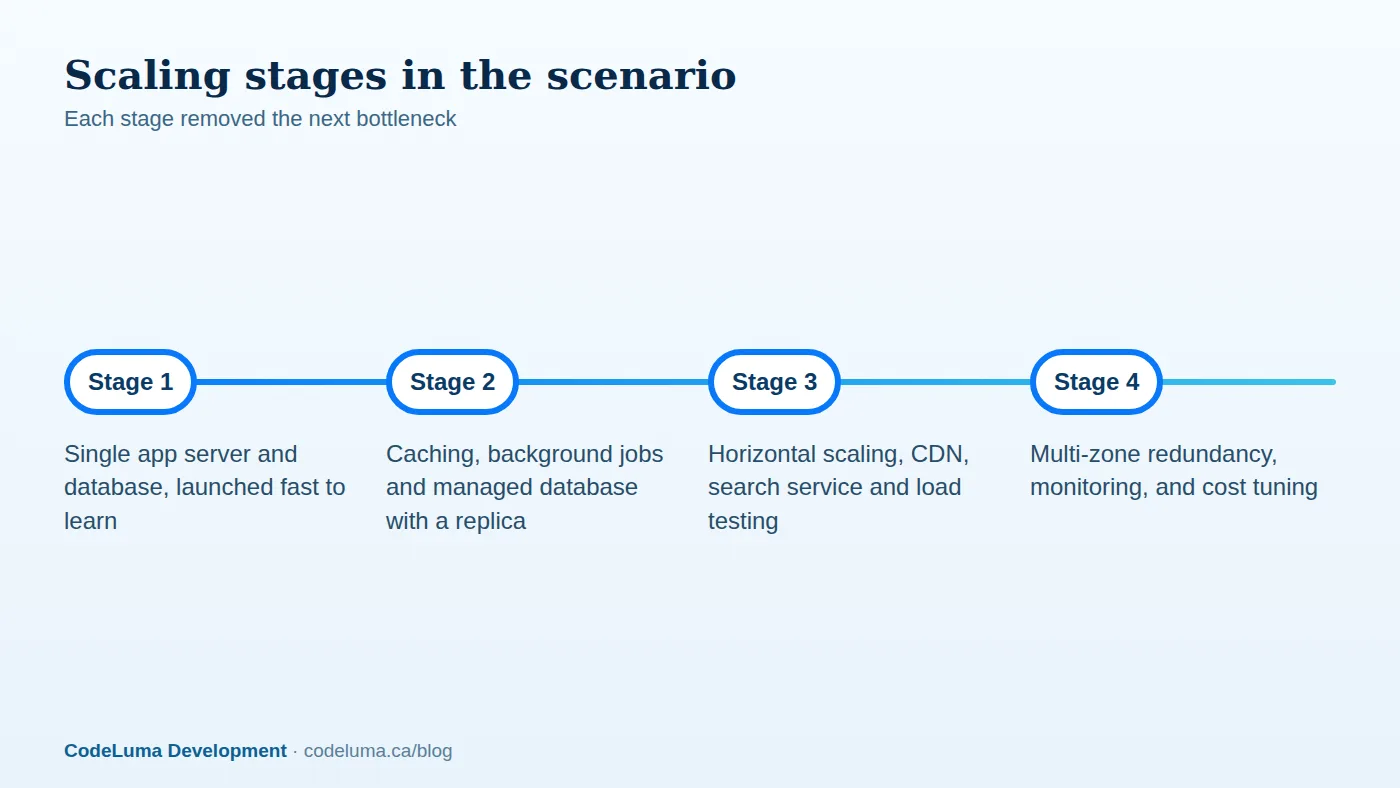
The first version used a mainstream web framework, a relational database and a single application server, with managed email, payments and file storage. It included authentication, subscription billing, a course library with progress tracking, and a basic admin area. We deliberately left out the forum, mobile apps and analytics dashboards. The goal was to reach paying users in weeks, following the approach in our MVP guide and how to scope an MVP.
Decisions that mattered early, and cost little:
- Multi-account thinking from day one: every record tied to an account and organisation, so team plans could arrive later without a rewrite; see our multi-client article.
- Payments through a mature platform with webhooks handled idempotently; see our payment gateway guide and subscription billing.
- Automated backups and monitoring from the first day; see our backup guide and monitoring guide.
- A deployment pipeline so releases were routine; see our CI/CD article.
The private beta had a few hundred members. One server was ample, and the team spent its time on onboarding and content rather than infrastructure.
Stage 2: the first bottlenecks
After public launch and a promotion, page loads slowed at peak times. Investigation, not guesswork, found the causes: repeated expensive database queries on the course library page, images served uncompressed, and email sending inside web requests. The fixes were ordinary and effective: query optimisation and indexes (our database guide), caching of the library and dashboard fragments (our caching guide), image optimisation (our front-end article), and moving email and certificate generation to background jobs (our background jobs article). The database moved to a managed service with a read replica, and load testing before each promotion became routine; see our traffic spike playbook.
Stage 3: adding features without adding chaos
Growth brought demands for the forum, live events, team plans and a mobile experience. Instead of splitting the system into many services, the team kept a modular monolith with clear internal boundaries, adding dedicated components only where needed: a search service for the library and forum (our search article), object storage and a CDN for media (edge delivery, streaming), and a managed video platform for live sessions rather than building one. The web app became installable as a progressive web app for members who wanted an app-like experience without store friction; see our PWA article. Feature flags allowed new capabilities to reach small groups first (our feature flags guide).
Stage 4: scaling to six figures
As active users climbed, reliability and cost became the concerns. The application servers were made stateless and autoscaled behind a load balancer, sessions and caches moved to a shared store, and the database gained automatic failover across zones; the reasoning is in our scalable architecture guide and our high-availability guide. Deployments became zero-downtime (our deployment guide). Rate limiting and abuse protection guarded sign-up and login endpoints (our access-control guide, web vulnerabilities). An audit trail recorded admin actions and support access (audit logging).
Costs were tracked per feature. Reviewing the bill revealed savings from right-sizing, lifecycle rules for old media, and scheduled non-production environments, the techniques in our cloud cost guide. Analytics dashboards for members and administrators were built on pre-aggregated data instead of live queries (our dashboards article).

What did not happen
- No premature microservices. The team never split the system for its own sake, which kept the team small and releases quick.
- No big rewrite. Bottlenecks were fixed as they appeared, guided by measurements.
- No over-provisioning up front. Capacity followed proven demand.
Lessons that generalise
- Validate demand before scaling anything. The most expensive infrastructure is the kind built for users who never arrive.
- Measure, then fix the actual bottleneck. It was rarely where intuition pointed.
- Design the seams early. Multi-account data, background jobs and stateless servers made later scaling incremental.
- Buy solved problems. Payments, email, video and search were assembled from services; the custom effort went to the product's unique value.
- Automate delivery and recovery. Pipelines, backups and monitoring made growth safe.
- Keep maintaining. A steady maintenance rhythm prevented the slow decay that catches fast-growing systems; see our retainer article.
How we approach similar projects
We begin with a discovery phase to define the smallest valuable product and its success metrics (our discovery phase article), estimate transparently (our estimation article), build in slices with regular demonstrations, and plan the scaling roadmap alongside the features. After launch we stay involved through monitoring, iteration and growth planning (our post-launch article). If you are planning a platform and want to talk through what stage you are at and what to build first, get in touch. Our software team builds and scales custom platforms, with hosting and maintenance services to carry them through each stage.
Put this into practice with CodeLuma
CodeLuma builds platforms that start lean and scale in stages, so you invest in capacity when demand proves it, with the architecture ready for the next order of magnitude.
- Custom software development - tailored systems, integrations and internal tools.
- Managed hosting - monitored, backed-up, Canadian-friendly hosting.
- Maintenance and support plans - updates, monitoring and ongoing improvement.
- Website and web application development - fast, accessible, search-friendly builds.
Start a conversation. Tell us about your project and we will reply with practical next steps, or browse all CodeLuma services. CodeLuma Development Inc. is a Canadian company that works with teams in Windsor, Essex, London, Toronto, Mississauga and across Ontario, throughout Canada and remotely.