Every founder dreams of a sudden surge of attention: a viral post, a big press mention, a successful campaign. Every engineer knows that surge can also be the moment an application falls over. The good news is that surviving traffic is less about exotic technology and more about a small number of architectural decisions made early. This guide covers those decisions in plain language.
First, define what "scale" means for you
Scaling is not a single number. Ask what you need to handle: concurrent visitors, requests per second, records in the database, file uploads, background jobs, or real-time connections. A content site with millions of readers and a payroll app with thousands of heavy users stress completely different parts of a system. Estimate realistic peaks, for example ten times your average traffic during a campaign, and design for those, with a plan to grow beyond them. Over-engineering for a hundred million users is as wasteful as ignoring the possibility of ten thousand.

Keep application servers stateless
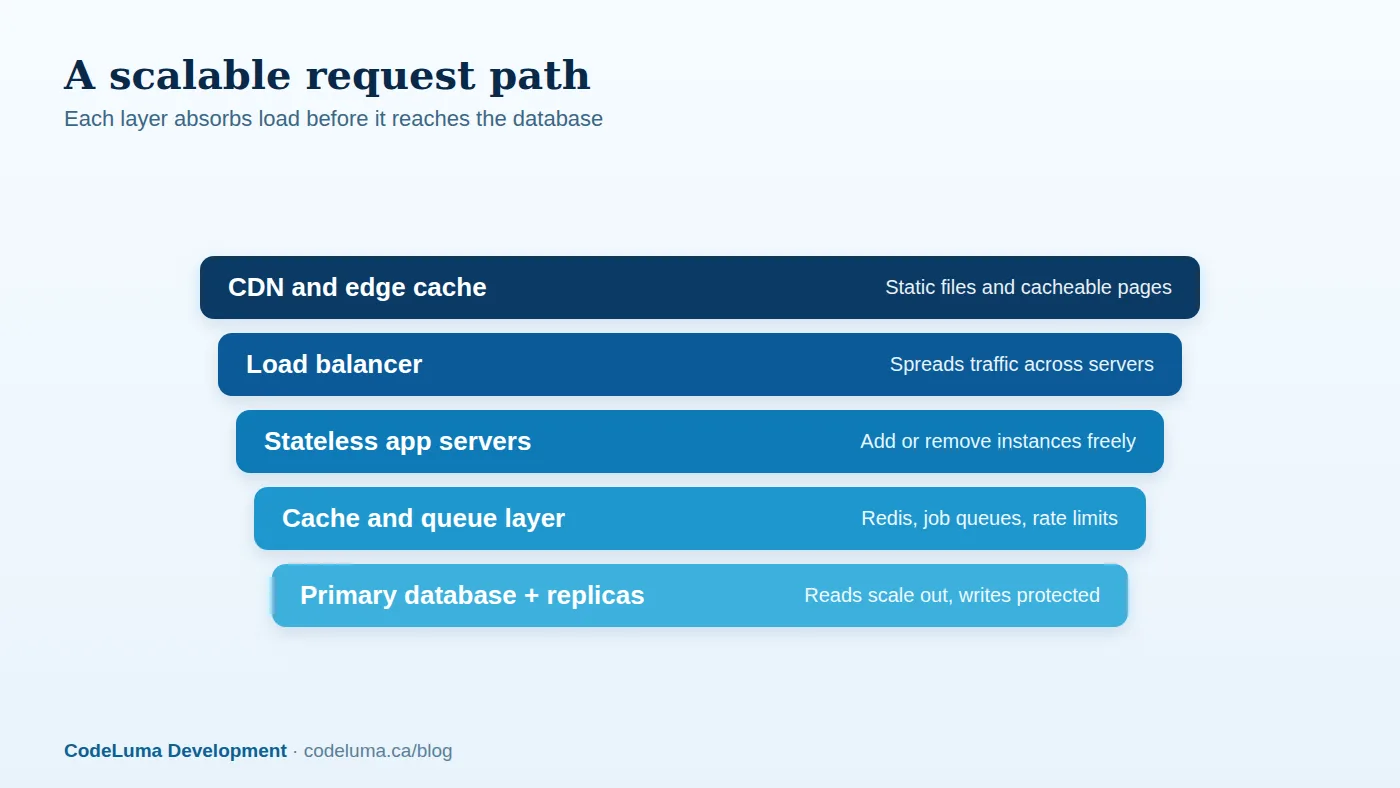
The single most valuable scaling decision is to keep your application servers stateless. That means no user sessions or uploaded files stored on the local disk of one server. Store sessions in a shared cache or database, keep files in object storage, and put configuration in environment variables. When servers are stateless you can add more behind a load balancer in minutes, replace unhealthy ones automatically, and deploy without downtime. Stateful servers force you to scale up (a bigger machine) instead of out (more machines), which has a hard ceiling.
Cache aggressively, and at the right layers
The cheapest request is the one you never process. Layer your caching:
- Browser caching with correct headers for static assets.
- CDN caching for images, scripts and even whole pages that do not change per user.
- Application caching for expensive computations and frequently read data, using an in-memory store such as Redis.
- Query caching for slow, repeated database reads.
Design cache keys and invalidation rules deliberately. Stale data is usually acceptable for seconds or minutes; wrong data is not. We cover practical patterns in our article on caching with Redis and CDNs.
Move slow work off the request path
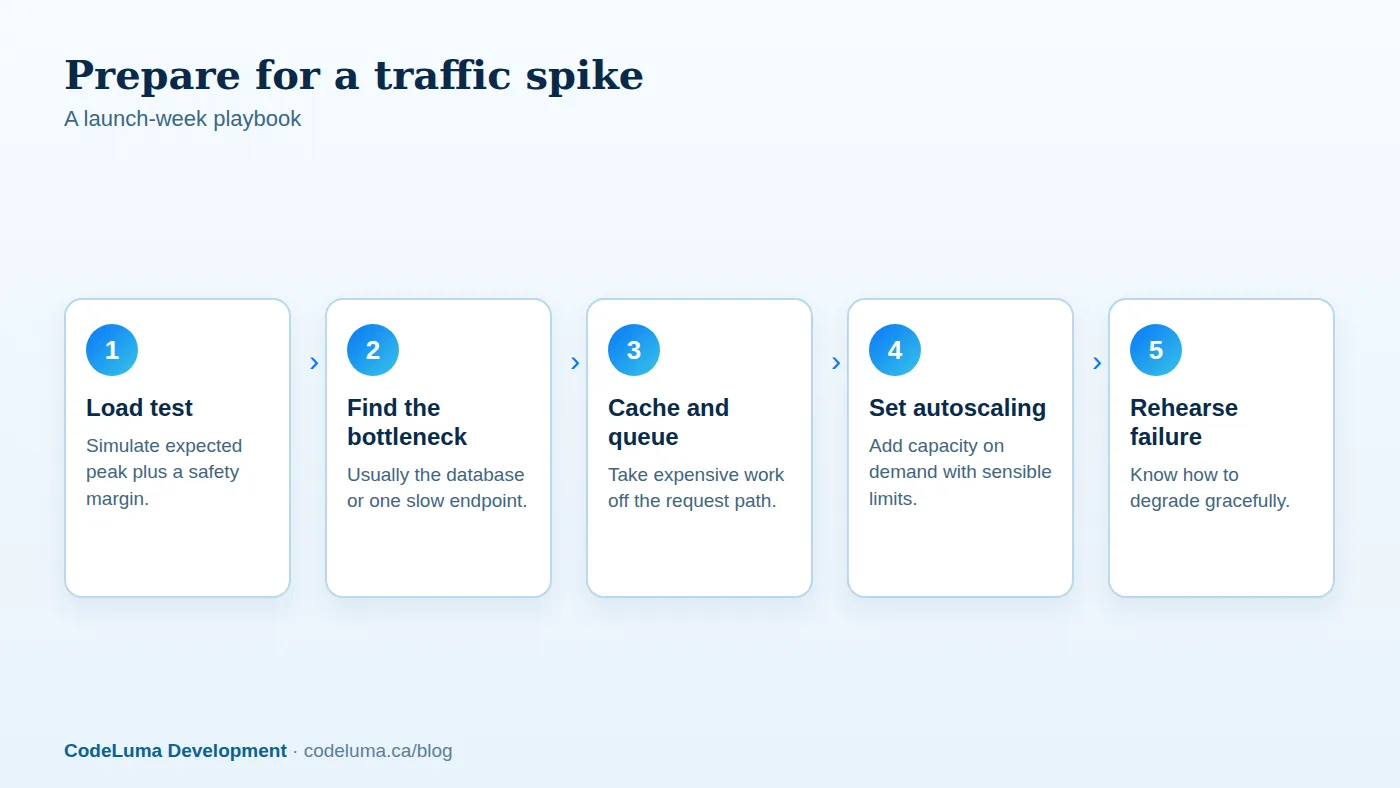
Sending emails, generating PDFs, resizing images, calling third-party APIs and importing files should not happen while a user waits. Put these tasks on a queue and process them with background workers. The user gets an instant response, workers scale independently, and a burst of jobs becomes a backlog rather than an outage. Add retries with backoff and a dead-letter queue for jobs that keep failing.
Treat the database as your most precious resource
Most scaling problems are database problems. Protect it:
- Index for your real queries and review slow-query logs weekly.
- Avoid N+1 queries where a page triggers hundreds of small reads.
- Paginate large lists and avoid unbounded queries.
- Use read replicas for reporting and heavy reads once a single database is busy.
- Use connection pooling so a spike in app servers does not exhaust database connections.
- Plan for growth in large tables with archiving or partitioning strategies before they become painful.
Put rate limits and graceful degradation in place
Under extreme load, a healthy system sheds load rather than collapsing. Add rate limits per user and per IP, protect expensive endpoints, and decide in advance which features can be switched off temporarily, such as recommendations, live counters or heavy search filters, to keep the critical path, like checkout, working. A "waiting room" for a hot launch is far kinder than an error page.

Load test before the launch
You do not know how your system behaves until you push it. Use load-testing tools to simulate realistic user journeys, not just hammering the home page. Ramp up gradually, watch response times, error rates, CPU, memory and database metrics, and find the first thing that breaks. Fix it, then test again. Testing at two to three times your expected peak gives a margin for error. Test with production-like data volumes; a query that is instant on a hundred rows may crawl on ten million.
Monitor and automate scaling
Set up metrics and alerts for latency, error rate, saturation and queue depth. Configure autoscaling with sensible minimum and maximum limits so cost does not spiral. Keep runbooks for common incidents so whoever is on call knows what to do at 2 a.m. Observability is what turns a scary spike into a manageable event.
Do not split into microservices too early
Many teams reach for microservices in the name of scale and inherit a distributed-systems problem they did not need. A well-structured single application scales surprisingly far. Split out a service only when a specific part has a genuinely different scaling profile or ownership. We explain the trade-off in our article on modular monoliths.
A practical checklist before a big launch
- Servers are stateless and can be replaced at will.
- A CDN serves static assets and cacheable pages.
- Slow work runs in background queues.
- Critical queries are indexed and reviewed.
- Rate limits and a kill switch for non-essential features exist.
- A load test at two to three times expected peak has passed.
- Monitoring, alerts and an on-call plan are live.
- Backups are tested and a rollback plan exists.
None of this requires a huge team. It requires making the right few decisions early and testing them. If you are planning a launch, a review of your architecture and a load test are among the best investments you can make.
Put this into practice with CodeLuma
CodeLuma designs and load-tests applications for the traffic you hope to get, using proven building blocks, so a successful launch becomes a celebration instead of an outage.
- Custom software development - tailored systems, integrations and internal tools.
- Managed hosting - monitored, backed-up, Canadian-friendly hosting.
- Maintenance and support plans - updates, monitoring and ongoing improvement.
Start a conversation. Tell us about your project and we will reply with practical next steps, or browse all CodeLuma services. CodeLuma Development Inc. is a Canadian company that works with teams in Windsor, Essex, London, Toronto, Mississauga and across Ontario, throughout Canada and remotely.