Please note: this is a composite, illustrative case study. It blends patterns from typical modernisation projects and does not describe a single named client. The numbers are illustrative and are not guarantees of results.
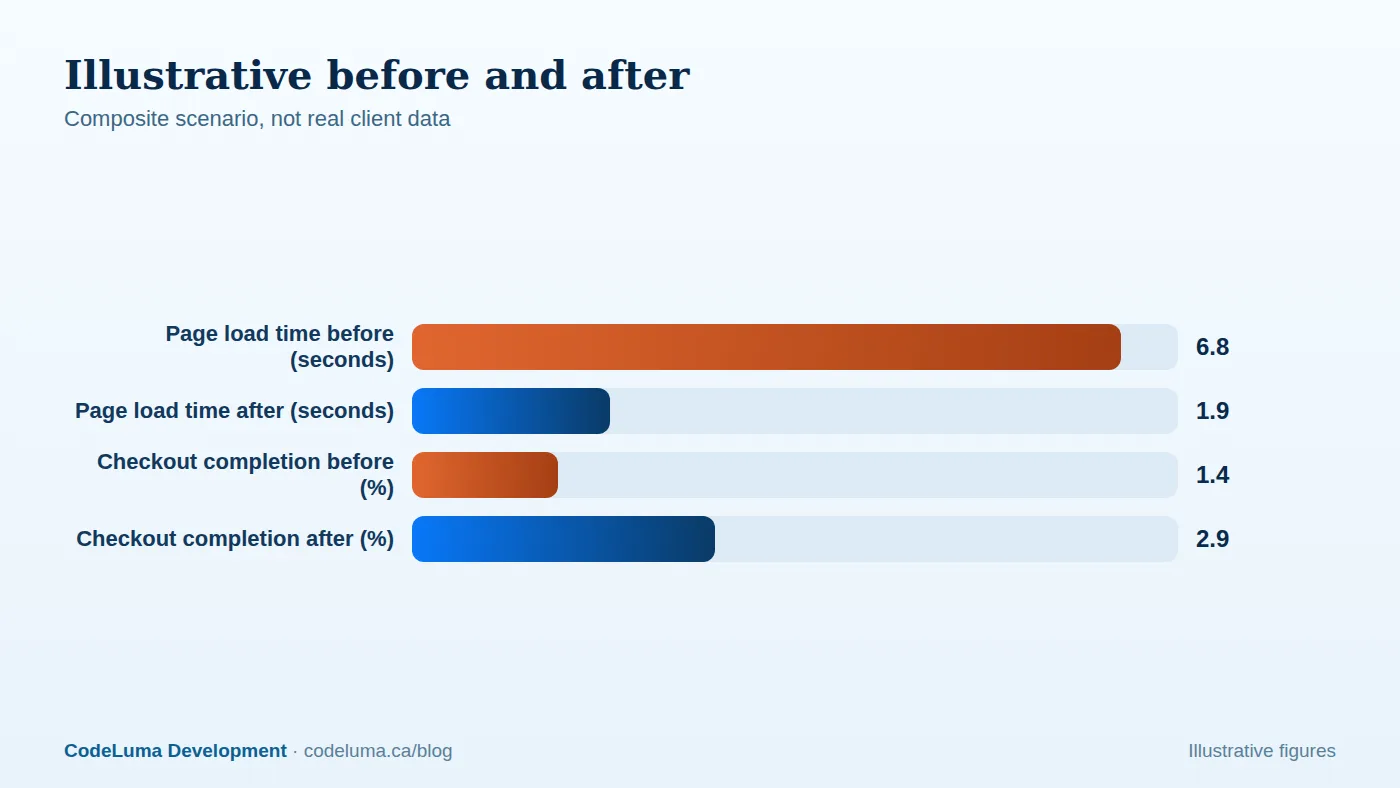
The scenario
A ten-year-old online business sold products through a large custom-built web application. It had been extended by a series of developers over the years and now held tangled code, an outdated framework version that no longer received security fixes, hand-edited templates, a database with inconsistent data and a hosting setup that only one contractor understood. Pages loaded slowly, especially on mobile; the checkout was a long, confusing multi-page process; small changes took weeks because nobody was sure what they might break. The owner suspected the site was losing sales and worried that a rewrite would be a costly gamble.

Step one: understand before touching anything
We began with a structured audit, the same approach as in our security audit guide and our discovery phase article:
- Analytics review: which pages produced revenue, where visitors dropped out, how mobile compared with desktop.
- Performance profiling: real-user speed data and server timings showing that most delay came from a few heavy database queries, unoptimised images, render-blocking scripts and a pile of third-party tags; see our Core Web Vitals guide.
- Code and dependency review: the outdated framework, unmaintained libraries and known vulnerabilities, with priorities based on risk; see our vulnerabilities article.
- Infrastructure review: single server, manual deployments, untested backups and an expiring certificate that nobody monitored; see backups and DNS and SSL.
- Stakeholder interviews: staff explained the workarounds hidden in the system and what customers complained about.
The output was a ranked list of problems by business impact and effort, and a clear recommendation: modernise incrementally.
Step two: make the system safe to change
Before any redesign, we secured the foundations. Automated backups were configured and a restore was tested; monitoring and uptime alerts were added (monitoring guide); the code moved into version control with a deployment pipeline (CI/CD); and a set of automated end-to-end tests covered the critical journeys of browsing, searching, adding to cart and checking out. AI-assisted tooling helped analyse unfamiliar code and generate initial characterisation tests, always reviewed by engineers; see our article on AI assistants. Environment variables and secrets were moved out of the code (our secrets guide). None of this changed the customer experience yet, but it made every later change lower risk.
Step three: quick wins on speed
Some of the largest gains were unglamorous. Images were compressed and served in modern formats with proper sizing; scripts were deferred and consolidated; unnecessary third-party tags were removed; full-page and fragment caching were added (caching); a CDN served static assets (edge delivery); and the worst queries were indexed and rewritten (database optimisation). In the scenario, these steps alone cut typical load times by more than half without any architectural change. See our front-end performance article.
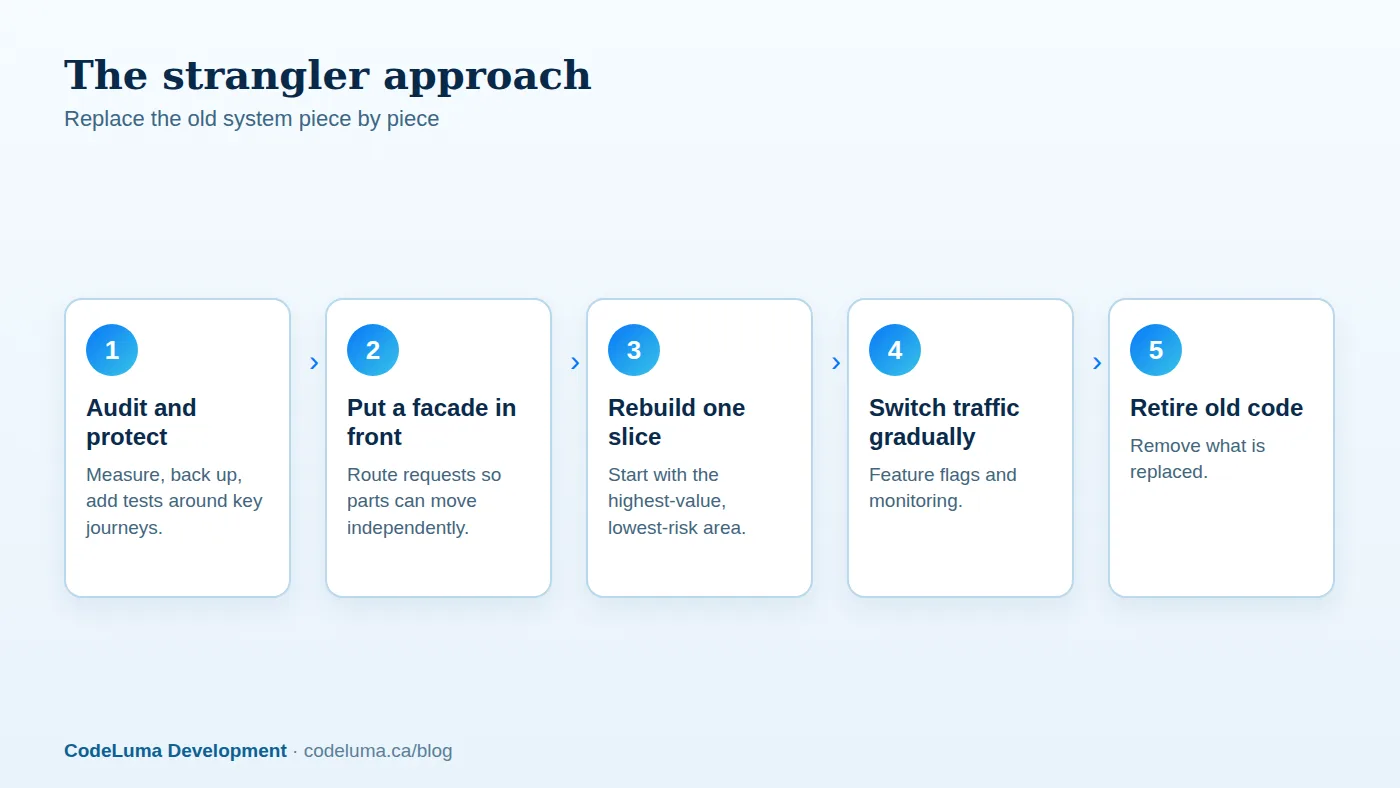
Step four: the strangler approach
Rather than rewriting the system, we used the incremental "strangler" pattern: place a routing layer in front of the old application and replace one area at a time with new, cleanly built components, sending traffic to the new implementation only when it was ready. This meant the business kept trading throughout, each piece could be rolled back instantly, and value arrived early. The sequence prioritised revenue and risk:
- Checkout and cart. The highest-value flow, redesigned as a short, mobile-first experience with guest checkout, clear costs, saved details and modern payment options; see our checkout optimisation guide and payment gateways.
- Product listing and search. Faster pages, better filters, and improved search relevance; see our search article.
- Account area and order history. Moved to modern authentication (our access-control guide).
- Admin tools. Rebuilt around actual staff workflows with roles and audit trails (audit logging).
- Integrations. Inventory, shipping and accounting connections rebuilt with reliable retries and monitoring (integration guide).
New components were deployed behind feature flags and released to a small percentage of visitors first (feature flags), with automated rollback triggers on error rates and conversion drops. Database changes were made backwards-compatible so old and new code could run side by side; see zero-downtime deployments.

Step five: measure, iterate, and retire
Each slice was measured against the baseline: speed, error rates, conversion and support tickets. When the new checkout proved better on the test group, it rolled out to everyone; the old code path was then removed rather than left to rot. In the illustrative scenario, the combination of much faster pages and a simpler checkout roughly doubled the checkout completion rate over the project, an outcome that depends heavily on how poor the starting point was and should not be treated as typical. Bounce rates on mobile fell, organic search visibility improved as speed and stability recovered, and support tickets about "the site is slow" nearly disappeared.
What we avoided
- The big-bang rewrite: months of parallel development, then a risky launch and a long tail of missing features.
- Rebuilding every quirk: we questioned old rules and kept only the ones with business value, as in our spreadsheet migration article.
- Change without measurement: every step had a metric.
- Leaving the team dependent on one person: documentation, pipelines and shared ownership replaced tribal knowledge.
Lessons
- Audit first. Data shows where the money and the pain are.
- Safety net before surgery: backups, tests, monitoring and pipelines.
- Take the cheap wins early: they build trust and often deliver a large share of the benefit.
- Replace incrementally, starting with the flows that make money.
- Keep maintaining afterwards, so the new system does not become the next legacy; see the value of a retainer.
- Be honest about uncertainty: results vary, so estimate ranges and confirm with measurement; see how we estimate projects.
If your website or application is slow, fragile or hard to change, a short audit is the best first step. Our software team and web team modernise legacy systems incrementally, our hosting service provides a safer platform, and our maintenance plans keep it healthy. Tell us about your system and we will suggest where to begin.
Put this into practice with CodeLuma
CodeLuma modernises legacy systems incrementally, protecting revenue during the transition, so your business gets a faster, safer platform without a risky big-bang rewrite.
- Custom software development - tailored systems, integrations and internal tools.
- Website and web application development - fast, accessible, search-friendly builds.
- Maintenance and support plans - updates, monitoring and ongoing improvement.
- Managed hosting - monitored, backed-up, Canadian-friendly hosting.
Start a conversation. Tell us about your project and we will reply with practical next steps, or browse all CodeLuma services. CodeLuma Development Inc. is a Canadian company that works with teams in Windsor, Essex, London, Toronto, Mississauga and across Ontario, throughout Canada and remotely.