Every year brings confident predictions about the future of the web, and most business owners reasonably wonder which of them deserve attention and money. The honest answer is that the fundamentals change slowly while the tools change quickly. Customers still want sites that load fast, work on their phones, answer their questions and feel safe. What shifts are the techniques for delivering those things, and a handful of genuinely important developments deserve planning. This article gives a grounded view for the coming year, with the caveat that nobody can predict the future precisely; treat these as informed directions, not promises.
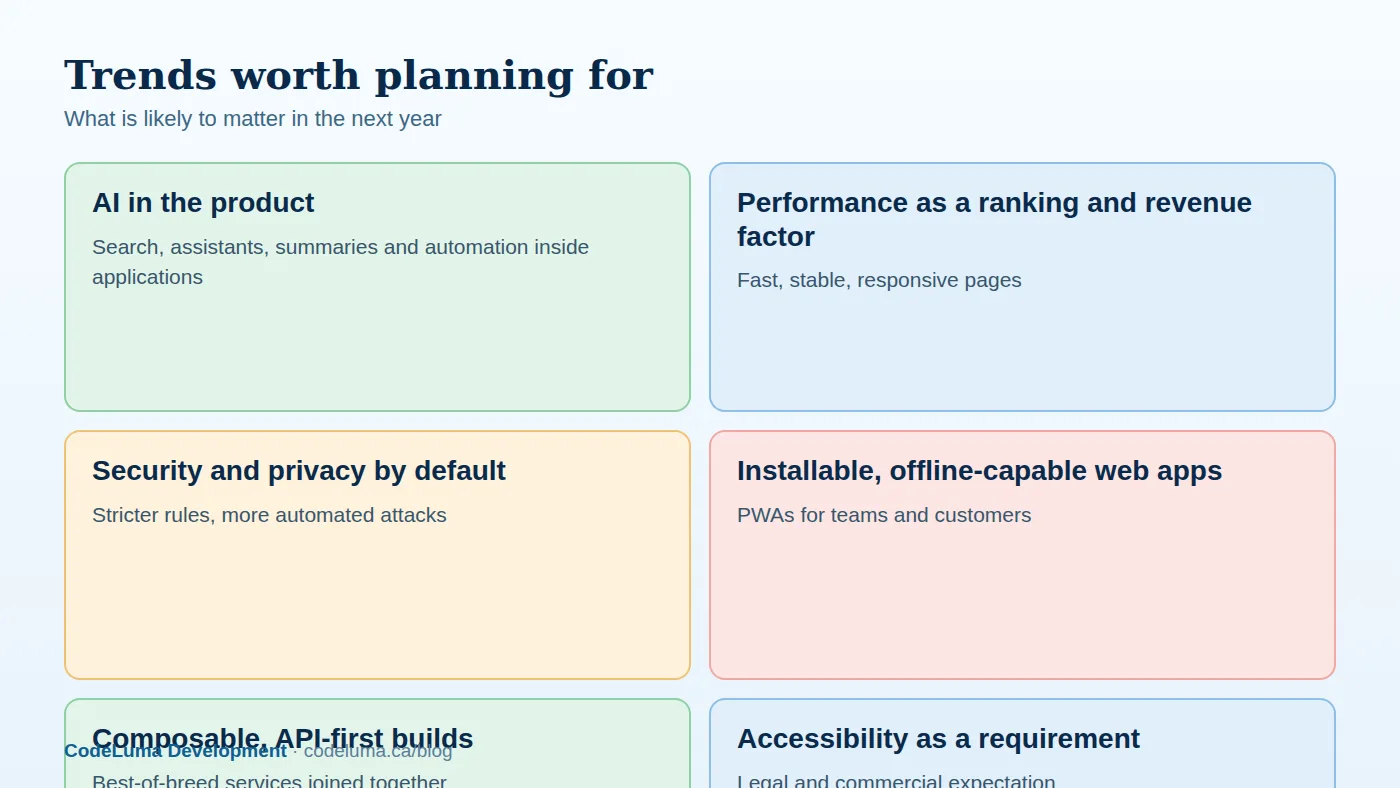
1. AI moves from novelty to expectation
Customers now encounter AI in search, support and writing tools, and increasingly expect similar convenience in the products they use: summaries of long content, natural-language search, drafting help, smart recommendations and automated routing. For business owners the useful question is not "should we add AI?" but "where do our customers or staff waste time reading, writing or searching?" Start with contained, low-risk features with human oversight, and build in evaluation, cost controls and privacy protection; see our guide to integrating generative AI, our search and recommendations article and our model strategy article. Expect AI to also change discovery: searchers increasingly get direct answers, so clear, authoritative, well-structured content and accurate business information matter even more; see our technical SEO checklist.
2. Performance and user experience keep mattering
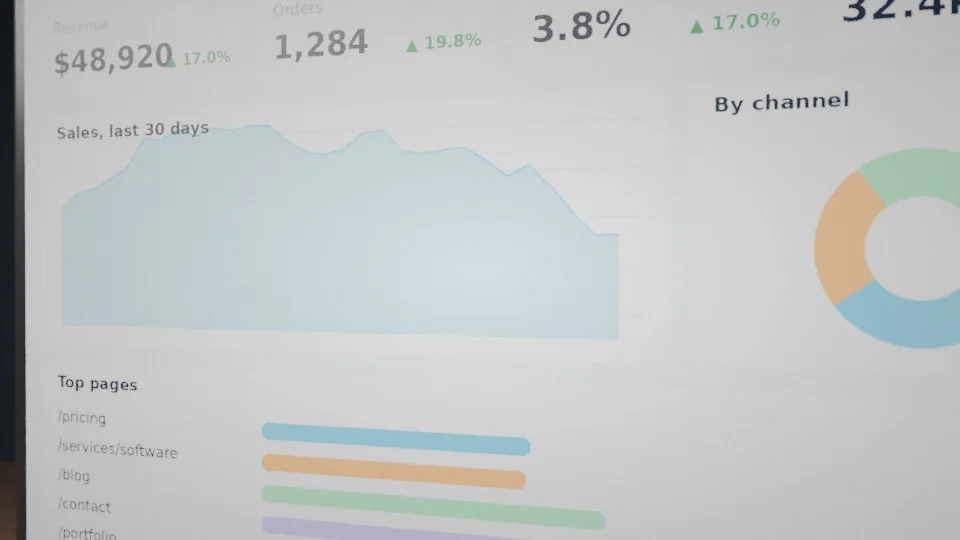
Page speed, visual stability and responsiveness affect search visibility, conversion and satisfaction, and the measurement standards keep tightening. The practical work is unglamorous: optimised images and fonts, lean scripts, caching and modern delivery networks, and restraint with third-party tags. Sites that treat performance as a budget, checked on every release, stay fast; see our Core Web Vitals guide, our caching guide and our front-end performance article. Expect more attention to real-user measurement rather than one-off lab tests.
3. Security and privacy become baseline
Attackers use automation and AI to find weaknesses faster, and regulators and customers expect stronger protection and transparency. Expect more scrutiny of software supply chains and dependencies, wider use of multi-factor authentication and passkeys, stricter handling of personal data, and security questionnaires from larger customers. The affordable response is discipline: patching promptly, least-privilege access, secure secrets, monitoring, tested backups and clear privacy practices; see our security audit guide, our access-control guide, our secrets guide and our privacy law overview. Preparing audit trails early, as in our audit logging article, avoids scrambles later.
4. Web apps that feel like apps
Browsers keep gaining capabilities: installability, offline support, notifications, background sync, camera and file access, and smoother animations. For many businesses, especially those with field teams or repeat customers, a progressive web app delivers most of the benefit of a native app at lower cost; see our PWA article. Real-time features such as live updates and collaboration are also getting easier to add (our real-time article).
5. Composable, API-first architectures
Rather than one giant platform, more businesses assemble specialised services (payments, search, email, content, authentication) behind a coherent front end, connected by APIs. This gives flexibility and best-in-class capabilities but shifts responsibility to integration quality, monitoring and vendor management; see our API design article and our integration guide. Choose composability where it solves a real limitation, not because it sounds modern; a well-run monolith is still a perfectly good architecture for many businesses, as we argue in our architecture article.
6. Accessibility is a requirement, not an extra
Accessibility legislation and litigation are expanding in many regions, and accessible sites reach more customers and tend to perform better in general. Semantic HTML, keyboard support, sufficient contrast, captions and clear forms should be built in from the start and tested with real tools and people. Retrofitting later is more expensive; consider it in every redesign and new feature, including video (our streaming article) and dashboards (our data visualisation article).
7. Automation of routine engineering work
AI-assisted development, automated testing and deployment pipelines make delivery faster and more consistent; see our article on low-code and AI assistants and our CI/CD article. For clients, the practical effects should be shorter timelines for standard work, more frequent releases, and more attention on design, security and operations, provided the team keeps disciplined review practices.

8. Sustainability and efficiency
Lighter pages, efficient hosting and sensible resource use reduce both costs and environmental impact. Cloud cost discipline, covered in our cloud bill guide, is increasingly a board-level concern, and efficient sites also tend to be faster.
What is probably not going to matter as much as the hype says
- Rewriting everything in the newest framework. Frameworks change constantly. Change for a business reason, not fashion.
- Chatbots on every page. A poorly grounded assistant hurts trust; useful ones solve specific tasks.
- Exotic technology without a customer problem, such as immersive experiences for products that need clear information and fast checkout.
- No-code as a replacement for all engineering; see the article above on its limits.
How to plan without chasing hype
- Start with business goals: revenue, leads, retention, cost, risk. Rank technology ideas by how much they move those numbers.
- Fix the fundamentals first: speed, mobile usability, security, tracking and clear calls to action often deliver more than any new trend; see our conversion guide.
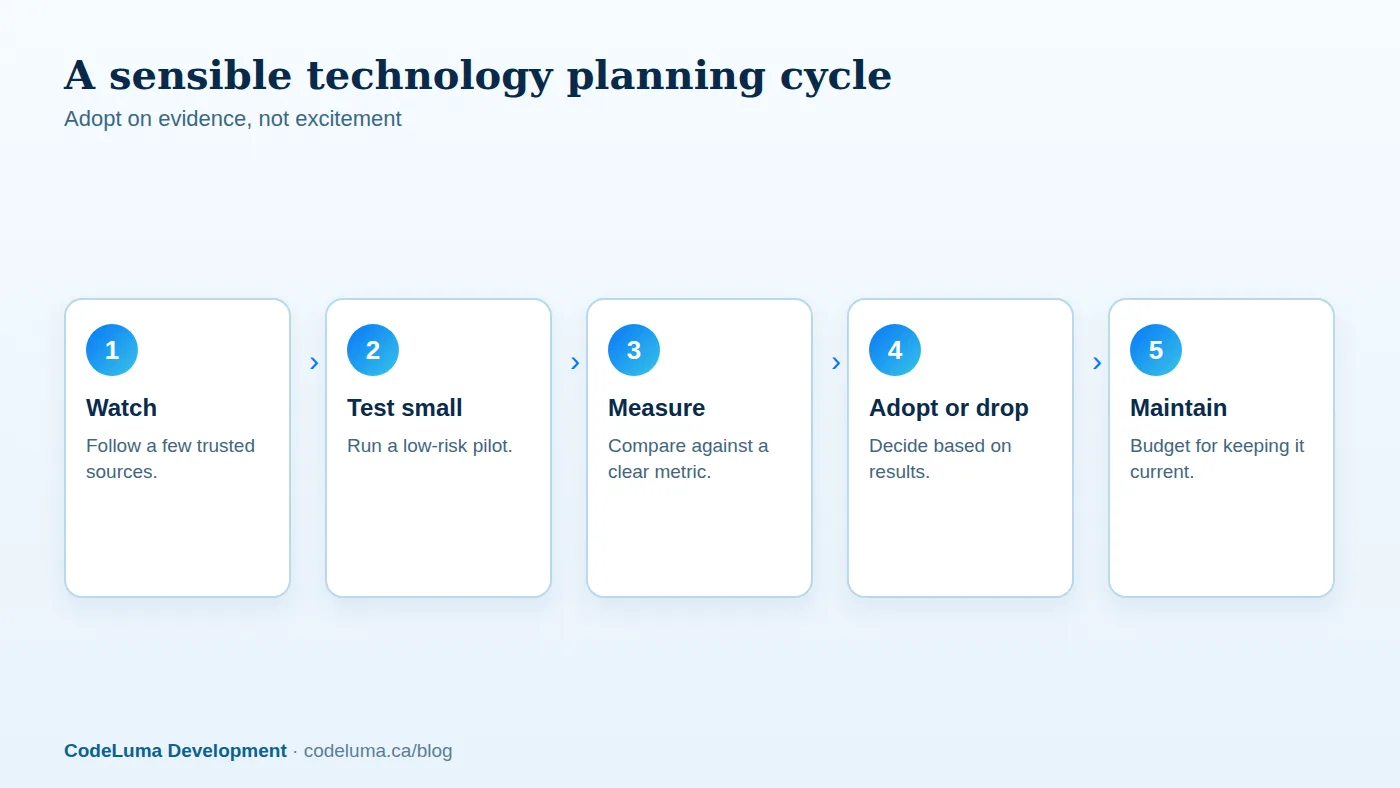
- Pilot small. Run a limited test of a new capability, measure it and only then invest.
- Budget for maintenance. A trend adopted and then neglected is a liability; see our retainer article.
- Keep options open. Prefer standards, portable data and clear ownership of code, domains and accounts.
- Review annually. Revisit your roadmap with your technical partner every six to twelve months.
A short next-year checklist
- Measure Core Web Vitals on real users and fix the worst pages.
- Audit dependencies, access and backups; enable multi-factor authentication everywhere.
- Identify one or two low-risk AI opportunities and pilot them.
- Review accessibility on your key journeys.
- Check that your site content answers the questions customers actually ask.
- Confirm you own your domains, code repositories and cloud accounts.
The best technology strategy is boring in the right places and bold only where it counts. Our web development team and software team help clients adopt what pays off and skip what does not, and our maintenance plans keep the result current as the landscape shifts.
Put this into practice with CodeLuma
CodeLuma keeps your website and software current without chasing fads, adopting what improves speed, security and conversions and skipping what does not, and explains each choice in plain language.
- Website and web application development - fast, accessible, search-friendly builds.
- Custom software development - tailored systems, integrations and internal tools.
- Maintenance and support plans - updates, monitoring and ongoing improvement.
- Managed hosting - monitored, backed-up, Canadian-friendly hosting.
Start a conversation. Tell us about your project and we will reply with practical next steps, or browse all CodeLuma services. CodeLuma Development Inc. is a Canadian company that works with teams in Windsor, Essex, London, Toronto, Mississauga and across Ontario, throughout Canada and remotely.