Some of the most successful businesses on the internet are platforms: others build products and services on top of their data or capabilities. You may not be aiming for a giant ecosystem, but a well-designed public API can still open real opportunities: letting partners integrate with your service, enabling customers to automate their workflows, powering a mobile app, or selling access to valuable data or functionality. The risk is that a poorly designed API becomes a security liability and a support burden. This guide covers how to create one that is safe, pleasant to use and commercially sensible.
Decide why you are building it
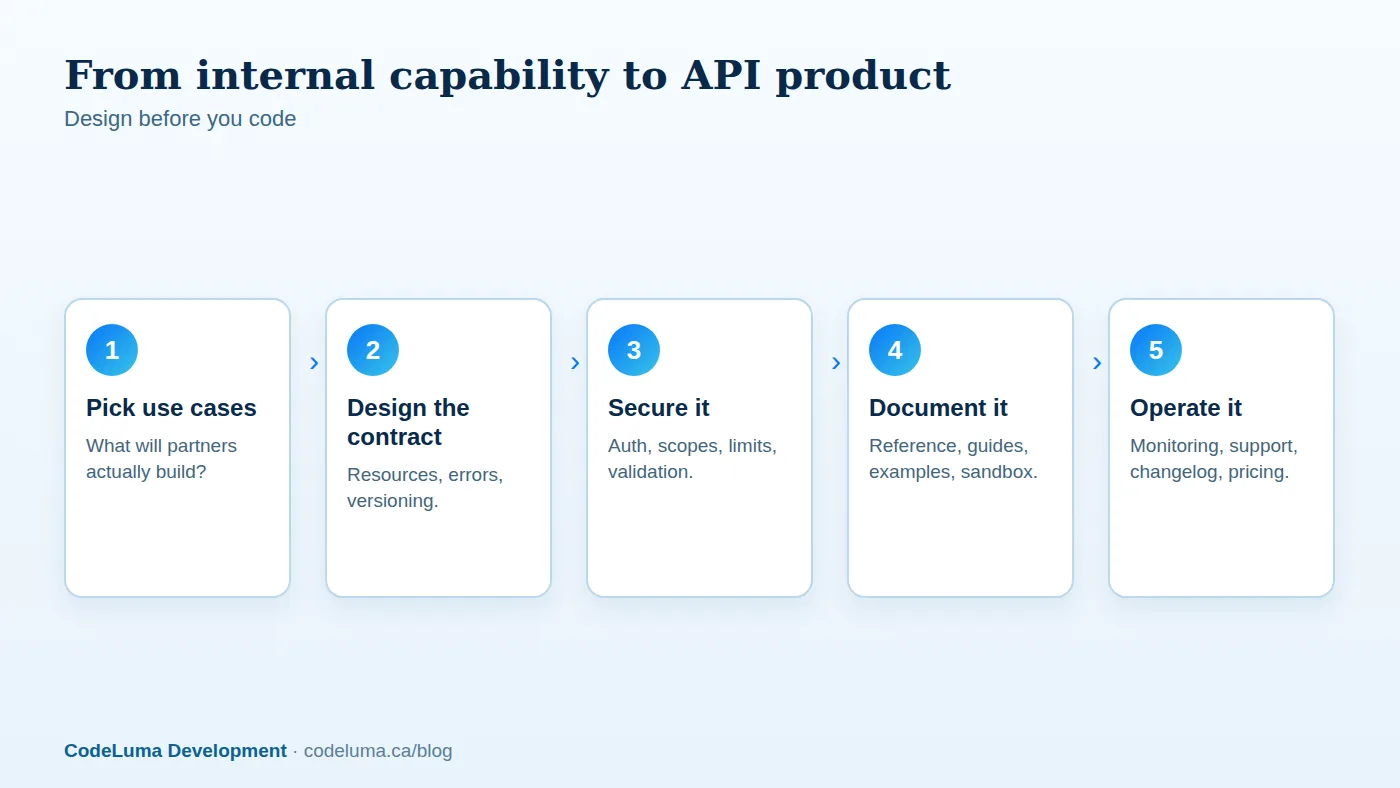
Start with the business purpose. Common reasons include letting customers integrate your product with their systems, which increases stickiness; enabling partners or marketplaces to distribute your products; monetising data or services directly through usage-based pricing; powering your own mobile and third-party front ends; and attracting developers who build extensions. Each purpose shapes the design: a partner integration API prioritises stability and clear contracts, while a data product prioritises performance, coverage and metering. Talk to potential users before designing; the best APIs solve concrete problems for real integrators.

Design a clean, predictable contract
- Resource-oriented design. Model nouns such as customers, orders and invoices with consistent URLs and standard HTTP methods. Alternative styles such as GraphQL suit some cases, but consistency matters more than fashion.
- Consistent naming, formats and conventions across every endpoint: dates in ISO 8601, amounts as integers with currency codes, uniform pagination and filtering.
- Useful errors. Return appropriate status codes with machine-readable error codes and human-readable messages, plus a request ID for support.
- Idempotency for operations that create things or move money, using idempotency keys so retries are safe.
- Pagination and limits on every list endpoint, using cursors for large sets.
- Webhooks so consumers can react to events instead of polling. We cover how to build a dependable system in our article on webhooks for partners.
- Design for evolution: add fields freely, but never remove or change the meaning of existing ones without a new version.
Authentication and authorisation
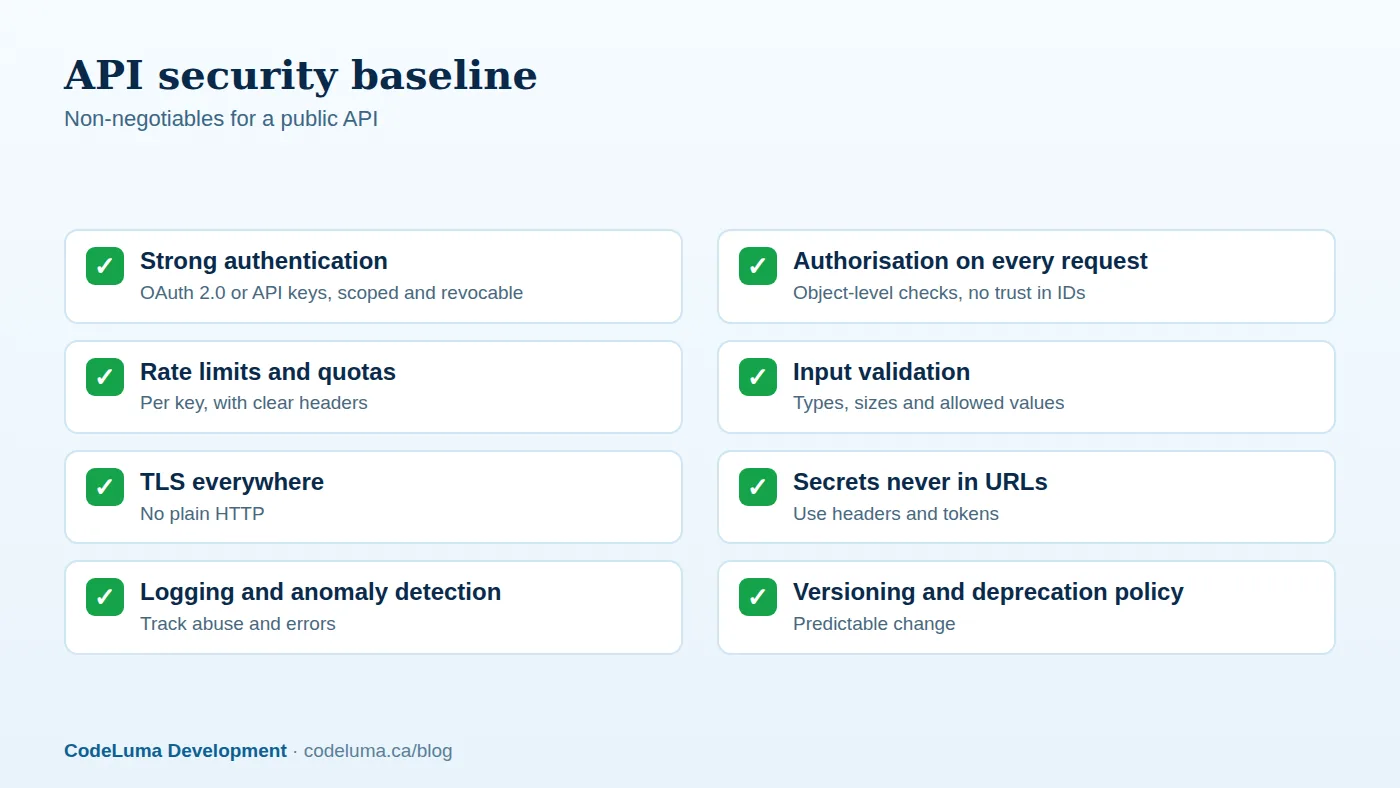
Identify who is calling and what they may do. For server-to-server integrations, scoped API keys or OAuth 2.0 client credentials work well. When acting on behalf of your users, use OAuth 2.0 authorisation flows so users can grant limited access without sharing passwords, and can revoke it later. Define fine-grained scopes, such as read invoices and write customers, and issue tokens with the least privilege. Support key rotation and immediate revocation. Crucially, enforce authorisation on every request at the object level: never assume that because a caller supplied an ID, they are allowed to access it. Broken object-level authorisation is among the most common and damaging API flaws. Multi-tenant designs need particular care; see our note on multi-tenant architecture and access control.
Protect against abuse
- Rate limits and quotas per key, with clear response headers so clients can adapt, and different tiers for different plans.
- Input validation: validate types, lengths, formats and allowed values, and reject unexpected fields to prevent injection and mass-assignment issues. See our note on common web vulnerabilities.
- Request size limits and timeouts.
- Protection from scraping and enumeration: avoid sequential IDs, and monitor unusual access patterns.
- TLS everywhere, and no secrets in URLs, which end up in logs.
- A web application firewall and gateway for blocking known attack patterns and shaping traffic.
Build the developer experience
Developers judge an API by how quickly they can make a successful first call. Invest in that experience:
- Excellent documentation: a reference generated from an OpenAPI specification, plus guides for common tasks, authentication walkthroughs and realistic examples.
- A sandbox with test data and test keys so developers can experiment without risk.
- Client libraries or code samples in popular languages.
- A self-service portal to sign up, create keys, see usage and manage billing.
- A changelog and status page, with advance notice of changes.
- Support channels that get a quick, knowledgeable response.

Versioning and deprecation
Integrators build on your promises. Version the API, for example in the URL or a header, keep old versions working for a published period, communicate deprecations well in advance through email, documentation and response headers, and track who still uses old versions so you can help them migrate. Breaking changes without warning destroy trust faster than anything.
Monitor and operate it like a product
Track availability, latency, error rates by endpoint and by customer, and usage against quotas. Alert on anomalies such as sudden spikes from one key or unusual error patterns. Keep audit logs of sensitive operations. Publish service levels if you offer them, and test failure scenarios. The observability practices in our monitoring guide apply directly. Plan capacity, as a popular partner integration can multiply load overnight; see our scaling article for patterns.
Monetise sensibly
Options include free access to support your core product, tiered plans with different quotas and features, pay-per-use pricing based on calls or on business events processed, revenue sharing with partners and enterprise contracts with custom terms. Meter usage accurately, expose it in dashboards, and bill through a reliable system; see our subscription billing guide. Make the terms of use, acceptable use and data-protection commitments clear, and get legal advice on liability and licensing.
Start small and grow
Launch with a focused set of endpoints that serve the top use cases, run a private beta with a few friendly integrators, listen closely, and expand. A public API is a long-term commitment, but the payoff, in stickiness, distribution and new revenue, can be significant. If you are considering opening up your platform, our software team can design the contract, build the gateway, security and portal, and support your first integrators.
Put this into practice with CodeLuma
CodeLuma designs and builds secure, well-documented public APIs and developer portals, with authentication, rate limiting and usage-based billing, so partners can integrate and your data becomes a product.
- Custom software development - tailored systems, integrations and internal tools.
- Website and web application development - fast, accessible, search-friendly builds.
- Managed hosting - monitored, backed-up, Canadian-friendly hosting.
Start a conversation. Tell us about your project and we will reply with practical next steps, or browse all CodeLuma services. CodeLuma Development Inc. is a Canadian company that works with teams in Windsor, Essex, London, Toronto, Mississauga and across Ontario, throughout Canada and remotely.