Website speed is often treated as a technical nicety, something for the developers to worry about after the "real" work of design and marketing is done. In reality it is a revenue lever. Every visitor you pay to attract, through advertising, search, email or referrals, passes through your site's loading experience before anything else happens. If that experience is slow, a share of those visitors disappears, and the money you spent to bring them is wasted. This article explains the mechanisms, shows how to estimate the cost for your own business, and outlines how to make a persuasive internal case for fixing it.
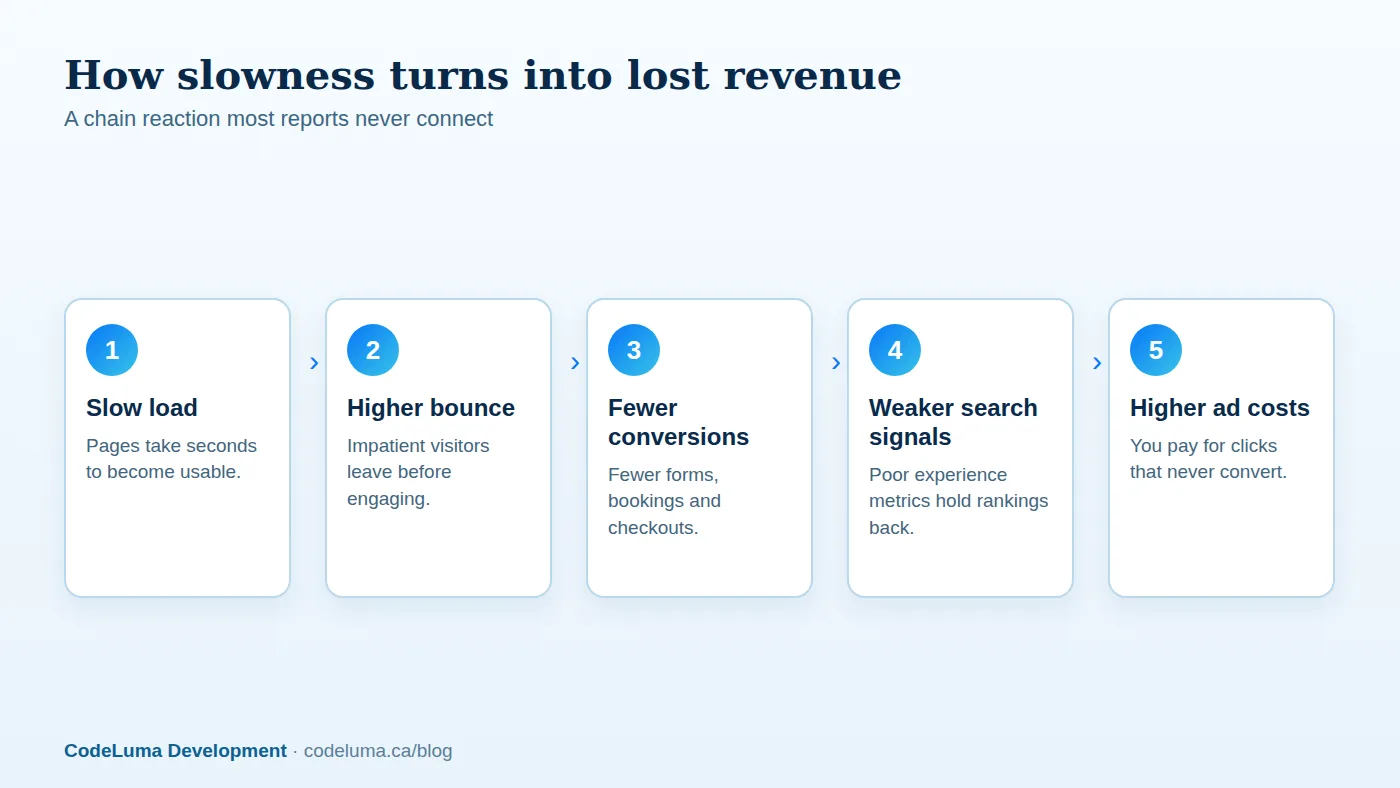
Mechanism one: bounce and abandonment
People are impatient in predictable ways. When a page takes several seconds to show something useful, a meaningful fraction leave, especially on mobile connections and when they arrived from an ad or a search result with plenty of alternatives. Those who stay are often less engaged: they browse fewer pages, trust the brand less and complete fewer actions. Large-scale studies published by major web companies have repeatedly found relationships between faster load times and better engagement and conversion. The exact size of the effect depends on your audience and offer, which is why you should measure your own site instead of relying on a headline statistic.

Mechanism two: search visibility
Google has confirmed that page experience, including Core Web Vitals, is one of the many signals used in ranking. Content relevance and authority matter more, but when several pages are similarly relevant, the faster and more stable experience can have an edge. There is also an indirect effect: users who bounce quickly or struggle to interact send weaker engagement signals, and slow pages are crawled less efficiently, which can limit how much of a large site gets indexed. We explain the metrics in our guide to Core Web Vitals and the wider optimisation work in our technical SEO checklist.
Mechanism three: paid traffic efficiency
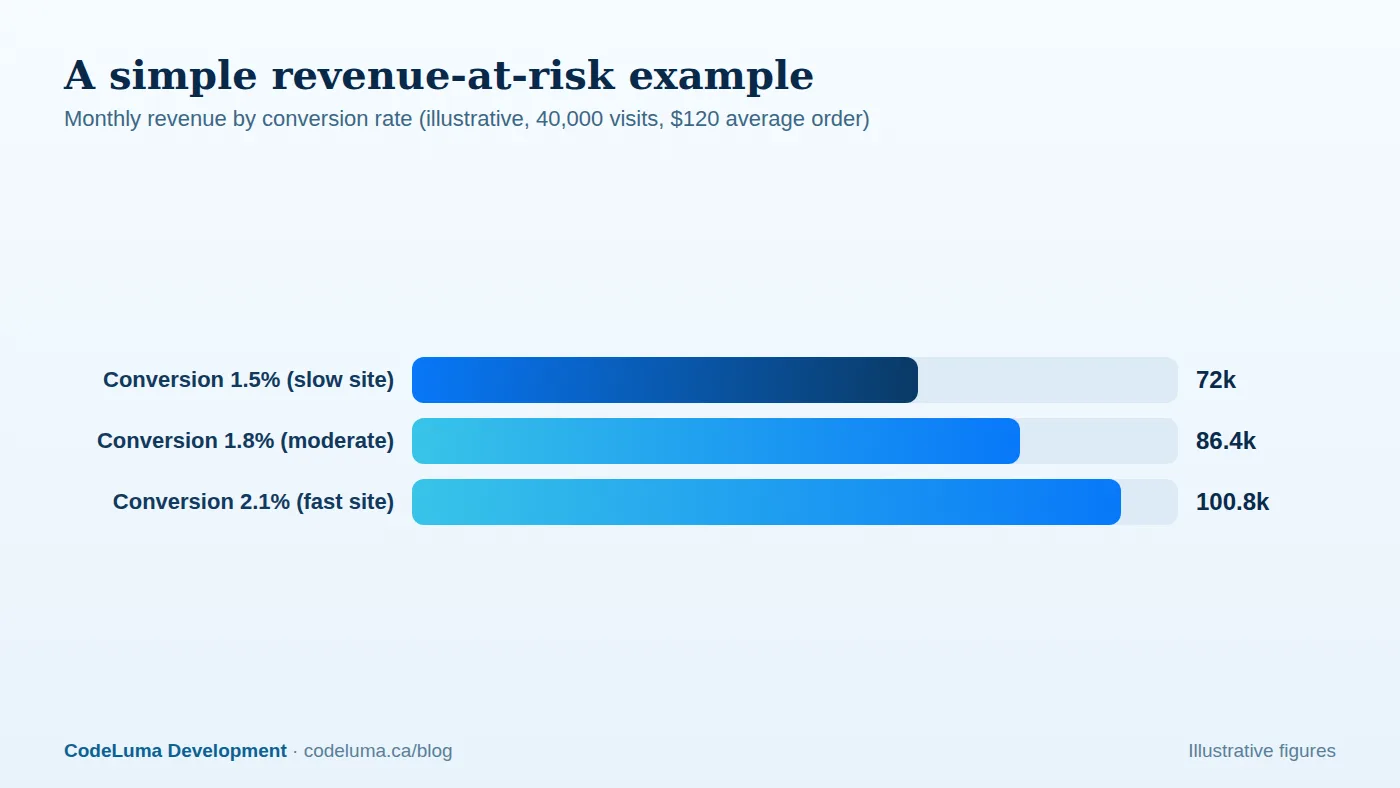
If you buy clicks, speed affects your return directly. A landing page that converts two percent of visitors instead of one and a half percent delivers the same leads for roughly a quarter less ad spend. Slow landing pages can also hurt the quality assessments used by some ad platforms, which can raise your cost per click. Before increasing an advertising budget, check that the destination pages are fast.
Mechanism four: trust and brand
Speed communicates competence. A snappy site feels professional and secure; a sluggish, glitchy one raises doubts about the business behind it, especially when payment or personal information is involved. Slow sites also frustrate loyal customers and staff, increasing support requests and reducing repeat business.
How to estimate what slowness costs you
You can build a rough model with numbers you already have:
- Traffic: monthly sessions to the pages that matter.
- Conversion rate: the percentage of those sessions that complete a valuable action such as a sale, lead or booking.
- Value per conversion: average order value or lead value multiplied by close rate.
- Speed segments: split your analytics by page load time bucket or Core Web Vitals status and compare conversion rates. If fast sessions convert noticeably better than slow ones, part of that gap is causal and part reflects audience differences, so be conservative.
Take the difference between the conversion rate of fast and slow sessions, apply a haircut for confounding factors, and multiply by traffic and value. Even conservative assumptions often show a five or six-figure annual opportunity for a mid-sized business.
Where the delay usually comes from
- Hosting and server response: underpowered shared hosting, no caching, slow databases.
- Heavy media: uncompressed images and video, especially hero sections.
- Bloated scripts: page builders, plugins, tag managers and third-party widgets.
- Poor front-end architecture: everything rendered in the browser after downloading megabytes of JavaScript.
- No content delivery network for visitors far from your server.
Building the business case
To get budget and priority, present speed as a growth investment, not a technical chore:
- Show the current numbers: real-user Core Web Vitals, and the conversion gap between fast and slow sessions.
- Estimate the revenue opportunity with a range, from cautious to optimistic.
- Propose a phased plan: quick wins first (image compression, caching, script cleanup), then structural work (hosting, architecture, rendering).
- Define success metrics and a review date so the effect is visible.
- Compare the cost with the cost of the alternatives: more advertising, or losing ground to faster competitors.
Quick wins that usually pay off fast
- Compress and resize images; serve modern formats.
- Enable server and browser caching, and put a CDN in front of the site.
- Remove unused plugins, scripts and fonts.
- Upgrade to a hosting plan or platform with fast, reliable performance.
- Fix layout shifts on your highest-traffic pages.
Keep it fast
Speed erodes as new content, features and tags are added. Set a budget for page weight and Core Web Vitals, monitor them, and review performance whenever significant changes ship. A managed hosting and maintenance arrangement that includes performance monitoring keeps the gains from quietly disappearing.
Put this into practice with CodeLuma
CodeLuma quantifies what slow pages cost your business and fixes the causes, from hosting and caching to front-end weight, then tracks the effect on leads, conversions and search performance.
- Website and web application development - fast, accessible, search-friendly builds.
- Managed hosting - monitored, backed-up, Canadian-friendly hosting.
- Maintenance and support plans - updates, monitoring and ongoing improvement.
Start a conversation. Tell us about your project and we will reply with practical next steps, or browse all CodeLuma services. CodeLuma Development Inc. is a Canadian company that works with teams in Windsor, Essex, London, Toronto, Mississauga and across Ontario, throughout Canada and remotely.