An MVP, or minimum viable product, is not a cheap prototype and it is not a half-finished product. It is the smallest release that delivers a real outcome to a real customer, built well enough to learn from and to grow. On a startup budget the difficult part is deciding what to leave out without creating a foundation you will have to demolish in a year. This article covers how we approach scope, architecture, delivery and launch so that the money you spend now keeps working for you later.
Start with the outcome, not the feature list
Founders often arrive with a list of forty features. The first task is to reduce it to one outcome. Ask: what is the single thing a customer must be able to do for this product to be worth paying for? Everything that does not directly support that outcome moves to a "later" list. A useful test is the "week-one customer" test: imagine your first paying customer on their first Monday. What do they need to log in, do their job, and see value? Build exactly that, and no more.
Write three to five success metrics before development starts. Examples: ten pilot customers onboarded within sixty days, a task completed in under two minutes, seventy percent of pilot users returning weekly. Metrics keep decisions honest when someone proposes adding just one more feature.

Scope with a simple prioritisation grid
Sort every proposed feature into four buckets:
- Must have for the outcome: without it the product does not work.
- Must have for trust: authentication, password reset, basic security, backups, legal pages, and payment handling if you charge.
- Nice to have: valuable, but customers can succeed without it in the first release.
- Not now: ideas you will revisit with real usage data.
The trust bucket is the one budget-conscious founders most often skip and regret. Skipping account recovery, audit trails, or proper data protection saves a little now and costs a lot the first time something goes wrong.
Choose boring, proven technology
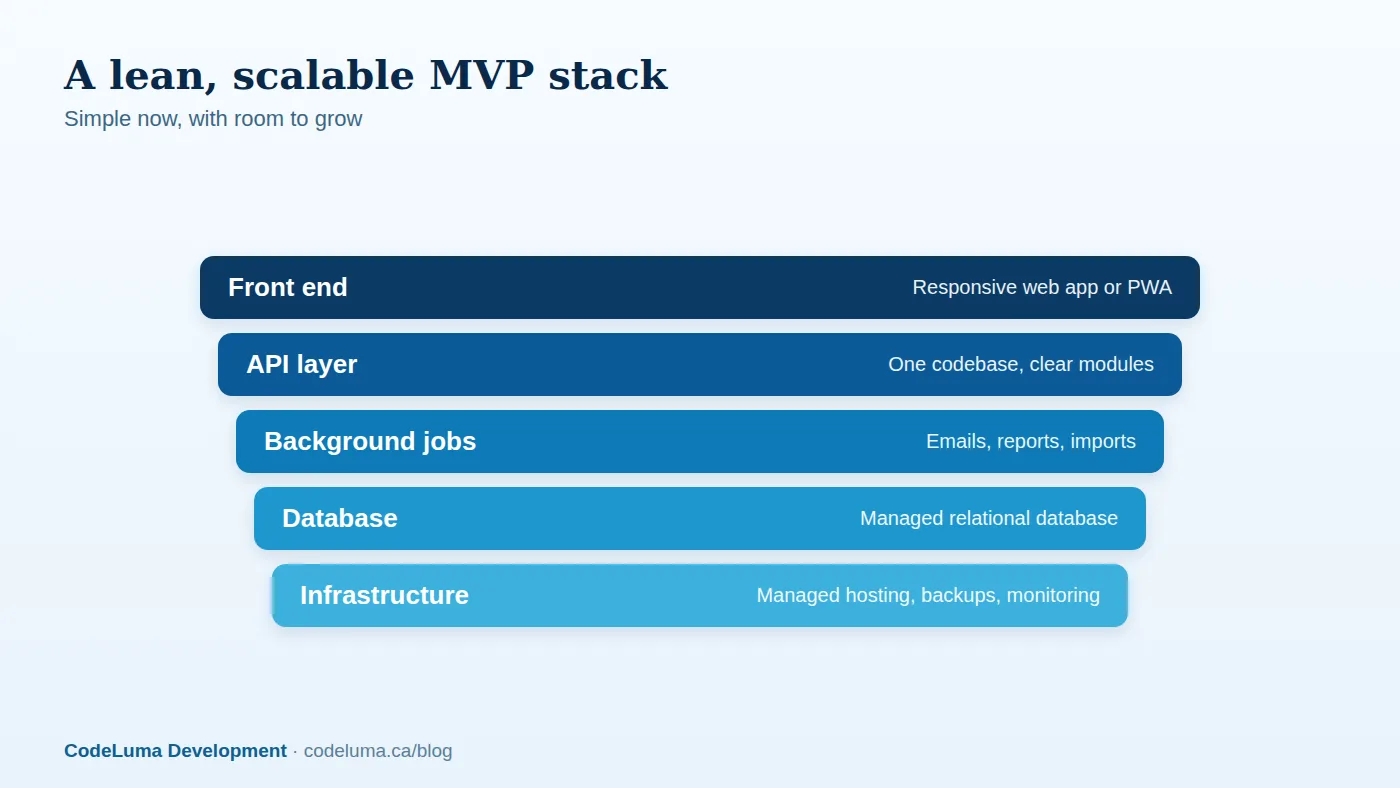
An MVP is not the place for experimental frameworks. Choose technology that has a large talent pool, good documentation, and a track record at scale. For most web products that means a mainstream server framework, a managed relational database such as PostgreSQL or MySQL, a modern front end, and managed hosting. The point is not that these tools are fashionable; it is that they are well understood, easy to hire for, and inexpensive to operate.
Resist premature microservices, custom infrastructure and exotic databases. A single, well-organised application, sometimes called a modular monolith, is easier to build, deploy, test and debug. It can serve tens of thousands of users on modest hardware, and it can be split into services later if the business genuinely requires it. We explain that path in detail in our guide to modular monoliths.
Design the data model carefully
Code can be refactored cheaply; data cannot. Spend real time on your data model: the entities, their relationships, ownership, and lifecycle. Decide early how you will handle multi-tenancy if you sell to organisations, how you will model users and roles, and what needs an audit history. Use migrations from the first commit so every environment can be recreated. Name things after business concepts rather than screens, and keep reporting needs in mind, because a model that is awkward to report on will hurt you the first time an investor asks for cohort retention.
Automate the boring parts on day one
A small amount of engineering hygiene pays for itself immediately:
- Version control with pull requests and code review, even in a two-person team.
- A repeatable deployment pipeline so releasing is a button, not a ritual.
- Automated tests around the highest-risk workflows, especially payments, permissions and data import.
- Error tracking and uptime monitoring so you hear about problems before customers do.
- Daily backups with a tested restore procedure.
None of this is glamorous, and none of it is expensive when set up at the start. Retrofitting it later, under pressure, is where budgets get burned.
Build in short cycles with visible progress
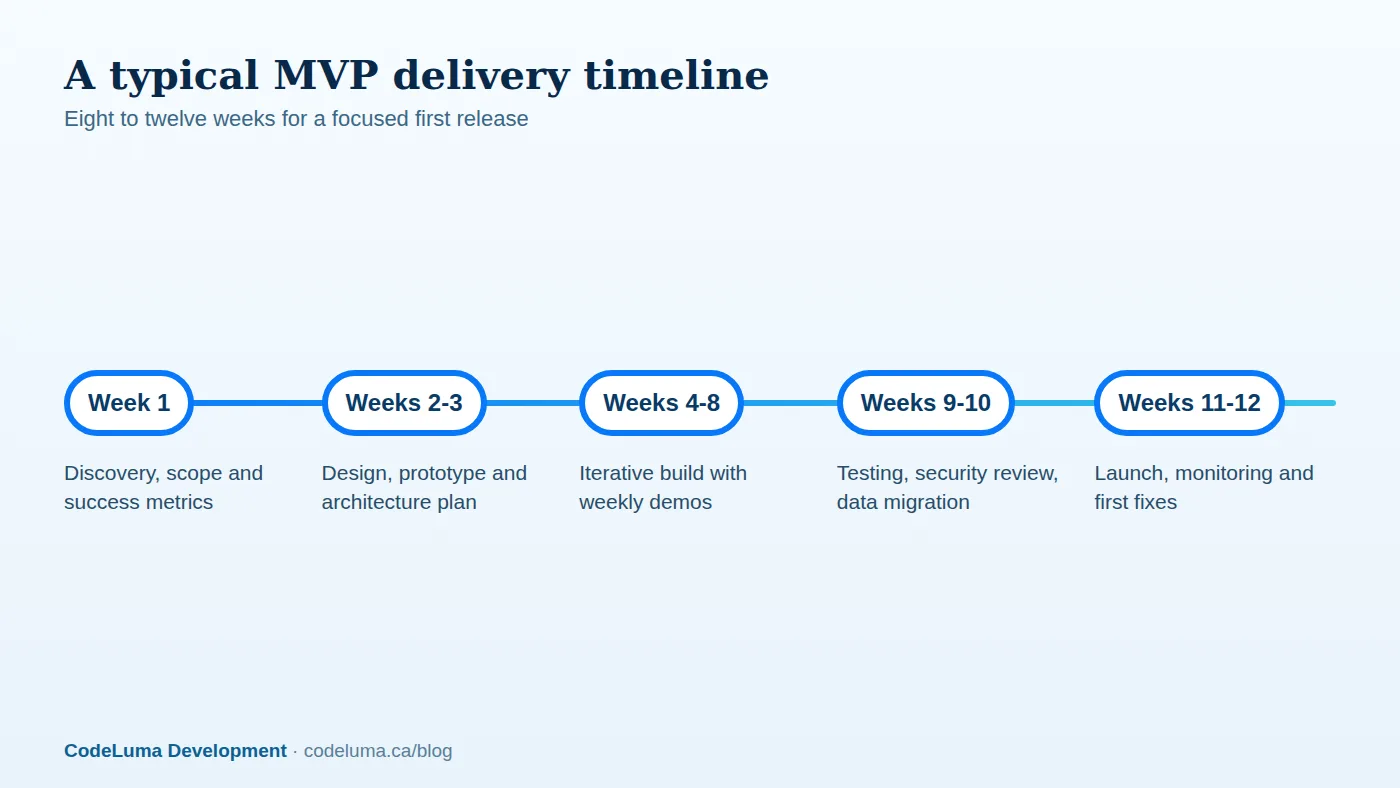
We recommend one-week iterations, each ending with a working demo you can click through. Frequent demos surface misunderstandings while they are cheap, and they let you change priorities without renegotiating a contract. Keep a live backlog, review it weekly, and be willing to cut features to protect the launch date. A launch on time with one fewer feature almost always beats a delayed launch with everything.
Plan the launch like a product, not an event
Before launch, do a short, structured readiness review: performance on real devices, security basics, transactional emails delivered to real inboxes, error pages, analytics events for your success metrics, and a rollback plan. Release to a small group of pilot customers first. Watch how they actually use the product, and schedule a follow-up conversation with each one within the first two weeks. Their feedback is the most valuable input you will have for the next release.
Budget for the year, not just the build
The build is only part of the cost. Plan for hosting, monitoring, email and messaging services, payment processing fees, backups, and a small ongoing allowance for fixes and improvements. Many founders reserve roughly a fifth to a third of the initial build cost per year for maintenance and iteration, adjusting for complexity. A maintenance plan with a predictable monthly fee is often easier to budget than surprise invoices.
A practical way to start
Bring a one-page brief: the buyer, the outcome, the three to five success metrics, and any prototype or interview notes. A good partner will challenge your scope, give you a phased estimate, and show you what can be deferred without creating debt. That conversation, whether with us or another team, is the best investment you can make before writing a line of code.
Put this into practice with CodeLuma
CodeLuma builds MVPs with the growth path already designed in: a lean first release you can afford now, on an architecture that will not need to be thrown away when your first hundred customers arrive.
- Custom software development - tailored systems, integrations and internal tools.
- Website and web application development - fast, accessible, search-friendly builds.
- Managed hosting - monitored, backed-up, Canadian-friendly hosting.
Start a conversation. Tell us about your project and we will reply with practical next steps, or browse all CodeLuma services. CodeLuma Development Inc. is based in Nova Scotia and works with teams across Canada and remotely.