When a visitor requests a page from your online store, something has to turn your data and templates into HTML. Where and when that happens determines how fast the page appears, how fresh the information is, how well search engines understand it, and how much your hosting will cost. The four main strategies are static site generation, incremental regeneration, server-side rendering and client-side rendering. Modern frameworks let you mix them page by page, which is exactly what most e-commerce sites should do.
The four strategies in plain language
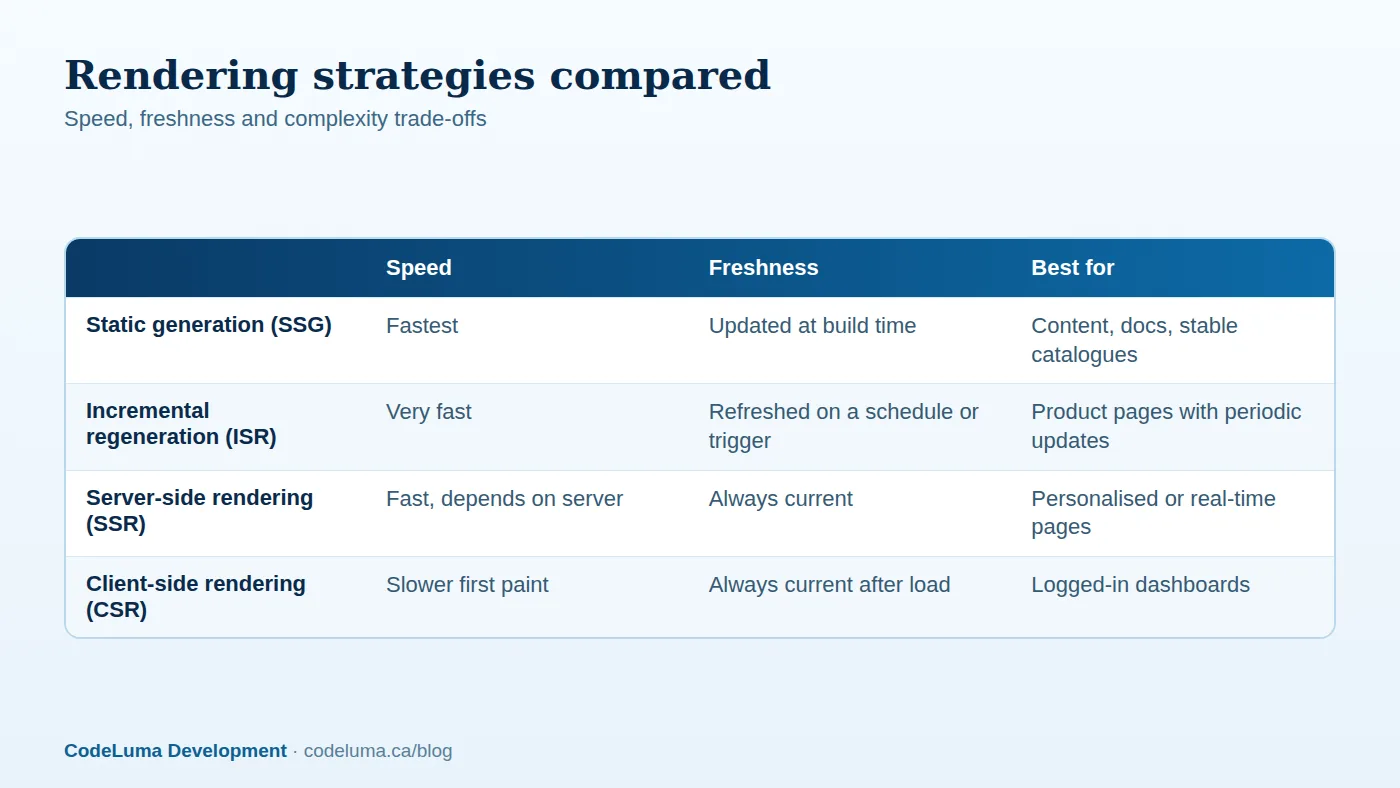
Static site generation (SSG) builds HTML pages ahead of time, during a build step, and serves them as files from a CDN. It is extremely fast and cheap to serve, and very resilient under traffic spikes. The trade-off is freshness: changing a price means rebuilding, and very large catalogues can lead to long build times.
Incremental static regeneration (ISR) is static generation with a refresh mechanism. Pages are generated on demand or in the background, served from cache, and regenerated after a set interval or when your system triggers a refresh. It gives you near-static speed with acceptable freshness and scales to large catalogues without rebuilding everything.
Server-side rendering (SSR) generates the HTML on the server for every request. Content is always current and can be personalised, and the browser receives complete HTML, which is good for search engines and for first paint. The cost is server work on every request, so it needs caching, capacity planning and good backend performance.
Client-side rendering (CSR) sends a small HTML shell and lets JavaScript in the browser fetch data and build the page. It suits highly interactive, logged-in experiences, but it delays first content, can hurt SEO if not handled carefully, and burdens low-powered devices.

What matters for e-commerce
An online store combines content that rarely changes with data that changes constantly. Product descriptions and images are stable; price, stock levels, promotions and shipping estimates are not. Personalisation, carts and accounts are unique per user. That mix is why a single strategy rarely fits every page. The most successful stores follow a simple rule: render everything that can be shared as early and as cheaply as possible, and fetch only the truly dynamic parts at request time.
Page-by-page recommendations
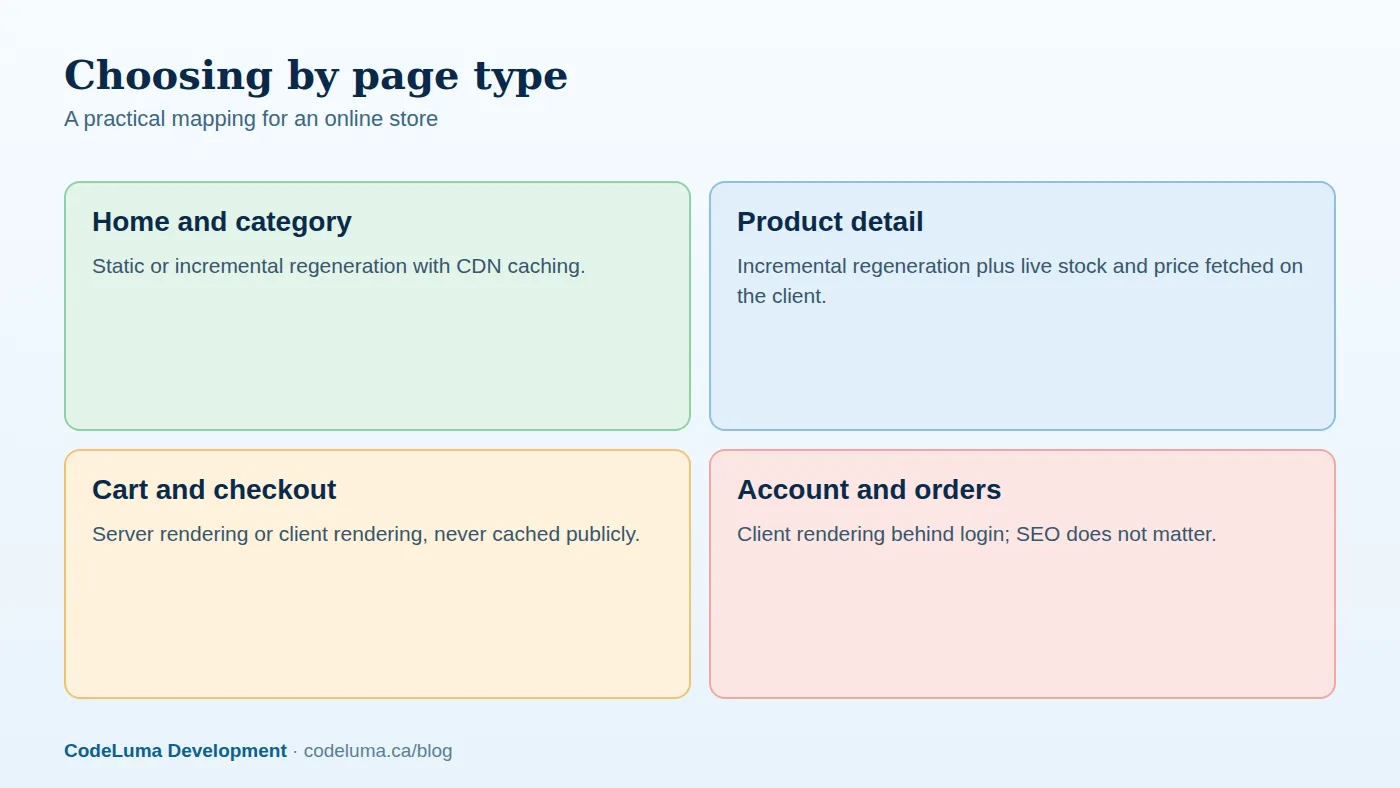
- Home page and category pages. Static or incremental regeneration with CDN caching. These pages drive discovery and SEO; speed is critical. Refresh on a schedule or when merchandising changes.
- Product detail pages. Incremental regeneration for the main content, images and structured data, with live price and stock fetched separately on the client or edge. This keeps HTML cacheable while showing accurate availability. For very large catalogues, generate popular products ahead of time and the long tail on first request.
- Search and filtered listings. Server-side rendering or a fast search API with client-side updates. Filtered URLs need clean, crawlable structure; avoid indexing endless filter combinations.
- Cart and checkout. Never cache these publicly. Use server rendering or client rendering with secure APIs. Prioritise reliability and clarity over cleverness.
- Account, order history and wishlists. Client rendering behind login is fine because SEO is irrelevant and data is personal.
- Content and blog. Static generation is ideal.
SEO considerations
Search engines can process JavaScript, but rendered HTML delivered at request time remains the safest, fastest way to ensure that content, titles, canonical tags and structured data are seen. For product and category pages, ensure the initial HTML includes the essential content, product schema markup, unique titles and descriptions, and proper canonical URLs. Pre-rendering or server rendering also helps social previews and accessibility tools. We describe related tactics in our technical SEO checklist.
Handling stock and price accuracy
The main risk with cached pages is showing stale prices or availability. Solve it deliberately:
- Fetch price and stock from an API at the edge or in the browser, and update the interface after load, with reserved space to avoid layout shifts.
- Use on-demand revalidation: when the inventory or catalogue system changes a product, trigger a refresh of that page.
- Re-check price and availability at cart and checkout, where accuracy is non-negotiable.
- Make sure structured data does not advertise an in-stock item that has sold out.

Build time and scale
A catalogue with hundreds of thousands of products cannot be fully rebuilt on every change. Use incremental approaches: generate the most visited pages at build time, the rest on demand, and invalidate pages individually when their data changes. Store rendered pages at the edge and let the CDN absorb traffic. If your platform rebuilds everything for every update, that is a design smell worth addressing.
Cost and operations
Static and incremental approaches move work from request time to build time, lowering the cost of serving traffic and improving resilience. Server rendering requires compute that scales with traffic, so pair it with caching and monitor response times. Consider the team's skills too: a simpler architecture that your developers can run confidently beats a clever one they fear touching.
How to decide
- List your page types and how often each one's data changes.
- Mark which need per-user content and which are shareable.
- Choose the cheapest strategy that meets freshness needs for each.
- Prototype the riskiest page, usually the product page, and measure real performance.
- Instrument Core Web Vitals and conversion, and adjust.
A well-designed custom front end can combine these strategies within one codebase, giving customers instantly loading pages and giving you fresh, accurate data.
Put this into practice with CodeLuma
CodeLuma designs e-commerce front ends with the right rendering strategy for each page type, delivering fast product pages, fresh inventory and strong SEO without unnecessary complexity.
- Website and web application development - fast, accessible, search-friendly builds.
- Custom software development - tailored systems, integrations and internal tools.
- Managed hosting - monitored, backed-up, Canadian-friendly hosting.
Start a conversation. Tell us about your project and we will reply with practical next steps, or browse all CodeLuma services. CodeLuma Development Inc. is a Canadian company that works with teams in Windsor, Essex, London, Toronto, Mississauga and across Ontario, throughout Canada and remotely.