If you have ever wished a chatbot could actually read your employee handbook, your product manuals, or your customer policies before answering a question, you are describing retrieval-augmented generation, or RAG. It is one of the more practical patterns to come out of the recent wave of language model tools, because it solves a real problem: a general-purpose model does not know anything about your business unless you show it. This article walks through how the pipeline actually works, so you can have an informed conversation when scoping a project like this.
What RAG Actually Means
Retrieval-augmented generation is a two-step process. First, a system searches your own content for the pieces most relevant to a question. Second, it hands those pieces to a language model and asks it to write an answer using only that material. The model is not answering from memory. It is answering from a stack of document excerpts placed in front of it moments earlier, the same way you might hand an employee the three relevant pages of a policy manual instead of asking them to recite it from memory.
This matters because it changes what the system is capable of. It can answer about yesterday's price list update. It can quote your actual return policy instead of a generic one. And when it does not know something, a well-built system can say so, rather than inventing a plausible-sounding answer.

The Pipeline, Step by Step
Underneath the simple idea, there are several distinct moving parts, and each one is worth understanding because each one is a place projects go right or wrong.
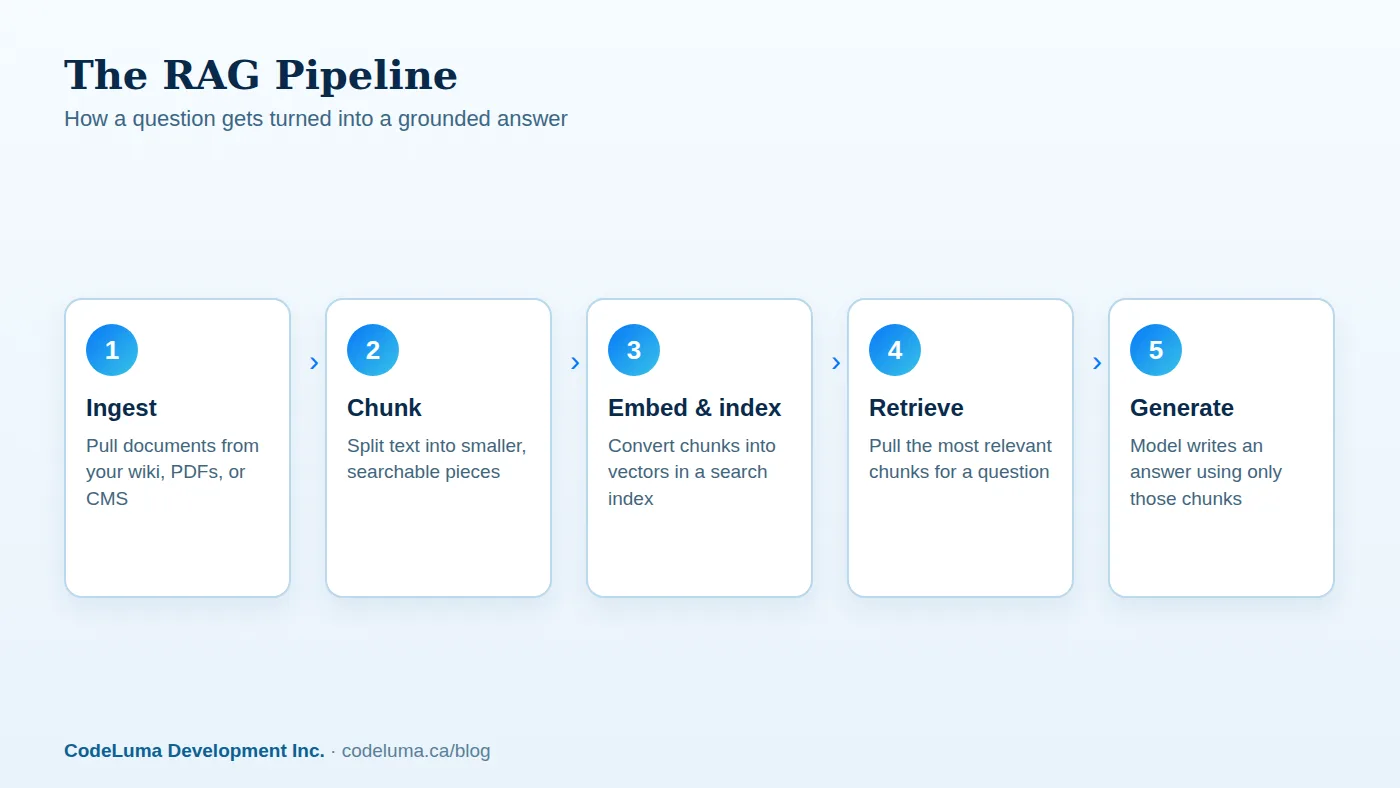
- Ingestion: pulling source documents out of wherever they live, whether that is PDFs, a wiki, a CMS, or spreadsheets, and converting them into clean text.
- Chunking: breaking that text into smaller pieces, usually a paragraph or a few hundred words, because a search system works better on focused pieces than on whole documents.
- Embedding: converting each chunk into a numeric representation that captures its meaning, so similar ideas end up with similar numbers.
- Indexing: storing those representations in a vector database or search index built to find "closest meaning" matches quickly.
- Retrieval: when a question comes in, converting it the same way and pulling back the handful of chunks that are the closest match.
- Generation: handing those chunks to the model along with the original question, and asking it to compose an answer grounded in that material.
Every one of those steps can be tested and improved on its own. That is one of the real advantages of RAG over trying to solve everything with a single clever prompt: you can measure whether retrieval is pulling the right chunks before you even worry about how the answer is worded.
Why Not Just Paste Everything Into the Prompt?
A reasonable question is why you need a search step at all. Why not just paste your whole manual into the model's context and let it answer? For a short document, you sometimes can. But most businesses have manuals, policy sets, and product catalogs that run into the hundreds of pages, far beyond what fits comfortably in a single request, and even when it technically fits, feeding a model more text than it needs tends to produce vaguer, less focused answers and costs more per question. Retrieval exists to narrow a large body of content down to the handful of passages actually relevant to one specific question.
Choosing What Documents to Include
This is the part teams underestimate. Scoping a RAG project is really a document audit disguised as a technical project. Before any engineering starts, it is worth answering a few questions honestly: which documents are actually current, which ones contradict each other, and which ones contain information you would not want surfaced to the wrong audience. A system built on outdated or conflicting source material will confidently retrieve and repeat whatever is in there, outdated policy included. We have found that this early cleanup, as unglamorous as it is, has more influence on how trustworthy the final answers feel than almost any technical decision that follows.
Chunking: The Detail Most Projects Get Wrong
How you split documents into chunks has an outsized effect on answer quality. Chunks that are too large bring in irrelevant context and dilute the match. Chunks that are too small lose the surrounding context a question needs. Splitting on arbitrary character counts, cutting a policy sentence in half, or ignoring headings and tables, are common ways this quietly degrades a system that otherwise looks fine in a demo. Good chunking respects the natural structure of the document: sections, headings, and tables, not just a fixed number of words.
RAG vs. Fine-Tuning
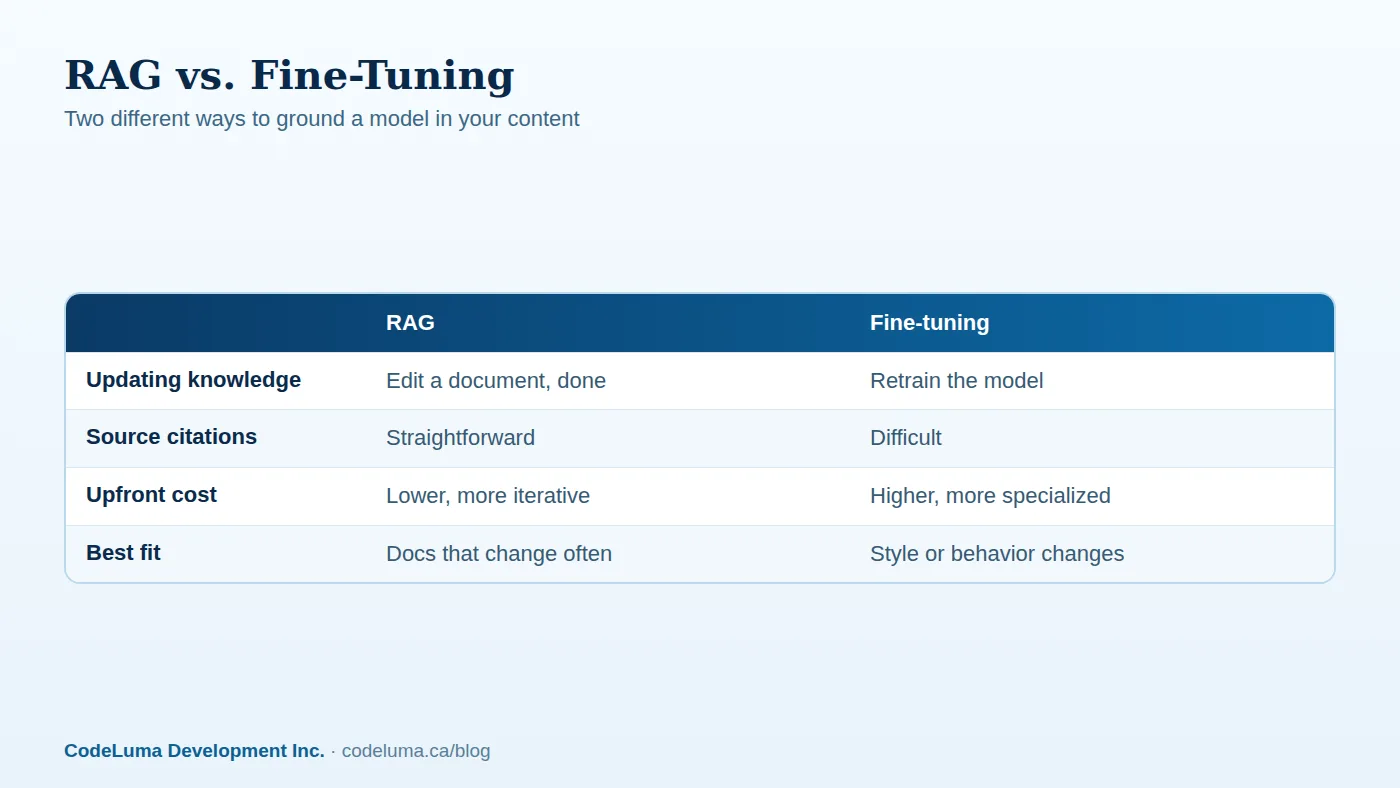
People sometimes assume retraining a model on company content is the "real" solution, and retrieval is a shortcut. In practice it is usually the other way around for document-based question answering. Fine-tuning changes how a model behaves or writes; it is not a reliable way to teach it new, specific facts, and every time your policy changes you would need to retrain. With RAG, updating an answer is as simple as editing the source document, since the retrieval step will pick up the new version automatically. Fine-tuning still has its place for tone or specialized behavior, but for "answer from our current documents," retrieval is the more maintainable approach.
Keeping Answers Honest: Citations and Guardrails
A well-built RAG system should be able to show its work. That usually means displaying which document and section an answer came from, so a reader can verify it rather than trust it blindly. It also means instructing the model clearly to say "I don't have that information" when retrieval comes up empty, rather than filling the gap with a guess. Neither of these is automatic. Both have to be deliberately designed into the prompt and the interface, and both are worth insisting on if accuracy matters to your use case, which for policy or compliance answers, it almost always does.

Common Mistakes We See
- Treating it as a one-time build. Documents change. Without a refresh process, the index quietly goes stale.
- Skipping the document audit. Feeding in every file in a shared drive, duplicates, drafts, and outdated versions included, and hoping retrieval sorts it out.
- No way to measure retrieval quality. If nobody checks whether the right chunks are coming back, you are only ever evaluating the final wording, not the actual accuracy.
- Ignoring access control. If some documents are confidential, the retrieval layer needs to respect who is asking, not just what is being asked.
- Over-trusting a good demo. A system that handles five sample questions well can still fail badly on edge cases outside that sample.
A Checklist for Scoping Your Project
Before you brief a developer or a studio on a project like this, it helps to have rough answers to the following:
- Which documents are the source of truth, and who owns keeping them current?
- How often does that content change, daily, monthly, rarely?
- Does any of it need to stay restricted to certain roles or teams?
- Do answers need to show citations or links back to the source?
- Where will this live, an internal tool, a customer-facing widget, or both?
- What does a wrong answer cost you, an annoyance, or a compliance problem?
That last question in particular shapes how much guardrail and review work the project needs. We cover related scoping questions in how to write a software project brief that gets useful quotes, which applies just as well here.
Maintenance Isn't Optional
A RAG system is closer to a living piece of infrastructure than a one-off script. Source documents change, the index needs re-running, and the underlying model you call may itself get updated or replaced over time. Treating this as something you build once and forget tends to produce a system that quietly drifts out of sync with reality within months. If this is going into production use, plan for an ongoing maintenance arrangement from the start rather than retrofitting one later.
Wrapping Up
RAG is not magic, and it is not a single tool you buy off a shelf. It is a pipeline of fairly ordinary steps, cleaning up documents, chunking them sensibly, indexing them, retrieving the right pieces, and generating an answer grounded in that material, each of which can be built well or built carelessly. Understood this way, it becomes a project you can scope realistically: start with a clean, current set of documents, measure retrieval before worrying about the wording of answers, and build in a way to show sources so people can trust what they are reading. If you are weighing this against a simpler scripted chatbot, our piece on agents versus chatbots is a useful next read. And if you want a second opinion on scope before committing budget, a short scoping conversation with a development team is a low-risk way to find out what a realistic version of this looks like for your documents specifically.
Put this into practice with CodeLuma
CodeLuma builds document-grounded chat tools for teams who want accurate answers pulled from their own manuals, policies, or product catalogs instead of generic guesses. We handle the full pipeline, from organizing your source documents through to a working search-and-answer system, and we can scope it as a focused pilot before committing to the full build.
- Custom software development - tailored systems, integrations and internal tools.
- Managed hosting - monitored, backed-up, Canadian-friendly hosting.
- Maintenance and support plans - updates, monitoring and ongoing improvement.
- CodeLuma support - help from a real team when you need it.
Start a conversation. Tell us about your project and we will reply with practical next steps, or browse all CodeLuma services. CodeLuma Development Inc. is a Canadian company that works with teams in Windsor, Essex, London, Toronto, Mississauga and across Ontario, throughout Canada and remotely.