When it's time to request quotes for a software project, a lot of business owners default to whatever document they've seen before: a long, formal RFP borrowed from a procurement template, or a vague paragraph dashed off in an email. Neither is automatically wrong, but neither is automatically right either. The format you choose shapes who responds, how fast you get usable quotes, and whether those quotes are even comparable. Here's how to decide, and how to build the right document without turning off the developers you actually want to hear from.
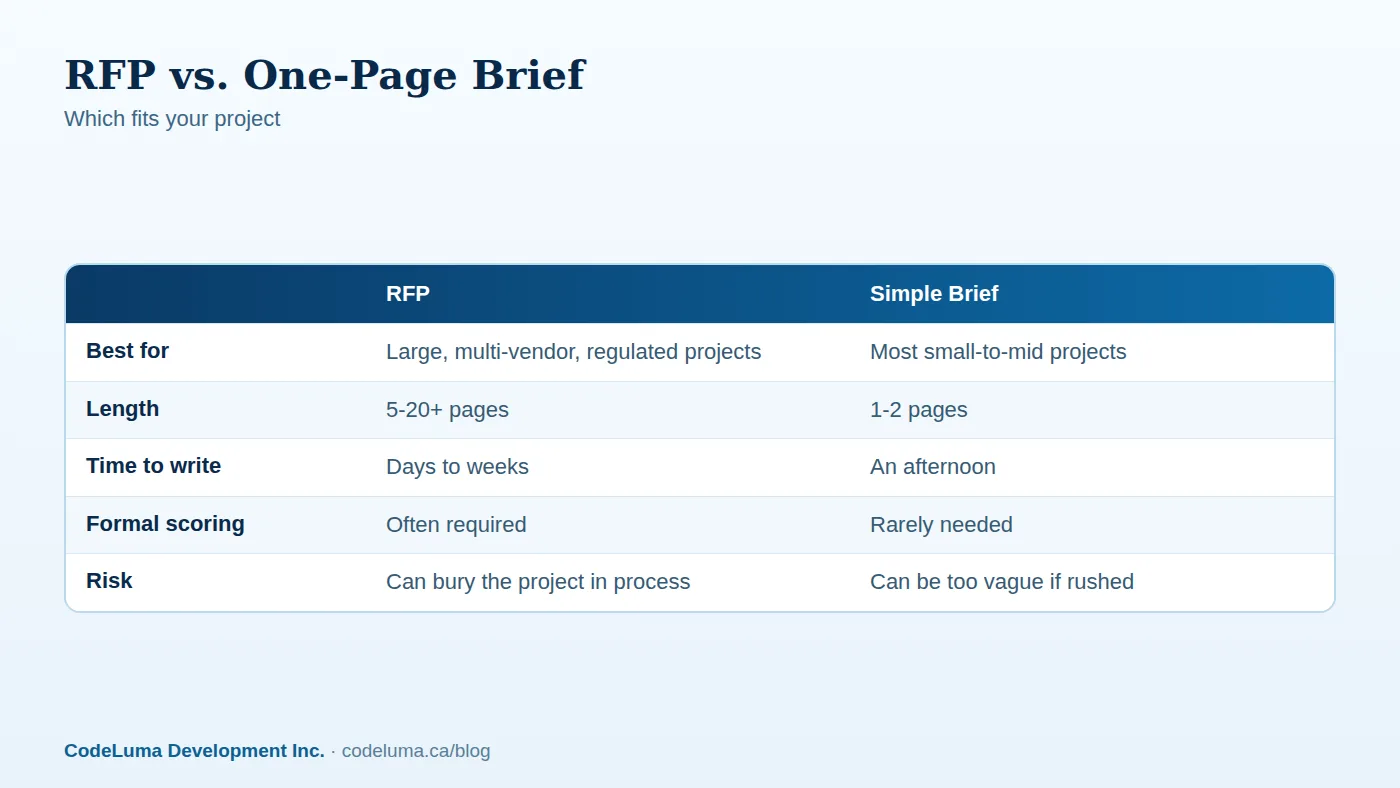
What an RFP Actually Is (and Isn't)
A Request for Proposal is a formal, structured document that asks vendors to respond point-by-point to defined requirements, often with scoring criteria, mandatory sections, and a submission deadline. It exists so that large organizations, usually ones with procurement rules or public funding, can compare multiple vendors fairly and defensibly. It is a process tool first and a communication tool second.
That's fine when the process itself is required. It's a liability when it isn't. An RFP built for a project that doesn't need that level of formality tends to produce generic, boilerplate responses, because serious development shops often decline to invest real time estimating against a document that reads like a compliance exercise.

What a Simple Brief Covers
A simple brief is one to two pages that explains what you're trying to accomplish, what exists today, what success looks like, and what constraints you're working within. It skips scoring rubrics and formal sections in favor of plain description. Most small and mid-sized software projects are better served by this format, because it gets a real person reading a real description of your problem instead of filling out a form.
We've written before about what makes a brief actually useful, and the short version is: specificity beats length every time.
Signs Your Project Needs a Formal RFP
- Your organization has a procurement policy that requires one, often tied to public funding or a board-level spending threshold
- You're evaluating five or more vendors and need a consistent basis for comparison
- The project involves regulatory, accessibility, or security requirements that must be formally acknowledged in writing
- Multiple internal stakeholders need a documented, auditable selection process
- The engagement will likely span multiple contracts or phases over a year or more
If none of these apply, an RFP is probably adding weight without adding value.
Signs a One-Page Brief Is Enough
- You're a single decision-maker or small team choosing a development partner
- The project is a new feature, a website, an internal tool, or an MVP rather than an enterprise system
- You want to start a conversation, not run a formal selection process
- Speed matters more than procedural fairness
This covers the majority of the projects we see. A brief gets you talking to a developer in days instead of weeks.
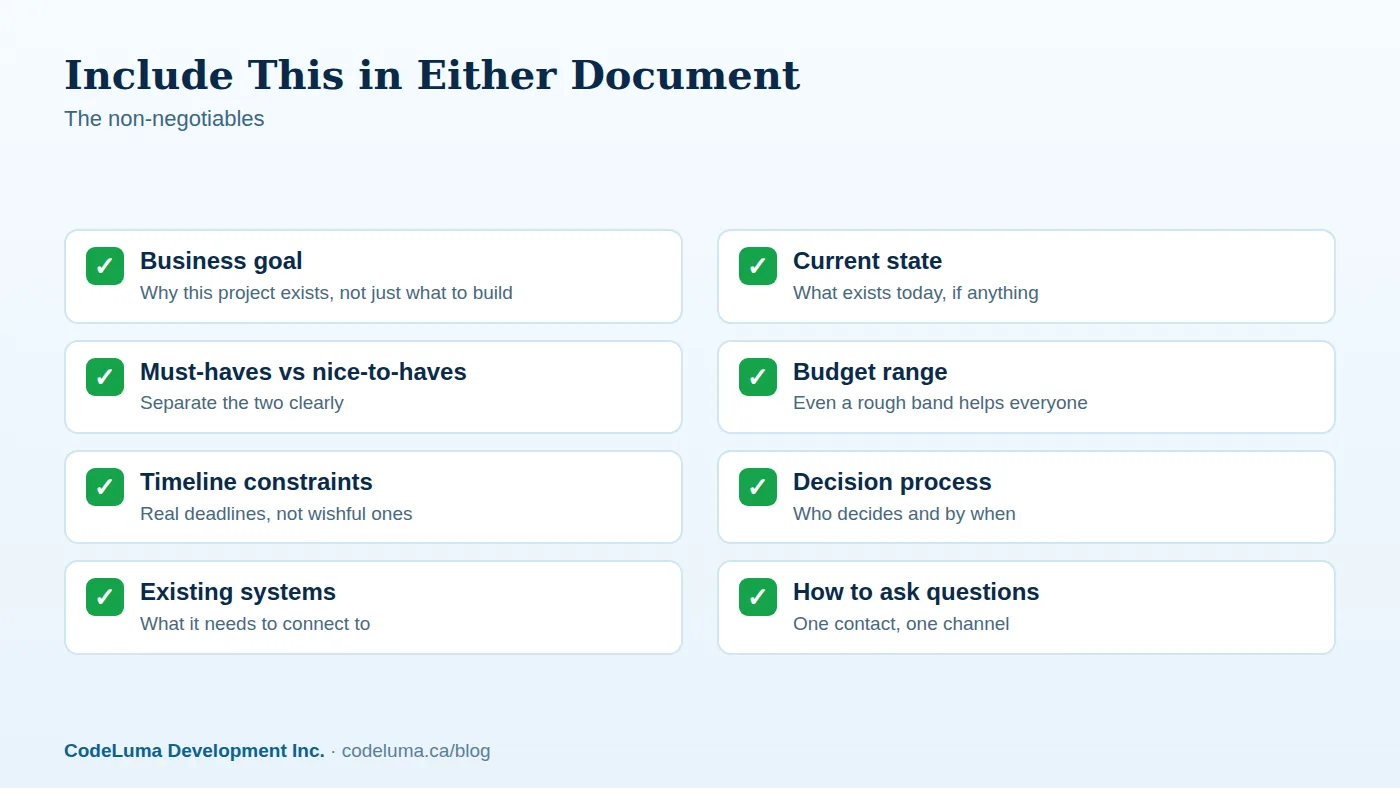
What Every Request Should Include, Regardless of Format
Whether you write five pages or one, certain information needs to be there or the quotes you get back won't mean much. Vague requests produce vague estimates, and estimates built on guesses tend to drift once real work starts.
Building the RFP Without Scaring Off Good Developers
If a formal RFP really is warranted, you can still keep it approachable. Lead with plain-language context before the structured sections, not after. Keep mandatory requirements to things that genuinely are mandatory, not a wish list dressed up as a requirement. Avoid asking for unpaid proof-of-concept work or fully priced fixed-bid proposals before any discovery has happened; that filters out shops who price projects responsibly and leaves you with vendors who are comfortable guessing. And set a reasonable response window. A two-week turnaround for a document with twenty questions tells serious respondents this process wasn't built with their time in mind.
Building the Simple Brief
A good one-page brief reads like you're explaining the project to a competent person who's never seen your business before. Start with the problem, not the solution; "our team spends three hours a week reconciling orders by hand" is more useful than "we need a dashboard." Then describe what you have now, what you want to change, who will use it, and any hard constraints on budget or timing. End with how you want to be contacted and by when you need a response. If you're specifically scoping a minimum viable product, a dedicated MVP brief format works even better, since it forces an early must-have versus later split.

Common Mistakes That Sink Good Quote Requests
- Asking for a fixed price before any discovery. Credible developers will either pad the number to cover unknowns or decline to bid.
- Omitting budget entirely. A rough range, even a wide one, saves everyone time and filters out mismatched proposals.
- Copying an RFP template from an unrelated industry. Sections about insurance certificates or data residency rules that don't apply just add noise.
- No single point of contact. Questions routed through three people produce inconsistent answers and slower timelines.
- Treating the brief as final. A good brief is a starting point for conversation, not a locked spec. Developers who ask clarifying questions are usually the ones worth hiring.
A Quick Checklist Before You Hit Send
- Does the document explain why this project matters, not just what to build?
- Is there a budget range, even approximate?
- Are must-haves separated from nice-to-haves?
- Is there one named contact for questions?
- Is the response timeline realistic for the amount of detail you're asking for?
- Would a developer who knows nothing about your business understand the problem after one read?
If you can answer yes to all six, you're ready to send it, whichever format you chose.
When You're Not Sure Which One to Use
When in doubt, start with the brief. It's faster to write, faster to read, and faster to act on. If the responses you get back raise questions about scale, compliance, or vendor comparison that genuinely need a formal process, you can always build an RFP from what you learned. Going the other direction, trimming an overbuilt RFP down after it's already scared off good respondents, is harder.
This decision also connects to the stage you're at. If you haven't yet nailed down what you're building, a short discovery conversation before you write anything can save you from scoping the wrong document entirely.
Wrap-Up
The format of your request matters less than its clarity. A formal RFP is a tool for a specific kind of decision: multi-vendor, auditable, procedurally constrained. A one-page brief is a tool for getting a real conversation started quickly, which is what most businesses actually need. Pick the one that matches your situation, fill it with the specifics that let a developer estimate honestly, and you'll get quotes worth comparing. Whether you need a new website or ongoing support after launch, the first document you send sets the tone for everything that follows.
Put this into practice with CodeLuma
CodeLuma reviews briefs and RFPs from prospective clients every week, so we know what helps us quote accurately and what just adds delay. If you're not sure which format fits your project, send us what you have and we'll tell you plainly what's missing before you send it anywhere else.
- Custom software development - tailored systems, integrations and internal tools.
- Website and web application development - fast, accessible, search-friendly builds.
- Maintenance and support plans - updates, monitoring and ongoing improvement.
- CodeLuma support - help from a real team when you need it.
Start a conversation. Tell us about your project and we will reply with practical next steps, or browse all CodeLuma services. CodeLuma Development Inc. is a Canadian company that works with teams in Windsor, Essex, London, Toronto, Mississauga and across Ontario, throughout Canada and remotely.