If your website or app collects even basic information from visitors — a name, an email address, a shipping address — and any of those visitors are in Quebec, Law 25 applies to you. It doesn't matter if your business is based in Windsor, Toronto, or anywhere else in Canada. This article breaks down what the law actually requires, in plain terms, so you can tell what applies to your situation and what needs to change.
What Law 25 Actually Is
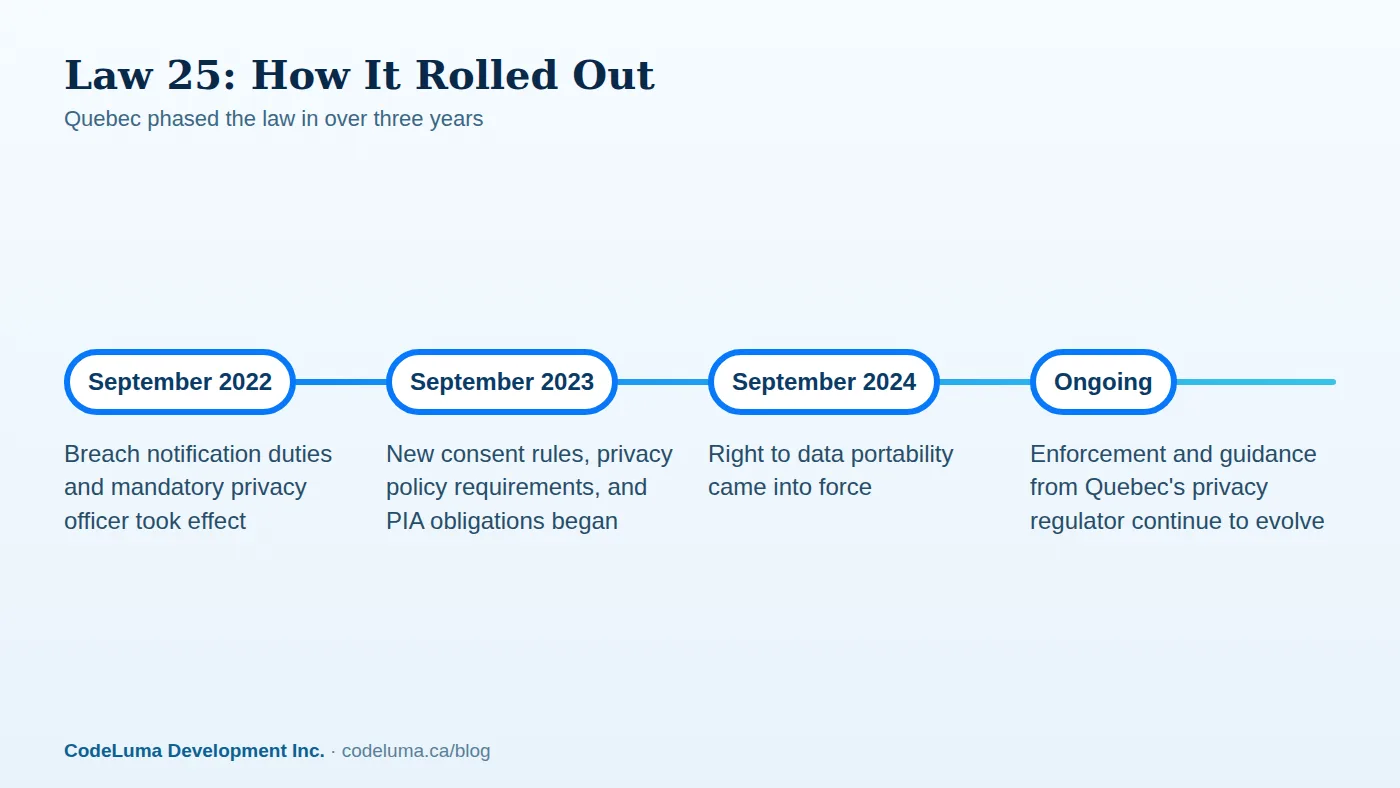
Law 25 (formerly Bill 64) is Quebec's overhaul of its private-sector privacy legislation, the Act respecting the protection of personal information in the private sector. It rolled out in three phases between September 2022 and September 2024, and all of it is now in force. It's widely described as the strictest privacy law in Canada, built with concepts similar to Europe's GDPR — mandatory privacy officers, privacy impact assessments, and real consent requirements, not just a checkbox buried in fine print.
It applies based on whose information you collect, not where your company is headquartered. An Ontario business selling online to customers across the country, including Quebec, is in scope the same as a Montreal company.

Do You Need to Comply? Here's the Quick Test
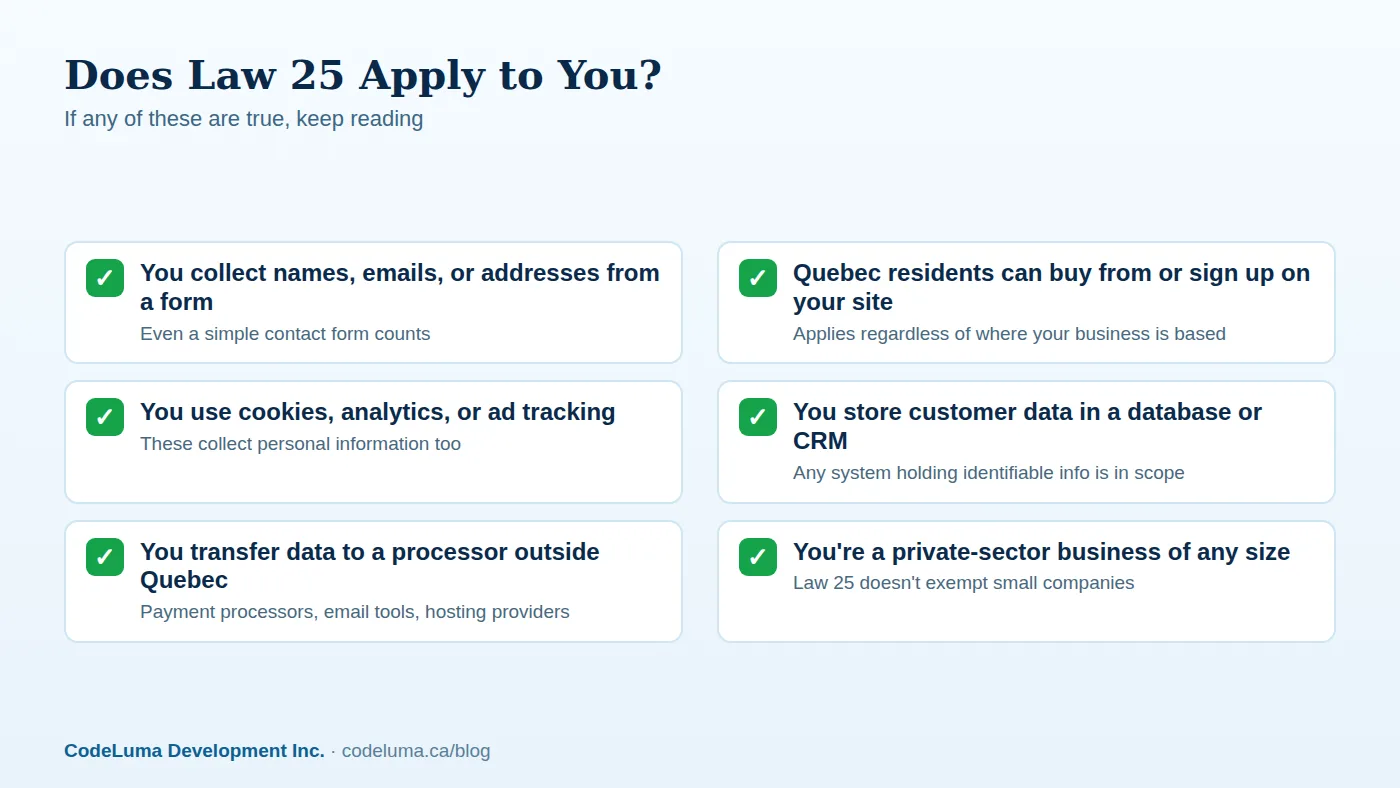
You're very likely in scope if you do business in Quebec and your website or app collects personal information through any of the following:
- Contact forms, account sign-ups, or newsletter opt-ins
- E-commerce checkouts that store names, addresses, or payment details
- Analytics or advertising cookies that track individual visitors
- Customer support tools, booking systems, or membership portals
There's no small-business exemption. A five-person company with a simple contact form has the same core obligations as a large retailer — the scale of what you need to document and the complexity of your systems is what differs, not whether the law applies.
Rule One: Consent Has to Be Real Consent
Law 25 requires consent to be clear, informed, and given for specific purposes — not implied by a pre-checked box or a blanket "by using this site you agree" statement buried in a footer link. In practice, that means:
- Consent requests must be separate from other terms, not bundled into a general terms-of-service agreement
- You need to explain what you're collecting and why, in language a non-lawyer can understand
- Consent for a new or different purpose has to be asked for again — you can't quietly repurpose data collected for one reason to use it for another
- Withdrawing consent needs to be realistically possible, not a dead end
This is the area where we see the most daylight between what businesses think they're doing and what the law expects. A cookie banner that only has an "Accept" button, with no real way to decline non-essential tracking, doesn't meet this standard.
You Need a Designated Privacy Officer
Every organization covered by Law 25 must have a privacy officer responsible for ensuring compliance. By default, that responsibility falls on whoever holds the highest authority in the business — typically the owner, CEO, or most senior executive — unless that role is formally delegated to someone else in writing.
This isn't just a title. The privacy officer's name and contact information need to be made available, usually on your website, and that person is the one responsible for handling privacy complaints, overseeing data-handling practices, and signing off on privacy impact assessments. For a small business, this is often the owner by default. For a larger team, it's worth deliberately assigning it to someone with the authority and time to actually own it.
When You Need a Privacy Impact Assessment
A privacy impact assessment (PIA) is a documented review of how a project affects personal information, done before the project goes live. Law 25 requires one in specific situations, including:
- Before acquiring, developing, or significantly overhauling an information system or electronic service that involves personal information
- Before transferring personal information outside Quebec, including to a cloud provider or processor based elsewhere
- Before communicating personal information to a third party without consent, in the limited cases where that's permitted
In other words, if you're planning a new app, a major website rebuild, a new CRM, or moving your hosting to a provider outside the province, a PIA isn't optional — it's part of the build process, not an afterthought. We talk through this kind of planning in how we approach discovery for any software project, since privacy review fits naturally into that early stage.
Your Privacy Policy Has to Be Visible and Plain-Language
Law 25 requires a privacy policy that's easy to find and written in clear, simple terms — not dense legal language designed to discourage anyone from reading it. At minimum, it should explain what personal information you collect, why, how long you keep it, who it might be shared with, and how someone can contact your privacy officer with a question or complaint.
This policy needs to be genuinely accessible from your site, not three clicks deep in a footer menu nobody uses. If you're updating or rebuilding a site, this is a good moment to also review the policy's actual content, not just its location — stale policies that describe systems you no longer use are a common finding in audits.
Breach Notification: What Changed
Since September 2022, any confidentiality incident that creates a risk of serious harm must be reported to Quebec's privacy regulator and to the affected individuals. This includes things like unauthorized access to a database, a misconfigured system exposing customer records, or a lost device containing personal information. You're also required to keep an internal register of incidents, even ones that don't meet the threshold for mandatory reporting.
This makes incident response planning a practical necessity, not a nice-to-have. Knowing who gets notified, how quickly, and what gets logged should be decided before an incident happens, not during one.

Automated Decision-Making and Profiling Disclosures
If your website or app uses personal information to make automated decisions about someone — for example, automatically approving or denying a credit application, or using profiling to personalize pricing — Law 25 requires you to inform the person that a decision was made this way, and give them the chance to ask questions or request a human review. This applies narrowly to automated decisions that have real effects on a person, not to routine personalization like showing recommended products.
Common Mistakes We See
- Treating the privacy policy as a copy-paste job. A policy copied from a template or another company's site often describes data practices you don't actually follow, which is its own compliance problem.
- Assuming a Quebec office is required for the law to apply. Location of your business doesn't matter — location of the people whose data you collect does.
- Skipping the PIA on "small" projects. A modest system change can still trigger the requirement if it affects how personal information is handled.
- No real consent withdrawal path. If someone can opt in with one click but can't reasonably opt out, that's a gap worth closing.
- Leaving the privacy officer role undefined. By default it falls on your most senior person — if nobody's thought about it, that's already your answer, whether or not they know it.
A Practical Starting Checklist
If you're working through this for the first time, a reasonable order of operations looks like:
- Confirm whether Quebec residents are among your users or customers
- Name a privacy officer and publish their contact information
- Review and rewrite your privacy policy in plain language, and make sure it's easy to find
- Audit how consent is collected across forms, cookies, and sign-up flows
- Document a breach response process, including who gets notified and how
- Flag any upcoming system changes, migrations, or new tools that may need a PIA before launch
This is the kind of review worth doing alongside an ongoing maintenance plan, since privacy obligations don't end at launch — they need to be revisited whenever your systems or data practices change.
Wrapping Up
Law 25 isn't a one-time checkbox — it's a set of ongoing obligations around consent, documentation, and accountability that need to be built into how your website or app actually works, not just written about in a policy page. None of it requires guessing: the rules about consent, privacy officers, and privacy impact assessments are specific enough to work through methodically. If you're planning a new build or a significant update, getting the data-handling design right from the start is far easier than retrofitting it later, and if you're unsure whether your current site meets the bar, a focused review through a web development assessment is a reasonable place to begin.
None of this is legal advice — for a definitive read on how Law 25 applies to your specific business, a privacy lawyer familiar with Quebec's regulator is worth the conversation. What we can help with is making sure your website or app is technically built to support whatever your compliance obligations turn out to be.
Put this into practice with CodeLuma
CodeLuma helps businesses audit their website or app against Law 25's consent, disclosure, and data-handling requirements, then implement the technical changes — consent banners, privacy policy pages, data export tools, and secure storage — that a compliant site actually needs. We also help you document the privacy impact assessments and retention practices regulators expect to see on request.
- Website and web application development - fast, accessible, search-friendly builds.
- Custom software development - tailored systems, integrations and internal tools.
- Maintenance and support plans - updates, monitoring and ongoing improvement.
- CodeLuma support - help from a real team when you need it.
Start a conversation. Tell us about your project and we will reply with practical next steps, or browse all CodeLuma services. CodeLuma Development Inc. is a Canadian company that works with teams in Windsor, Essex, London, Toronto, Mississauga and across Ontario, throughout Canada and remotely.