Ask five developers to quote the same project and you'll often get five wildly different numbers. Most business owners assume this means someone is overcharging or someone is cutting corners. Usually the real problem is simpler: the brief they sent didn't give any of the five developers the same information to work from. A good brief doesn't guarantee identical quotes, but it makes the differences meaningful instead of random.
Why Vague Briefs Get You Vague Quotes
When a request reads "we need an app for booking appointments," a developer has to fill in dozens of blanks before they can price anything: how many users, what kind of scheduling logic, does it need payments, does it replace an existing system or run alongside one. Every blank they fill in is a guess, and guesses go in different directions. One quote assumes a simple form. Another assumes a full multi-staff booking engine. Neither is wrong, but they aren't comparable, and you end up choosing based on price alone instead of scope.

Start With the Problem, Not the Solution
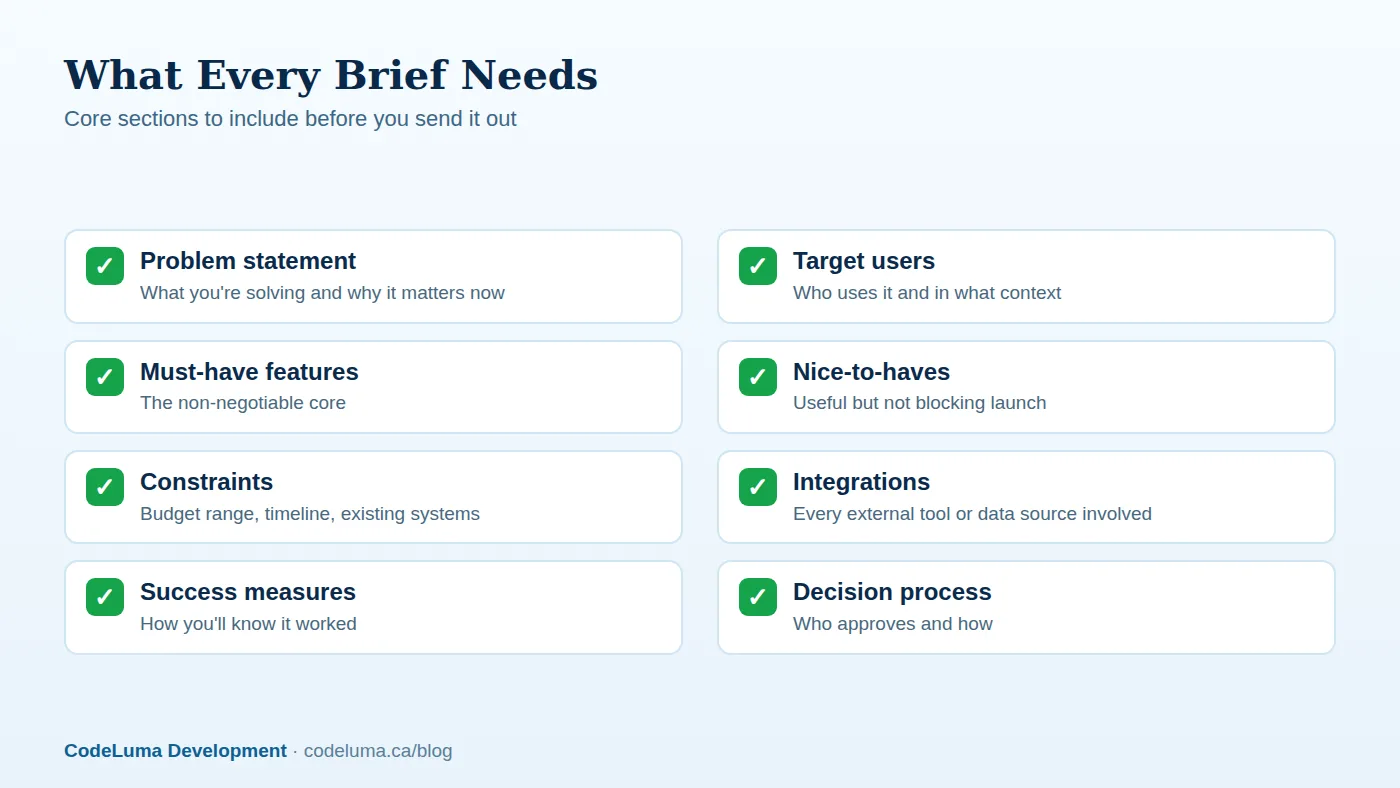
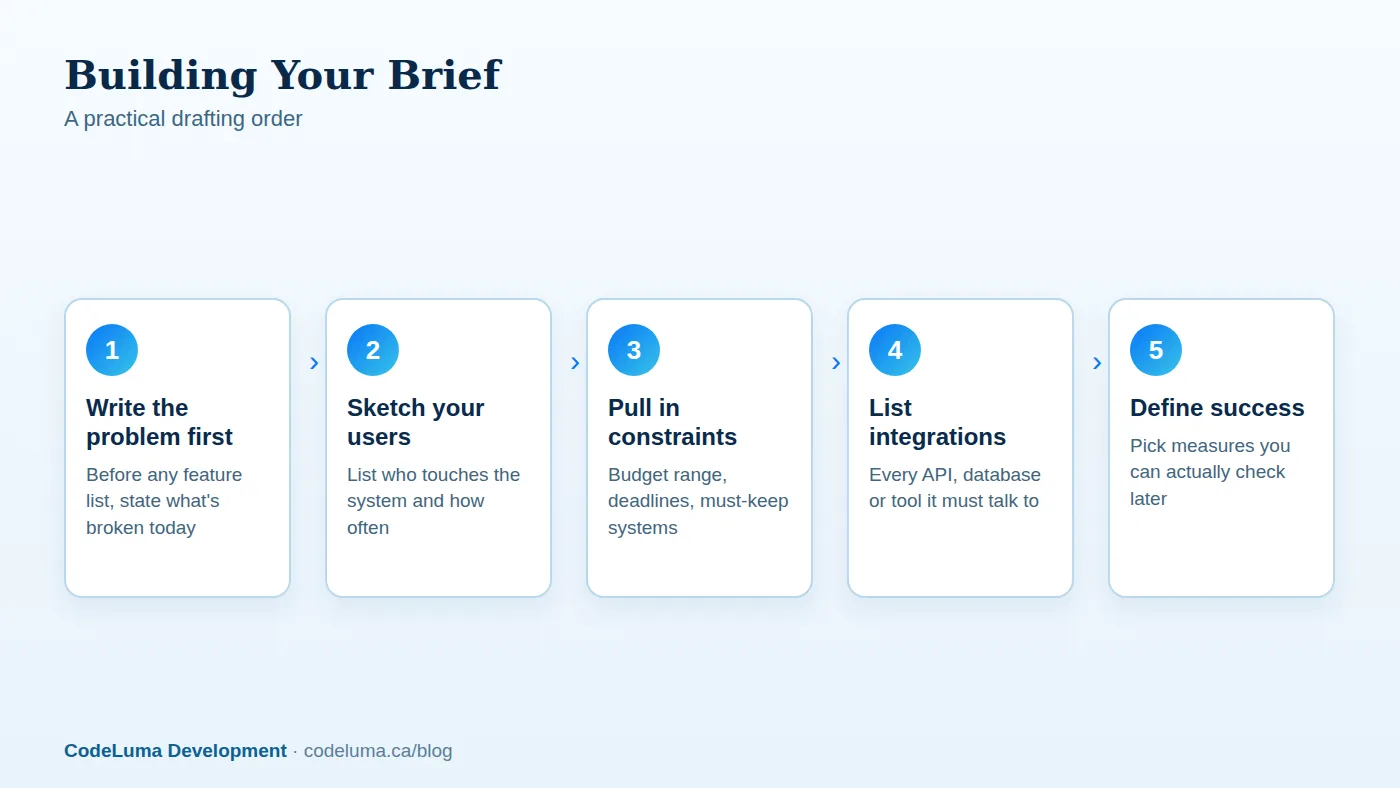
It's tempting to open a brief with a feature list, but features are your guess at a solution, not the problem itself. Lead with what's actually broken or missing today: a manual process that doesn't scale, data trapped in spreadsheets, a competitor doing something you can't match, customers asking for something you can't offer. A developer who understands the underlying problem can flag cheaper ways to solve it, or warn you early if a feature you asked for won't actually fix it. A developer who only sees a feature list can't do either.
Describe Your Users and How They'll Actually Use It
List who will use the system and in what context: internal staff at a desk all day, field workers on a phone with patchy signal, customers browsing on mobile at night, an administrator who logs in once a month to pull a report. This shapes real technical decisions, from whether the product needs to work offline to how much you invest in mobile layout versus desktop. It also affects the quote directly, since a tool used by three trained staff is a different build than a public-facing product used by thousands of strangers.
List Your Real Constraints
Budget range, timeline, and any systems that must stay in place are constraints, not details to mention later. A rough budget range, even a wide one, helps a developer propose something that fits instead of something impressive but unaffordable. A hard deadline changes what's realistic to build well. And if there's a piece of infrastructure you're not willing to replace, whether it's an accounting system, a hosting provider, or a database your team already knows, say so upfront so proposals don't get built around ripping it out.
What counts as a constraint
- A budget range you're comfortable sharing, even approximate
- A real deadline, and what happens if it's missed
- Systems or vendors you must keep or must avoid
- Internal resources available, like a designer or IT contact
- Compliance or industry rules that apply to your data
Name Every Integration You Already Depend On
Integrations are one of the biggest sources of surprise cost on any project, and they're also the thing business owners most often forget to mention because the tools are so familiar internally that they don't feel worth stating. List every system the new software needs to talk to: your accounting platform, your CRM, a payment processor, a shipping API, an existing customer database, single sign-on. Each integration has its own quirks, rate limits, and documentation quality, and a developer needs to know about them before pricing, not after the contract is signed.
Define What Success Looks Like
A brief should say how you'll know the project worked, in terms you can actually check later. That might be a measurable outcome like reduced manual data entry, or it might simply be a specific capability existing where it doesn't today. Avoid vague goals like "modernize our systems," since nobody can quote or later verify against a goal that isn't concrete. If you're not sure how to measure success yet, say that honestly in the brief rather than inventing a number you don't believe.
Show, Don't Just Tell: Include Examples and References
A few screenshots of your current process, a competitor's product you like a specific part of, or a rough sketch on paper can communicate more in thirty seconds than several paragraphs of description. You don't need polished mockups. Annotated screenshots of an existing spreadsheet or admin panel, with notes on what's frustrating about it, are often more useful to a developer than a wireframe, because they show the real data and real workflow instead of an idealized version of it.

Decide What's In Scope and What's Not
Separate what must exist at launch from what would be nice to have eventually. This is one of the hardest parts of writing a brief because everything feels important when you're the one who wants it built. Try sorting features into "the product doesn't work without this" and "we'd like this someday." A developer who can see both lists can price the must-haves accurately and tell you honestly whether the nice-to-haves are a quick add or a significant expansion. For a deeper look at making that cut, see our guide to must-have versus later scoping.
Common Mistakes That Sink a Brief
A few patterns show up again and again in briefs that produce unusable quotes:
- Leading with a tech stack instead of a problem. Naming a specific framework or platform before explaining what you're solving can lock developers into an approach that isn't actually the best fit.
- Omitting existing systems. Leaving out a tool because it "isn't part of the new project" often means it's actually an undisclosed integration.
- No mention of who decides. If three stakeholders need to approve scope and only one is in the conversation, timelines slip regardless of how good the quote was.
- Treating the brief as final instead of a starting point. A brief that invites questions produces a better quote than one that discourages them.
If you're evaluating multiple developers or agencies against each other, it also helps to know what a weak proposal looks like on the other side. Our piece on hiring red flags covers signs worth watching for once quotes start coming back.
How Much Detail Is Too Much
There's a balance to strike. A brief that's forty pages of exhaustive specification can be just as hard to quote against as one that's a single paragraph, because reviewers either skim it or get lost in details that don't affect pricing. Aim for enough detail that a competent developer could ask three or four clarifying questions and be ready to scope the work, rather than needing to reconstruct half the project from scratch. If you genuinely don't know the answer to something yet, such as exact reporting requirements, write "to be defined together" instead of guessing just to fill the section.
What Happens After You Send It
A good brief isn't the end of the conversation, it's the start of a better one. Expect clarifying questions back, and treat them as a good sign rather than a nuisance; a developer who asks nothing is more likely guessing than confident. Many studios, including ours, use the brief as the basis for a short custom software discovery conversation before finalizing any quote, since a document alone rarely captures everything a fifteen-minute conversation can surface. If your project is really a rebuild of something public-facing, that conversation often extends into web development specifics like hosting, performance targets, and search visibility that a written brief alone won't cover.
Wrapping Up
The point of a project brief isn't to write a perfect specification before any developer is involved. It's to give everyone quoting your project the same starting information, so the quotes you get back differ because of approach and judgment, not because each developer imagined a different project. Cover the problem, the users, your real constraints, the integrations you depend on, and how you'll measure success, and you'll spend a lot less time trying to compare numbers that were never actually comparable in the first place.
Put this into practice with CodeLuma
If you'd rather talk an idea through than write it up alone, CodeLuma offers a short discovery conversation that turns into a clear written brief before any quote is given. We ask the boring-but-important questions about integrations, users, and constraints so the proposal that comes back actually matches what you need built.
- Custom software development - tailored systems, integrations and internal tools.
- Website and web application development - fast, accessible, search-friendly builds.
- CodeLuma support - help from a real team when you need it.
Start a conversation. Tell us about your project and we will reply with practical next steps, or browse all CodeLuma services. CodeLuma Development Inc. is based in Nova Scotia and works with teams across Canada and remotely.