Every few years a new wave of teams asks the same question before writing a line of backend code: should this API be REST or GraphQL? The honest answer is that neither one is "better" in the abstract. They solve different problems, and the right choice depends on your data, your clients, and the people who will maintain the code after launch. This article walks through how to make that call with confidence instead of guesswork.
What REST Actually Gives You
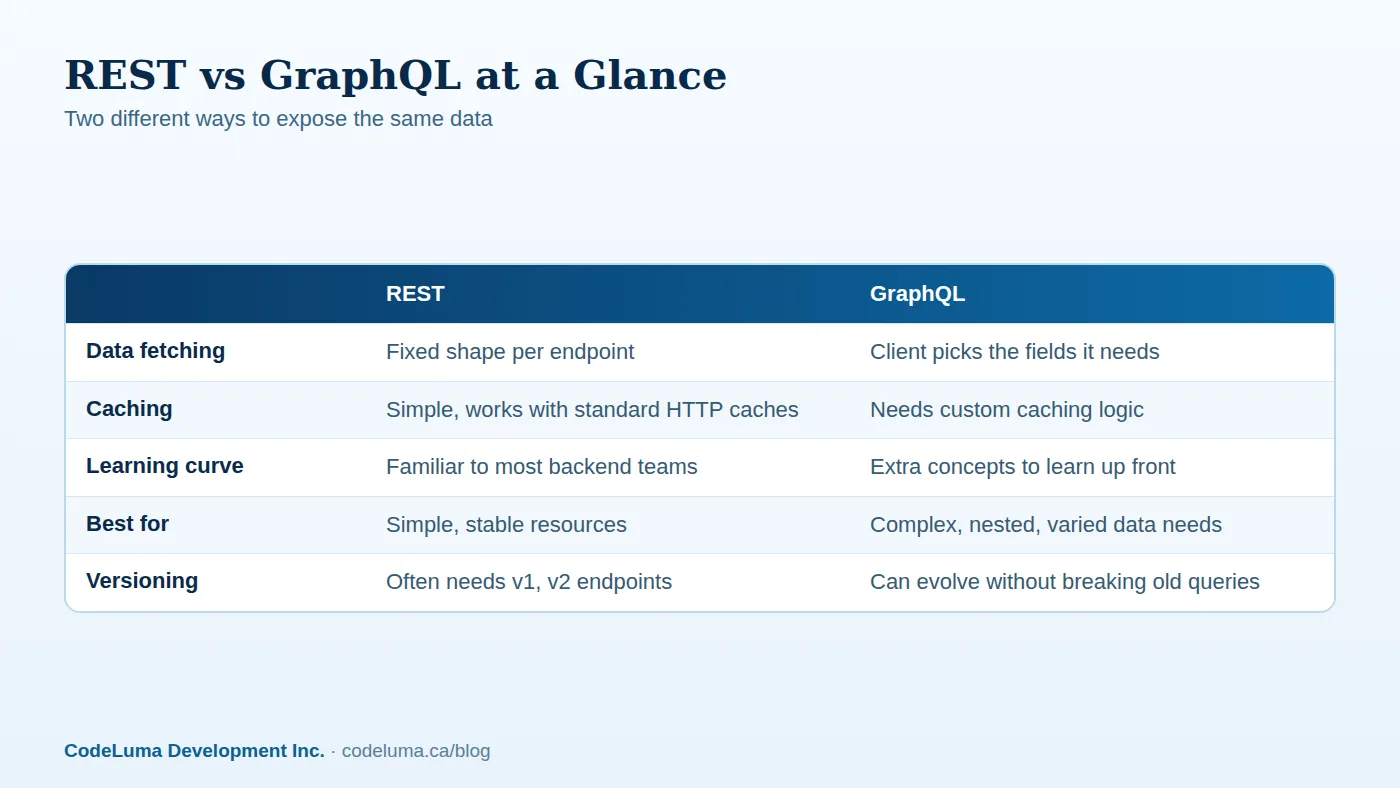
REST has been the default for web APIs for over two decades, and that's not an accident. It maps naturally onto HTTP: a URL represents a resource, and GET, POST, PUT and DELETE describe what you're doing to it. Because it leans on standard HTTP, REST plays well with browser caches, CDNs, and almost every tool a developer already knows. It's also easy to reason about: a request to /orders/482 returns an order, and that's that.
The trade-off shows up when your front end needs data from several resources at once. A mobile screen that shows an order, its customer, and recent support tickets might need three separate REST calls, or a bespoke endpoint built just for that screen. Over time, teams end up with either a lot of round trips or a sprawl of purpose-built endpoints that are hard to keep consistent.

What GraphQL Actually Gives You
GraphQL flips the model: instead of many fixed endpoints, you expose one endpoint and let the client describe exactly the fields and relationships it wants in a single request. That order-plus-customer-plus-tickets screen becomes one query instead of three calls, and the response contains only what was asked for, nothing more.
That flexibility comes with real costs. Caching is harder because every query can look different, so you lose the simple wins that HTTP caching gives REST for free. Query complexity needs to be watched, because a client can accidentally (or deliberately) ask for deeply nested data that's expensive to compute. And your team needs to understand schemas, resolvers, and how to prevent one bad query from slowing down the whole service.
Start With Your Data Shape, Not the Hype
The clearest signal is usually the shape of your data. If your product is built around a handful of independent resources, flat records like products, invoices, or support tickets, REST tends to stay simple for years. If your product is relationship-heavy, think a project management tool where a task has assignees, comments, attachments, and a parent project, GraphQL can prevent the endpoint sprawl that tends to show up in REST as those relationships grow.
A useful exercise: sketch three or four real screens in your product and list what data each one needs. If most screens map cleanly to one or two resources, REST is probably fine. If most screens need a custom blend of data from different parts of your system, that's GraphQL's strongest case.
Who's Actually Calling Your API
Think about your clients, not just your data. A single web app you fully control can absorb some REST inefficiency because you can tune the endpoints as you go. A product with a web app, a mobile app, and a handful of partner integrations, each wanting slightly different fields, is a much stronger GraphQL case, since each client can shape its own query instead of you maintaining separate endpoints for each.
If outside developers will consume your API, also weigh discoverability. REST with solid documentation is easy for an unfamiliar developer to explore endpoint by endpoint. GraphQL's schema is self-documenting in tools like introspection browsers, but it assumes the developer already understands the query model, which is a bigger ask for a partner integrating quickly.
Your Team's Skills Matter More Than the Spec
This is the part teams skip, and it's often the deciding factor. GraphQL done well, with proper query depth limits, batching, and caching strategy, takes real experience. GraphQL done poorly can be slower and harder to secure than the REST API it replaced. If your team has shipped GraphQL in production before, that experience is worth a lot. If this would be everyone's first GraphQL project under a real deadline, that's a legitimate reason to default to REST, or to bring in a team that has done this before for the API layer specifically.
The same logic applies to your future hires. REST skills are broadly available and transferable. GraphQL skills are common but slightly more specialized, which matters if you expect turnover or plan to hand this project to a different team later.
Caching and Performance Trade-Offs
REST's biggest quiet advantage is how naturally it works with existing caching infrastructure: browsers, CDNs, and reverse proxies all understand HTTP caching headers out of the box. That can meaningfully reduce server load with almost no extra engineering.
GraphQL requires you to build caching deliberately, usually at the application layer, because a single endpoint can't be cached the same way by generic infrastructure. This is solvable, and well-run GraphQL services do it successfully, but it's an additional piece of architecture you need to plan for rather than get for free. If your product depends on lean, predictable hosting costs, factor this in early rather than discovering it after launch.
Security, Rate Limiting and Abuse Considerations
With REST, rate limiting is straightforward: you cap requests per endpoint or per key, and the cost of each call is fairly predictable. With GraphQL, a single query can be cheap or extremely expensive to compute depending on how it's nested, so rate limiting by request count alone isn't enough. Teams running GraphQL in production typically add query complexity limits and depth limits so one query can't quietly overload the database. If you're exposing an API to outside partners under either style, it's worth reading our piece on API rate limiting before you finalize the design.

A Practical Decision Checklist
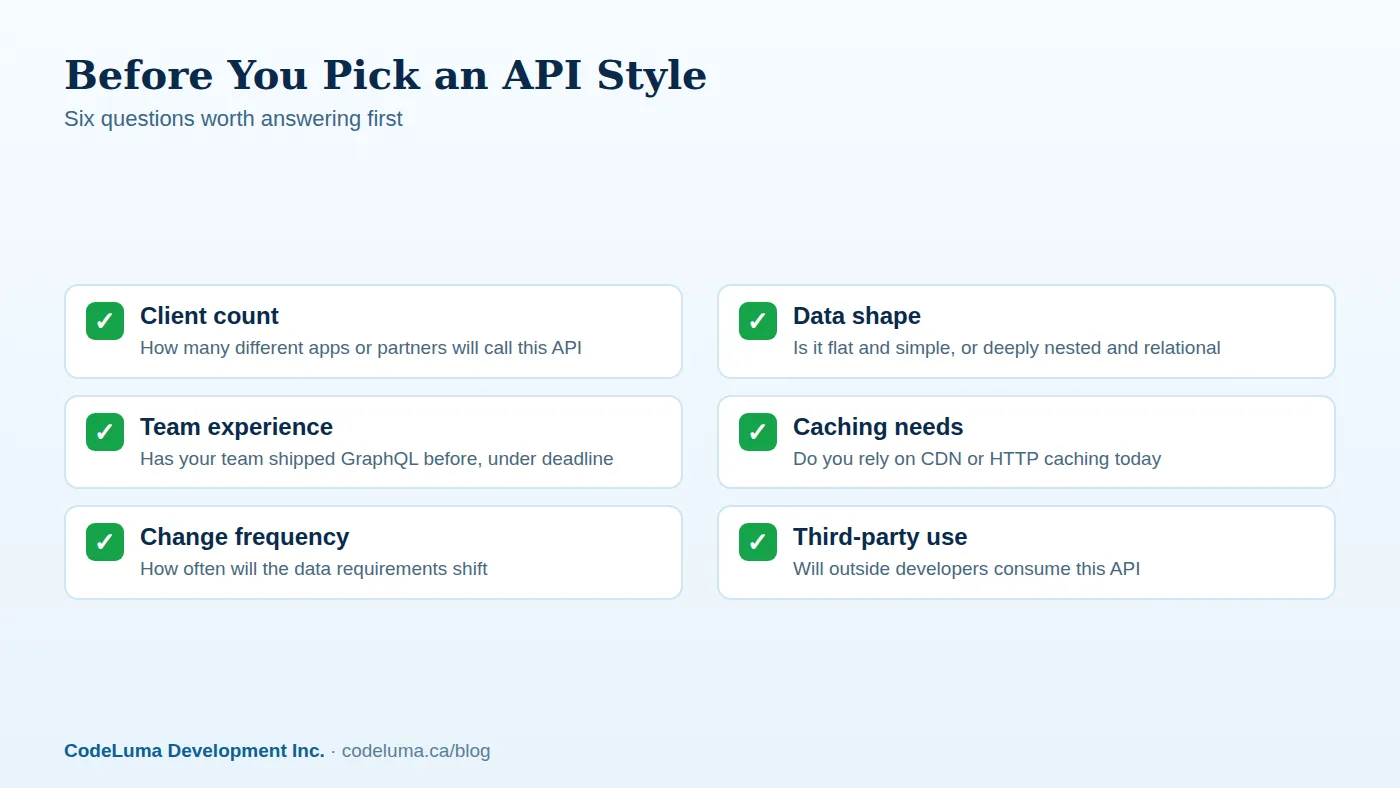
Before committing, work through this list with your team:
- Map three to five real screens or integrations and note how many resources each one touches.
- Count your distinct client types: web, mobile, partner integrations, internal tools.
- Ask honestly whether anyone on the team has shipped GraphQL in production.
- Decide how much you rely on simple HTTP or CDN caching today.
- Estimate how often your data requirements will change over the next year.
- If outside developers will use this API, weigh how much onboarding friction each option creates for them.
If most answers point toward simple, stable, few-client scenarios, REST is the lower-risk default. If they point toward complex, nested, many-client scenarios with a team that can support it, GraphQL earns its complexity.
Common Mistakes We See
A few patterns come up repeatedly, regardless of which style a team picks:
- Choosing GraphQL for its reputation, not the problem. It's often picked because it feels modern, then abandoned or patched around once caching and query cost become real issues nobody planned for.
- Building REST endpoints per screen instead of per resource. This creates the exact endpoint sprawl that made GraphQL attractive in the first place, without any of its benefits.
- Skipping query complexity limits in GraphQL. Without them, a single poorly written client query can slow down the whole API for everyone.
- Ignoring versioning strategy in REST. Data needs change; deciding how you'll evolve endpoints before you need to avoids painful v1/v2 duplication later.
- Treating the choice as permanent and irreversible. It's a real decision with real switching costs, but it's not the last one you'll ever make about this system.
Can You Mix Both?
Yes, and plenty of production systems do. A common pattern is REST for simple, stable, cache-friendly resources, like public product listings or static reference data, and GraphQL for the parts of the product with genuinely complex, client-specific data needs, like a dashboard aggregating several relationships at once. This isn't a compromise so much as using each tool where it's actually strong. It does mean maintaining two mental models, so it's worth it only when the complexity split is real, not just theoretical.
Wrap-Up
There's no universally correct answer to REST versus GraphQL, and anyone promising one hasn't looked closely at your product. The decision holds up best when it's grounded in your actual data shapes, your actual client mix, and what your actual team can support after launch, not what's trending in a conference talk. Spend the time mapping your screens and your team's experience before writing a schema or an endpoint, and whichever you choose will be easier to defend, and easier to live with, two years from now. If you want a second opinion on your current setup or help scoping a new one, our team can walk through your product's data and client needs with you directly.
Put this into practice with CodeLuma
CodeLuma designs and builds the API layer behind your product, and we pick REST, GraphQL, or a mix of both based on how your actual clients and data behave, not on trend. If you're mid-decision or already live with the wrong fit, we can review your current setup and map out what a change would realistically take.
- Custom software development - tailored systems, integrations and internal tools.
- Website and web application development - fast, accessible, search-friendly builds.
- Maintenance and support plans - updates, monitoring and ongoing improvement.
- CodeLuma support - help from a real team when you need it.
Start a conversation. Tell us about your project and we will reply with practical next steps, or browse all CodeLuma services. CodeLuma Development Inc. is a Canadian company that works with teams in Windsor, Essex, London, Toronto, Mississauga and across Ontario, throughout Canada and remotely.