You asked three developers for a quote. You got back three numbers, three page counts, and three very different documents that are supposedly about the same project. Comparing them by the total at the bottom feels efficient, but it's one of the easiest ways to pick the wrong partner. The proposal that looks cheapest on paper is often cheapest because it covers less, assumes more, or leaves the hardest decisions for later. This article walks through a simple way to score proposals side by side so you're comparing like with like, not just comparing digits.
Why the bottom-line number is misleading on its own
A single total price tells you almost nothing about what's inside it. Two developers can look at the same brief and produce wildly different quotes, not because one is overcharging, but because they've scoped the work differently. One might include a staging environment, QA passes, and a short support window after launch. Another might quote only the build itself and leave testing, deployment, and fixes as separate, unstated costs that show up later. Without reading the fine print, you can't tell which is which.
This is especially true if you sent out a short brief rather than a detailed one. If you haven't already, writing a clearer project brief before you request quotes will narrow the gap between proposals and make comparison much easier from the start.

Start with scope clarity
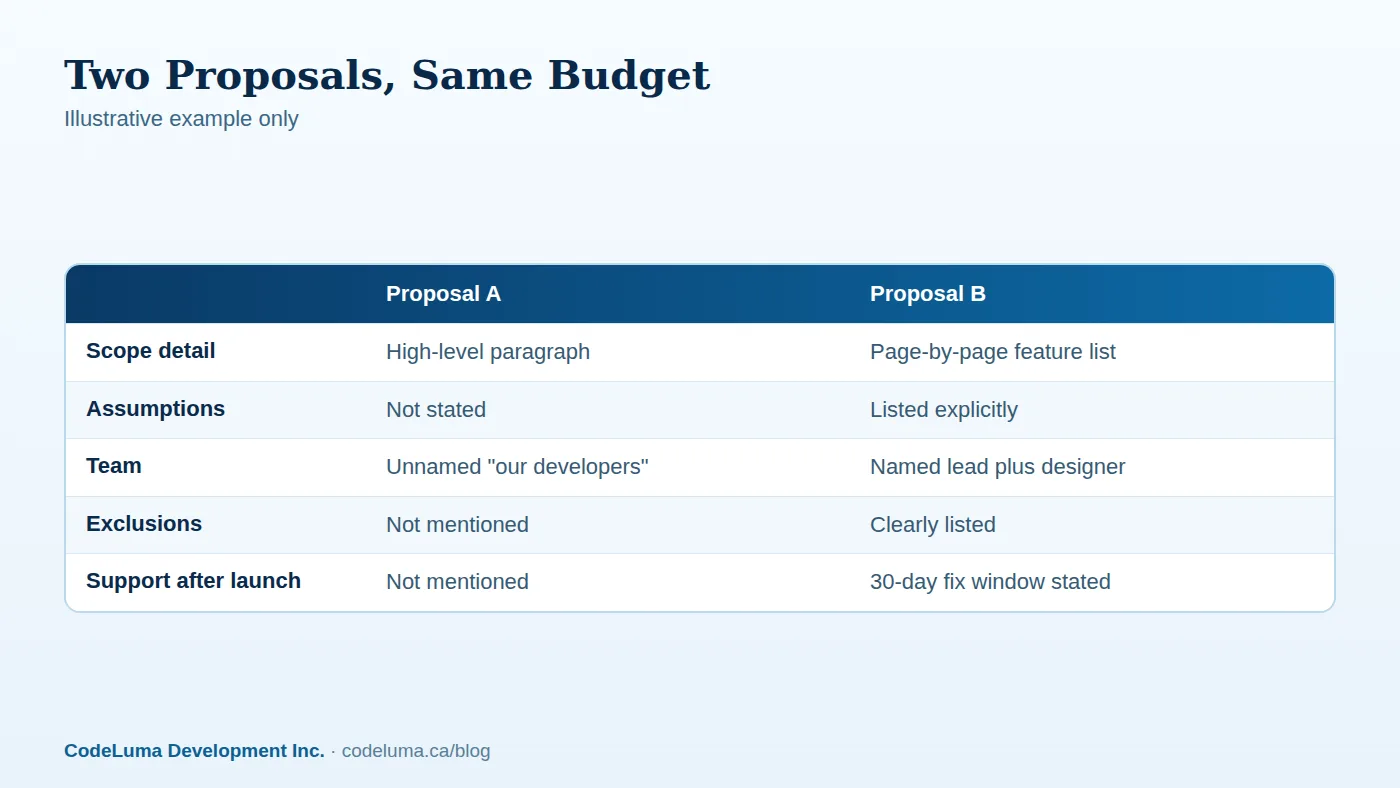
Read each proposal and ask a blunt question: could a stranger read this and know exactly what will be built? Vague language like "develop a modern website with the features we discussed" is a red flag, because "the features we discussed" means something different to you than it does to them, and that gap tends to surface as a change order later. A strong proposal lists pages, screens, user roles, or core workflows by name. It describes what a user can actually do when the project is finished, not just the general category of product.
Score this on a simple scale: does the document name specific deliverables, or does it describe a general direction? The more specific, the easier it is to hold either side accountable later.
Read the assumptions section carefully
Every honest proposal includes assumptions, because no developer can promise a fixed number without conditions. The assumptions section is where you learn what has to be true for that price to hold. Common ones include a fixed number of revision rounds, a cap on the number of pages or user roles, an expectation that you'll supply content and images by a certain date, or reliance on a specific third-party service staying available and affordable.
Proposals that skip this section aren't necessarily more confident, they're often just less thorough, and the assumptions still exist, you just won't see them until something outside the stated scope comes up mid-project. Weigh a proposal with a detailed assumptions list higher than one with none at all, even if the one with none has a lower number.
Look past job titles to the actual team makeup
"Our team will handle this" is not the same as knowing who is actually doing the work. Ask, or look for, whether the proposal names a lead developer, describes how many people will touch the project, and clarifies whether any part of the work is subcontracted out. This matters more for ongoing products than for a single static site, because the people who build something are usually the ones best positioned to fix or extend it later.
It's reasonable to ask a follow-up question here if the proposal doesn't say. A studio that can clearly answer "who specifically works on this" is giving you useful signal about accountability and continuity.
Check the communication plan
Some proposals state how often you'll get updates, what the point of contact looks like, and what tools will be used for day-to-day communication. Others say nothing, which usually means communication will be reactive rather than scheduled. For anything beyond a very small project, a stated cadence, whether that's a weekly check-in, a shared task board, or scheduled demos, is worth scoring highly, because poor communication is one of the most common reasons timelines slip and expectations drift apart.
Exclusions matter as much as inclusions
This is the section people skip, and it's often the most important one. A good proposal tells you plainly what is not included: maybe that's content writing, stock photography, third-party account setup, ongoing hosting, or post-launch bug fixes beyond a short window. If a proposal doesn't list exclusions, don't assume everything is covered. Ask directly, in writing, what's out of scope. You want this answer before you sign, not after you've received an invoice for "additional work" you assumed was part of the build.
A simple scoring sheet you can reuse
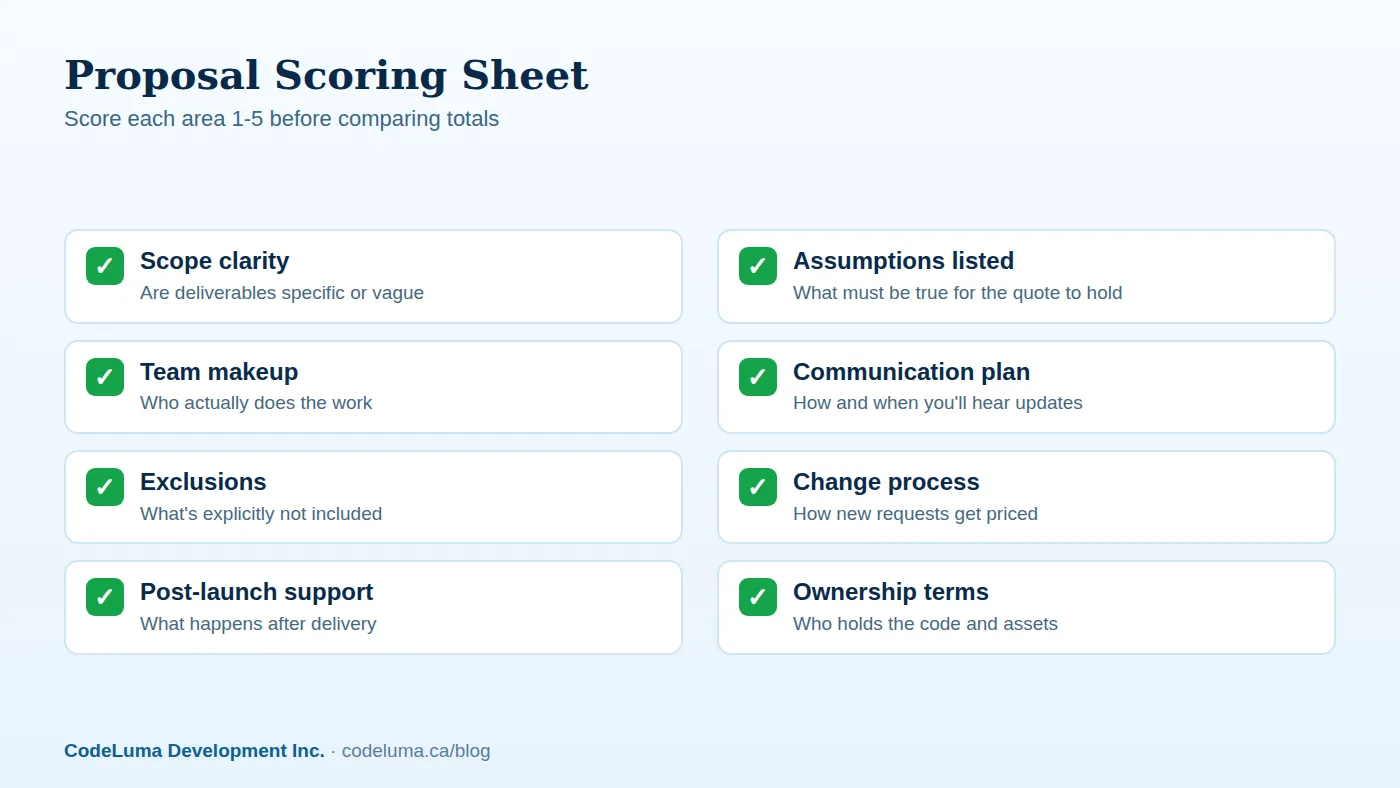
Score each proposal from 1 to 5 on the following, then compare totals alongside price rather than instead of it:
- Scope clarity — are deliverables specific and named, or described in general terms?
- Assumptions — are the conditions behind the price spelled out?
- Team makeup — do you know who is actually doing the work?
- Communication plan — is there a stated cadence and point of contact?
- Exclusions — is it clear what you are not paying for?
- Change process — does it explain how new requests get priced and approved?
- Post-launch support — is there any stated window for fixes after delivery?
- Ownership terms — does it say you'll own the code, assets and accounts at the end?
Add the scores up and look at the total next to price. A proposal that scores low across the board but comes in cheap is a bet on everything going smoothly, and projects rarely go perfectly smoothly.

Common mistakes when comparing quotes
A few patterns show up again and again when business owners compare proposals:
- Comparing totals without comparing scope. A lower number attached to a smaller scope isn't actually cheaper, it's just incomplete.
- Treating silence as inclusion. If a proposal doesn't mention something, that almost always means it's not included, not that it's assumed to be free.
- Ignoring the change process. Projects change. A proposal that doesn't explain how changes get priced is setting up a disagreement later.
- Skipping questions out of politeness. Asking a developer to clarify assumptions or exclusions before you sign is normal procurement practice, not an insult.
- Assuming the most detailed proposal is overpriced. Sometimes it just reflects a more realistic read of the work involved.
Ask the same questions of every bidder
Fair comparison depends on asking every developer the same follow-up questions, not just the ones who left gaps in their proposal. If you ask one bidder to clarify their assumptions, ask the others too, even if their document looked complete. This keeps the comparison even and gives you a clean basis for scoring, rather than penalizing the most transparent proposal simply because it raised more questions on the surface.
What good proposals tend to have in common
Across industries, the proposals that lead to smoother projects tend to share a few traits: they describe the work in terms you can picture, they tell you what has to be true for the price to hold, they name who's doing the work, they set expectations for how you'll communicate, and they tell you plainly what you're not getting for that price. None of that guarantees a good outcome on its own, but it removes a lot of the ambiguity that turns into disputes later. If you're also evaluating whether to outsource the build entirely or bring in a longer-term partner, it's worth reading how to avoid common pitfalls when outsourcing web development alongside this comparison process.
Wrap-up
The bottom-line number is the easiest thing to compare and the least useful one on its own. Scope clarity, assumptions, team makeup, communication plans, and exclusions tell you far more about what you're actually buying and how the relationship is likely to go once the contract is signed. Use a simple scoring sheet, ask the same follow-up questions of every bidder, and treat a detailed proposal as a sign of a developer who has actually thought through your project, not as a developer trying to pad the price. Whether you need custom software development or a more standard website build, a proposal that holds up to this kind of scrutiny is one you can plan a budget and a timeline around with some confidence.
Put this into practice with CodeLuma
CodeLuma writes proposals with scope, assumptions, and exclusions spelled out in plain language, so you can compare us against anyone else on a level footing. If you'd like a second opinion on a proposal you've already received, we're happy to review it with you before you sign anything.
- Custom software development - tailored systems, integrations and internal tools.
- Website and web application development - fast, accessible, search-friendly builds.
- Maintenance and support plans - updates, monitoring and ongoing improvement.
- CodeLuma support - help from a real team when you need it.
Start a conversation. Tell us about your project and we will reply with practical next steps, or browse all CodeLuma services. CodeLuma Development Inc. is a Canadian company that works with teams in Windsor, Essex, London, Toronto, Mississauga and across Ontario, throughout Canada and remotely.