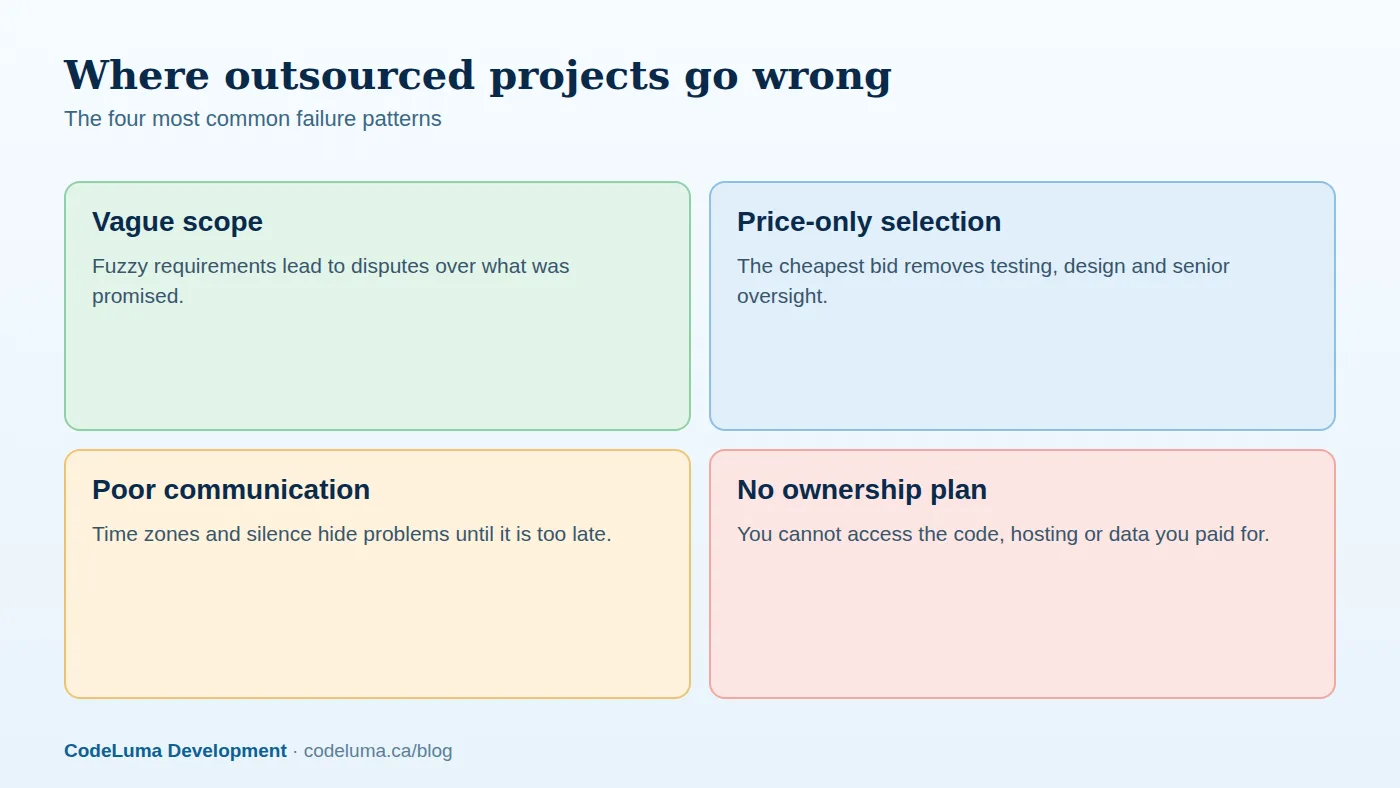
Outsourcing web development is a sensible choice for most businesses. Hiring a full in-house team is expensive and slow, and specialist skills are only needed for parts of a project's life. Yet stories of failed outsourcing are common: sites that never launch, code nobody can maintain, agencies that disappear, invoices that keep growing. Almost all of these failures come from a handful of avoidable mistakes. This guide shows how to avoid them.
Start by getting clear on what you need
Outsourcing goes wrong first on your side of the table, when the requirements are vague. Before you contact a single vendor, write a short brief covering:
- The business goal: what should be different after launch, and how will you measure it?
- The users: who they are and what they need to do.
- The must-have features for the first release, separate from nice-to-haves.
- Integrations and data: systems that must connect, and existing content or records to migrate.
- Constraints: budget range, deadline drivers, compliance, brand requirements.
- Examples of sites or apps you like and dislike, with reasons.
Sharing a budget range is not a mistake. It helps a good partner propose the right approach and filters out those who cannot deliver within your reality.

Where to look, and what to look for
Referrals from other business owners are the best source, followed by portfolios and reviews. Whichever route you choose, evaluate on substance:
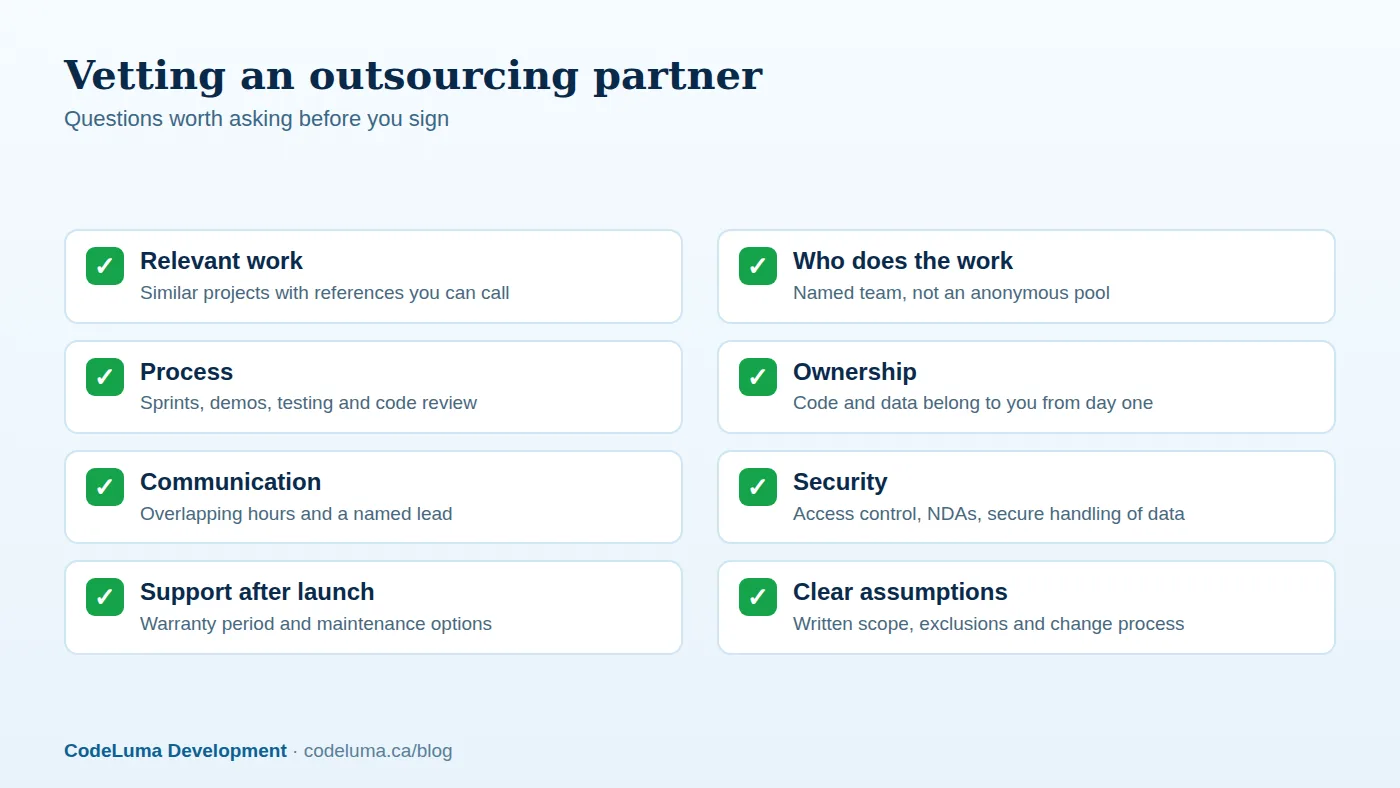
- Relevant experience. Have they built something like your project? Can you speak to a past client?
- Working software you can see. Live sites and apps you can try beat polished slide decks.
- A clear process. Ask how they discover, plan, build, test and release. Vague answers are a warning.
- Who will do the work. A strong sales lead is not a strong delivery team. Ask to meet the people involved.
- Technical judgement. Do they recommend simple, maintainable approaches and explain trade-offs, or do they push the latest trend?
- Honesty. A good partner will tell you what to cut, and sometimes that you do not need what you asked for.
Be wary of the lowest bid
Price matters, but a bid far below the others is usually missing something: testing, security review, design, project management, senior oversight or realistic estimates. Ask what is included and what assumptions the price depends on. Compare proposals line by line. When you get a large gap, ask the low bidder to walk you through how they will deliver at that price. The answer tells you a lot.
Choose a contract that fits the project
For well-defined work, a fixed price with clear deliverables and acceptance criteria gives budget certainty. For evolving work, time-and-materials with a budget cap and regular reviews offers flexibility. In either case, insist on the following:
- Ownership. You own the source code, designs and data, with the transfer effective as you pay. Get access to the code repository from day one.
- Payment tied to milestones, not just time, with a portion held until acceptance.
- A change process. How new requests are estimated, approved and scheduled.
- Warranty. A period after launch in which defects are fixed at no charge.
- Confidentiality and data-protection terms appropriate to your business.
- Exit terms. How the relationship can end and how handover works.
Have a lawyer review any significant agreement; this article is general information, not legal advice.
Structure communication so problems surface early
Most project failures are communication failures. Agree the rhythm up front: a named project lead on each side, a weekly demo of working software, a shared task board you can view at any time, and a single channel for day-to-day questions. Time zones matter less than responsiveness, but at least a few hours of overlap each day will save weeks. Insist on seeing working software early; if a vendor cannot show progress after a few weeks, treat that as a red flag.

Protect your access and your data
Keep control of the critical assets from the beginning:
- Register the domain and hosting accounts in your own name, and give the vendor delegated access.
- Use a repository under your organisation's account.
- Keep credentials in a password manager and use individual accounts, never shared logins.
- Store backups where you can reach them.
- Insist on documentation: setup instructions, architecture notes and deployment steps.
Plan the handover and the after-launch period
Software does not end at launch. Discuss maintenance, monitoring, hosting and support before you sign, including response times and cost. A vendor that offers a clear maintenance and support plan is planning for the long term. Ask what happens if you want to bring the work in-house or move to another provider; a confident partner will make that easy.
Warning signs to watch during the project
- Demos are postponed or consist of slides instead of working software.
- Estimates change without explanation.
- The team keeps changing without notice.
- Questions about code access or hosting are met with resistance.
- Requests for large payments without corresponding progress.
If you see these signs, address them directly and early. The best partnerships handle awkward conversations calmly, because both sides want the project to succeed.
A simple selection process
Shortlist three partners, share the same brief, and hold a short call with each. Ask for a proposal with phases, assumptions and exclusions, check two references, and start with a small paid discovery phase to test the working relationship before committing to the whole build. That step alone prevents most outsourcing disasters.
Put this into practice with CodeLuma
CodeLuma works as an accountable, transparent development partner: clear scope, weekly demos, direct access to the people doing the work, and full ownership of the code and data transferred to you.
- Custom software development - tailored systems, integrations and internal tools.
- Website and web application development - fast, accessible, search-friendly builds.
- CodeLuma support - help from a real team when you need it.
Start a conversation. Tell us about your project and we will reply with practical next steps, or browse all CodeLuma services. CodeLuma Development Inc. is a Canadian company that works with teams in Windsor, Essex, London, Toronto, Mississauga and across Ontario, throughout Canada and remotely.