Most founders want to build the software first and find customers second. A concierge MVP flips that order: you deliver the actual result your customer wants, by hand, before you write any code. It feels slower and less impressive, but it's one of the most reliable ways to learn what's actually worth building.
What a concierge MVP actually is
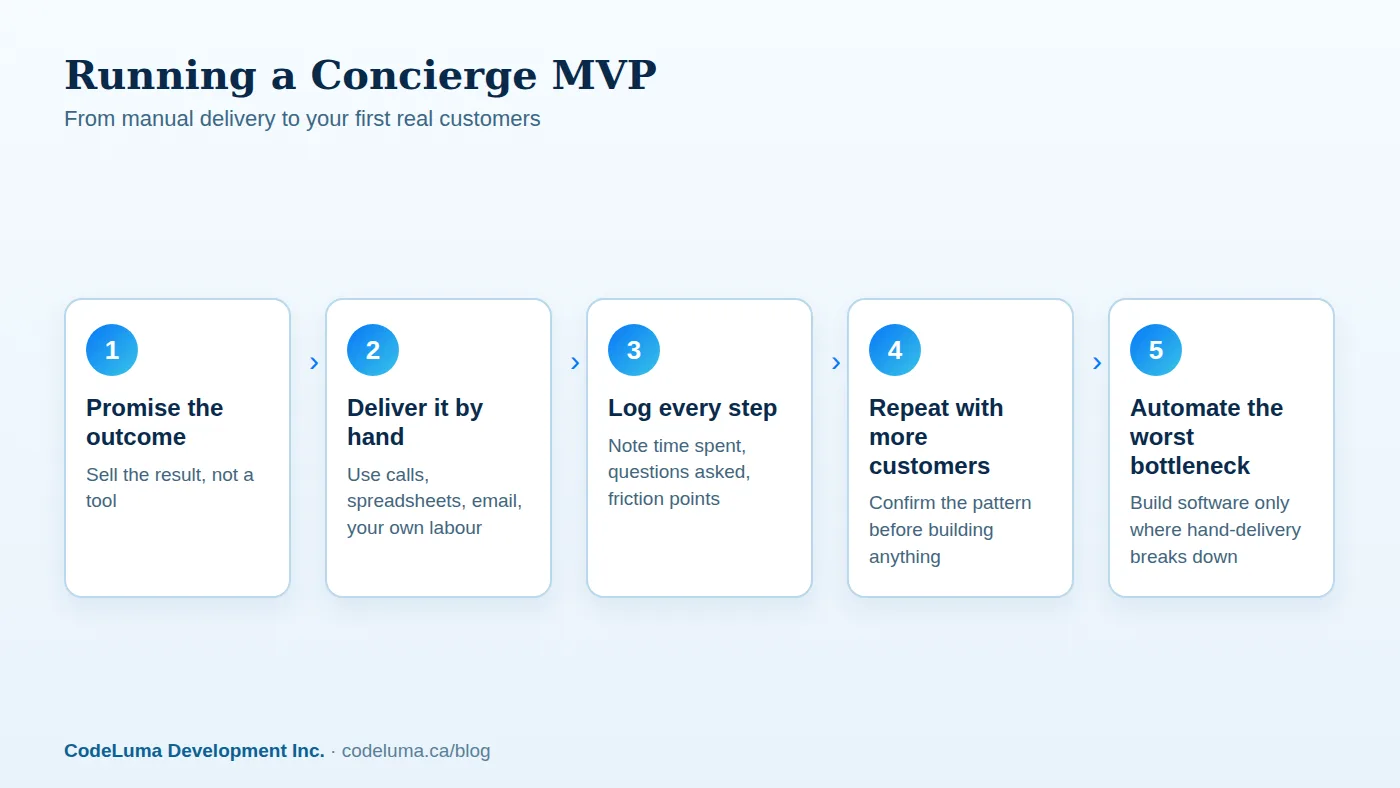
A concierge MVP means you personally do the work your software would eventually automate. If you're building a meal-planning app, you email customers their weekly plan yourself. If you're building a scheduling tool for tradespeople, you take the booking calls and text the confirmations. The customer gets the outcome they were promised. They usually don't know - and don't need to know - that a human is doing the work behind the scenes.
This is different from a prototype or a demo. A concierge MVP is a real, working service. Customers pay (or at least commit) for a real result, and you deliver it, just without the automation layer.

Why deliver it by hand first
Code is expensive to build and even more expensive to unbuild. Every workflow you automate before you've tested it with real customers is a guess wearing the costume of a decision. Doing the work manually first replaces that guess with evidence.
It also forces you to confront the parts of the business that founders like to skip past in a pitch deck: how do you actually get customers to respond, what do they ask that you didn't expect, where does the process stall. Software can't fix problems you haven't found yet.
When a concierge MVP makes sense
This approach works best when:
- You're not sure which parts of the workflow customers actually value
- The service can plausibly be delivered by one or two people for a small number of customers
- You need to validate willingness to pay, not just willingness to sign up
- The cost of building first and being wrong is high relative to the cost of your time
It's less useful if the value is entirely in speed or scale from day one - a trading platform or a high-volume consumer app can't fake the experience by hand. In those cases, a narrower fake door test to measure demand may fit better than a full concierge run.
How to run it without losing the lesson
A concierge MVP only pays off if you treat it as research, not just as a way to serve a few early customers. Structure it on purpose:
- Define the outcome you're promising in one sentence, and keep every manual step pointed at that outcome.
- Pick a small, real cohort of customers - five to fifteen is usually plenty to start.
- Build a simple log (a spreadsheet or even sticky notes on a wall works fine) for every step you take on their behalf.
- Time yourself. Minutes spent per step tell you more than opinions about what's "hard."
- Collect the exact questions and complaints customers raise, in their own words.
What to track while you're doing the work
The whole point of staying manual is the data you collect while you do it. At minimum, record:
- Time spent per customer, broken into individual steps
- Which steps you dread repeating (that's a signal, not just a feeling)
- Where customers get confused or go quiet
- What customers ask for that you didn't originally offer
- Which steps are easy to batch across multiple customers at once
A plain notebook or shared doc is fine for this. The format doesn't matter. What matters is that you write it down instead of trusting memory, because memory tends to flatter the parts you enjoyed and skip the parts that were tedious but important.
Deciding what to automate first
Once you have a few weeks of real delivery behind you, look at your log and sort each step by two things: how often it happens, and how much it hurts (time, errors, or your own willingness to keep doing it).
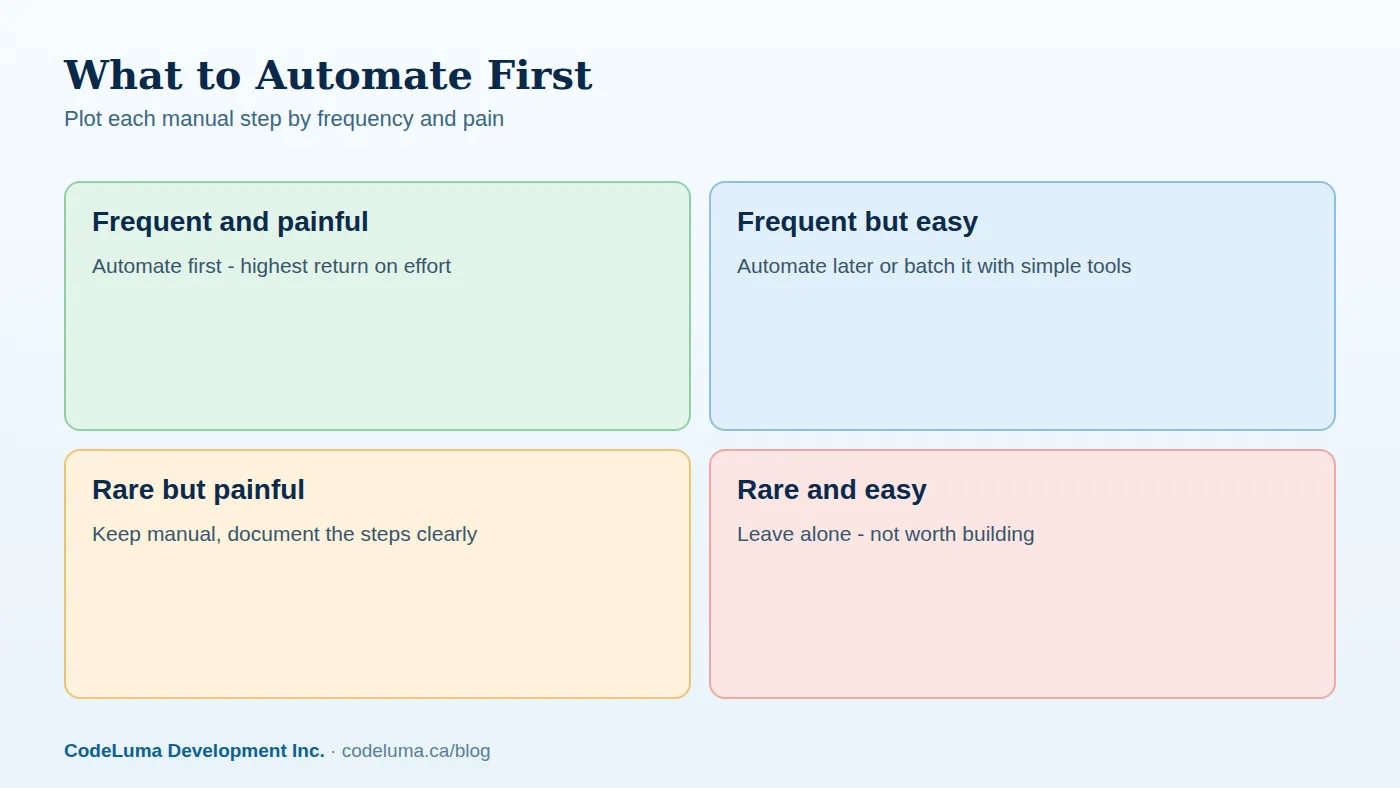
Steps that are both frequent and painful are your first automation target - they're where software replaces real, repeated cost. Frequent-but-easy steps can often wait, or be handled with a simple template or script rather than a full build. Rare-but-painful steps are usually fine to keep doing manually and just document well. Rare-and-easy steps aren't worth your attention at all yet.
This sorting exercise is also a good input into a proper must-have vs. later filter once you move from concierge delivery into an actual build.
An illustrative example
Picture a founder testing a service that curates and ships a monthly box of local products to subscribers. In the concierge phase, they personally pick the items, pack the boxes, write the shipping labels, and email each customer a short note about what's inside. After six weeks with a dozen customers, their log shows that writing the personalized note takes the most time per box but gets the most positive replies, while label printing and tracking updates are repetitive but low-value busywork customers barely mention.
That pattern (illustrative, not a real case) would point toward automating labels and tracking first, and keeping the personal note manual or semi-manual longer, since it's part of what customers actually value. Without running the service by hand first, that priority would have been a guess.

Common mistakes with concierge MVPs
- Treating it as free labour instead of research. If you're not logging what you learn, you're just working for free.
- Hiding that it's manual when honesty would build trust. You don't need to announce it, but don't actively lie about how the service works.
- Running it with too many customers at once. You'll burn out and the data gets noisy. Start small and deliberate.
- Automating the fun parts first instead of the painful ones. Build toward what your log shows, not what interests you to build.
- Staying manual too long out of fear of the build. Once a step is clearly validated, repeated, and painful, delaying automation just caps your growth.
Knowing when to stop and build
There's no fixed timeline for this, and anyone who promises you one is guessing. The honest signal to watch for is repetition: once you're doing the same steps, in the same order, for enough customers that the pattern feels boring rather than surprising, you likely have enough evidence to build against. If every customer still reveals something new about the workflow, you're probably not ready to automate yet - you're still learning what the product is.
When you do get there, bring the log with you. A clear, time-stamped record of what you did by hand is one of the most useful documents you can hand to a development team, because it replaces assumptions with a real specification. If you're working with an outside team on the build, it pairs well with a one-page MVP brief so the first automated version matches what you actually proved works.
A short checklist before you automate
- You've delivered the service manually to a real, paying (or committed) cohort
- You have a written log of time spent and friction per step
- You can name the one or two steps that are both frequent and painful
- You've distinguished "customers love this" from "customers tolerate this"
- You know which steps should stay manual for now, on purpose
From there, the build itself is a normal custom software project - but one grounded in evidence instead of assumptions. Many teams also pair the first automated version with a web application front end so customers can self-serve the parts you've proven work, while keeping the trickier steps manual a little longer.
Wrap-up
A concierge MVP isn't a shortcut and it isn't glamorous. It's slower, by design, because the slowness is where the learning happens. Done well, it tells you exactly which parts of your idea customers actually value and which parts were never worth building in the first place. That's a far better foundation for a first release than a guess, however confident it feels.
Once you're ready to move from manual delivery to a real build, having a team that can turn your concierge log into working software - and keep it running afterward through a maintenance plan - makes that transition a lot less risky. If you get stuck partway through, CodeLuma support is also there to help you sort out what to build next.
Put this into practice with CodeLuma
CodeLuma works with founders after the concierge phase to turn the manual workflow you've already proven into properly built software. We help you figure out which steps actually deserve engineering effort first, so the build matches what your early customers showed you, not what you assumed on day one.
- Custom software development - tailored systems, integrations and internal tools.
- Maintenance and support plans - updates, monitoring and ongoing improvement.
- CodeLuma support - help from a real team when you need it.
- Website and web application development - fast, accessible, search-friendly builds.
Start a conversation. Tell us about your project and we will reply with practical next steps, or browse all CodeLuma services. CodeLuma Development Inc. is a Canadian company that works with teams in Windsor, Essex, London, Toronto, Mississauga and across Ontario, throughout Canada and remotely.