If you've ever had a customer, auditor, or procurement officer ask "where exactly does our data live," you already know this isn't an academic question anymore. Canadian data residency — the idea that certain data must be stored and processed inside Canada — has moved from a niche compliance topic to something business owners and product teams need a real answer for. The good news is that getting this right doesn't require a total rebuild. It requires knowing why the requirement exists, what it actually covers, and which decisions matter.
What "data residency" actually means
Data residency refers to the physical location where data is stored, and sometimes where it's processed and backed up. It's a narrower idea than data privacy. A system can be fully PIPEDA-compliant and still store data on servers in Virginia — residency is specifically about geography, not just about consent and handling practices. Some contracts and rules care about storage location only; others also care about where data is processed in transit, and where support staff accessing that data are located. Read the actual clause or regulation carefully, because the scope varies more than people expect.

Where the requirement actually comes from
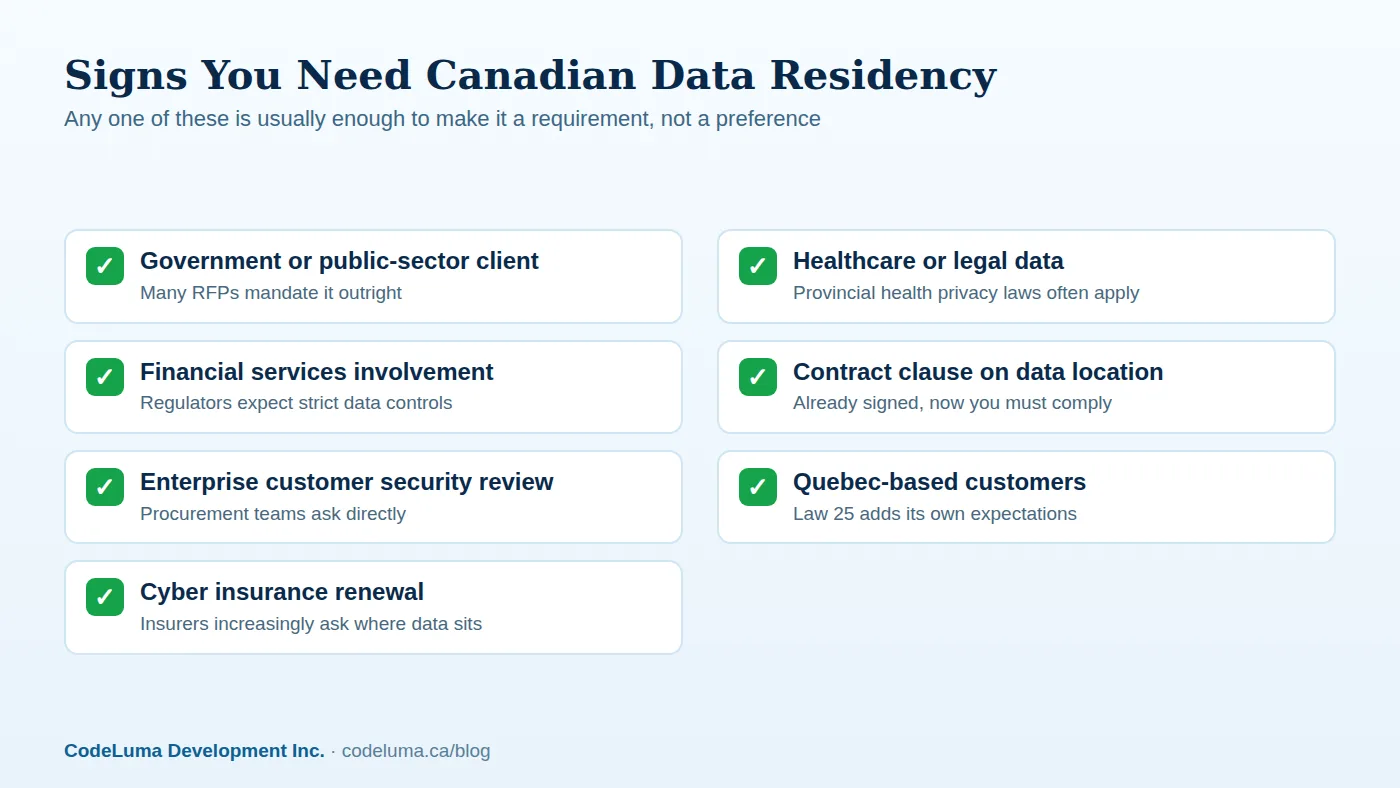
In our experience, Canadian data residency requirements show up from three directions, and it's worth knowing which one you're dealing with because the fix differs:
- Contracts. A government agency, bank, or enterprise customer writes a data location clause into the master services agreement or RFP. This is the most common source, and it's usually non-negotiable once signed.
- Sector rules. Some provincial health privacy statutes and public-sector policies effectively require Canadian storage for certain categories of personal health or citizen data. Rules vary by province and by data type, so this needs a specific legal read for your situation rather than a general assumption.
- Customer expectations. Even without a formal rule, Canadian customers increasingly ask about data location as part of basic trust — especially after a few years of public conversation about cross-border data access laws in other countries.
None of these are hypothetical anymore. If your app already serves government, healthcare, legal, or financial clients, assume someone will ask, and have an answer ready before the RFP lands.
What Canadian cloud regions actually offer
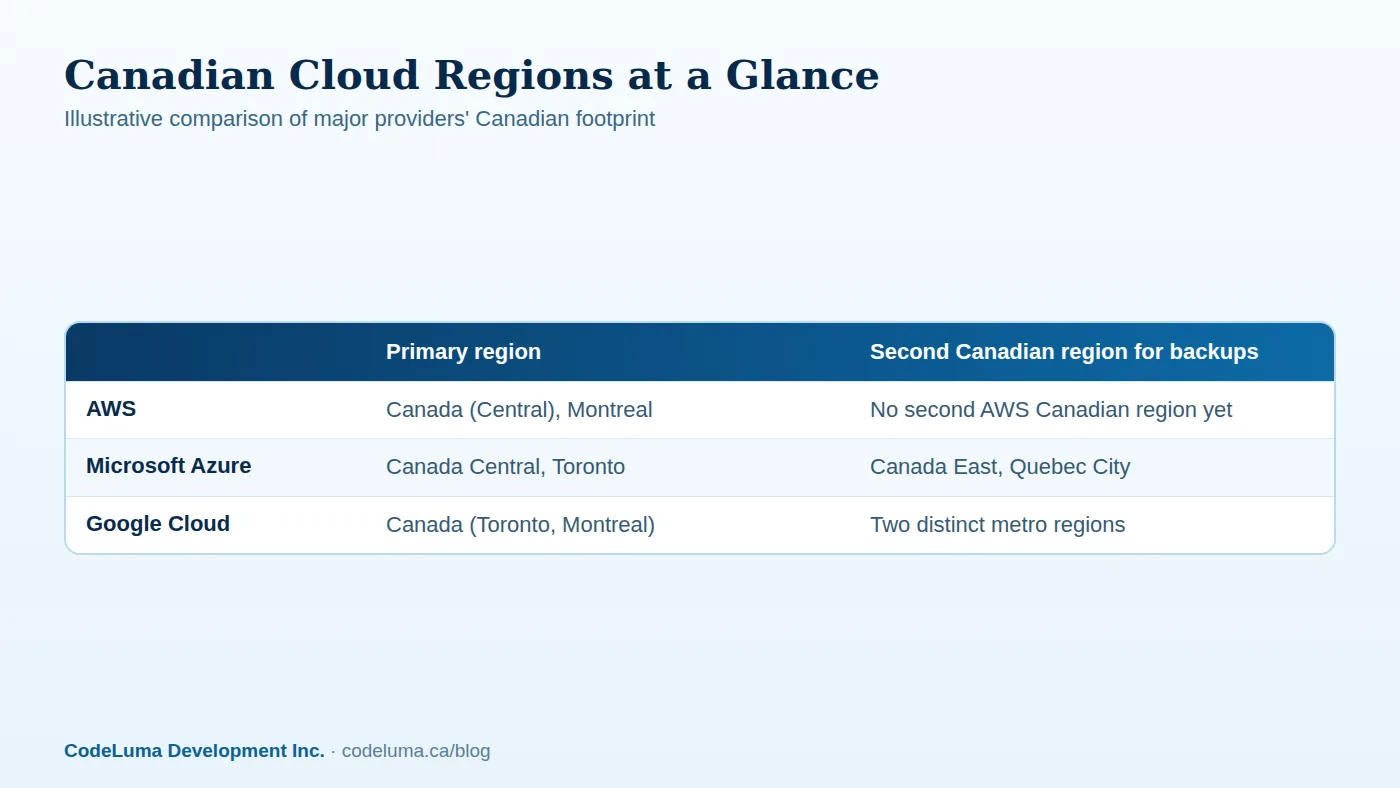
All three major hyperscale providers — AWS, Microsoft Azure, and Google Cloud — operate data centre regions physically located in Canada, typically around Toronto, Montreal, and Quebec City. Choosing a Canadian region for storage and compute is usually straightforward from a technical standpoint: it's a configuration choice at setup, not a different product. The harder part is making sure every piece of your stack respects that choice — database, backups, file storage, logging, and any third-party service you've bolted on.
This is also where smaller, Canadian-owned hosting providers fit in. They're not always cheaper or faster than the hyperscalers, but for some contracts "Canadian-owned company, Canadian data centre" satisfies a requirement more cleanly than "foreign-owned company, Canadian region." Read your contract's exact wording before assuming either option clears the bar.
Questions to ask a vendor before you sign
Whether you're picking a cloud provider directly or evaluating a SaaS tool that will touch customer data, ask these before committing, not after:
- Where is primary storage located, specifically — not just "Canada," but which region?
- Where are backups and disaster-recovery copies stored?
- Does any support, logging, or monitoring data cross the border, even temporarily?
- Do any embedded third-party services (email delivery, analytics, payment processing, error tracking) store or transmit data outside Canada?
- Will they put the data location commitment in writing, in the contract itself — not just in a sales deck?
That last point matters more than people think. A vendor's marketing page saying "data stays in Canada" isn't a contractual guarantee. If residency is a real requirement for you, it needs to be a clause, not a claim.
Practical steps to make an app Canada-resident
If you're starting from an existing app that wasn't built with this in mind, here's a realistic path:
- Map every place data actually lands. Database, file storage, backups, email service, analytics, error logging, third-party APIs. This step alone usually surfaces two or three services nobody remembered were storing anything.
- Classify what actually needs to be Canada-resident. Not every byte needs the same treatment. Customer records might; anonymized product analytics often doesn't. Being precise here avoids over-engineering the whole system.
- Choose region and vendor deliberately, using the questions above, and get the commitment in writing.
- Migrate or re-point services one at a time, starting with primary storage, then backups, then the smaller dependent services.
- Re-verify after launch. Cloud configurations drift; a new backup job or logging integration can quietly send data outside Canada months later.
This kind of migration is a good fit for a focused custom software engagement rather than a DIY weekend project, mainly because step 1 — mapping where data actually lands — is easy to underestimate.

Common mistakes
A few patterns come up repeatedly:
- Assuming "cloud region" covers everything. Teams set the main database to a Canadian region and stop there, missing that their email provider, payment processor, or error-tracking tool stores data elsewhere.
- Treating a marketing claim as a contractual guarantee. If it's not written into the agreement, it's not enforceable.
- Over-applying the requirement. Locking down every byte of data to Canada when only a specific data category actually needs it adds cost and complexity for no real benefit.
- Forgetting backups and disaster recovery. Primary storage is Canadian; the disaster-recovery copy quietly isn't.
- Confusing residency with privacy compliance. Satisfying a residency clause doesn't automatically mean you're meeting PIPEDA requirements or, for Quebec-facing products, Law 25 obligations. They're related but separate checklists.
A quick checklist before you commit to a region or vendor
- Have you read the actual contract clause or sector rule word for word, not a summary?
- Do you know which specific data categories are in scope, and which aren't?
- Have you mapped every service — including third-party tools — that touches that data?
- Does your chosen provider's Canadian region cover storage, backups, and processing?
- Is the data location commitment written into your vendor contract?
- Do you have a plan to re-verify this periodically, not just at launch?
What data residency doesn't solve
It's worth being honest about the limits here. Keeping data physically in Canada doesn't automatically make your app secure, doesn't satisfy consent and disclosure obligations under privacy law, and doesn't protect you from a poorly configured database or a weak access control setup. Residency answers "where," not "how safely" or "who can see it." Those are separate, ongoing concerns that belong in your regular maintenance and monitoring practice, not a one-time migration project.
Wrap-up
Canadian data residency is rarely about nationalism or preference — it's almost always a specific contract clause, sector rule, or customer expectation that you can trace back to its source. Once you know which one applies to you, the decisions get a lot more concrete: which region, which vendor, which data categories, and what to put in writing. Treat it as a mapping-and-verification exercise rather than a vague compliance goal, and it stops being intimidating. If you're not sure where your own data actually sits right now, that's the first thing worth finding out, with help from the support of a team that's done this mapping before.
Put this into practice with CodeLuma
CodeLuma helps teams map where their data actually lives, choose Canadian-friendly hosting and vendors, and rebuild data flows so contracts and sector rules are satisfied without slowing the product down. We've guided clients through exactly this kind of region and vendor selection as part of {{svc:hosting}} and {{svc:software}} engagements.
- Managed hosting - monitored, backed-up, Canadian-friendly hosting.
- Custom software development - tailored systems, integrations and internal tools.
- Maintenance and support plans - updates, monitoring and ongoing improvement.
- CodeLuma support - help from a real team when you need it.
Start a conversation. Tell us about your project and we will reply with practical next steps, or browse all CodeLuma services. CodeLuma Development Inc. is a Canadian company that works with teams in Windsor, Essex, London, Toronto, Mississauga and across Ontario, throughout Canada and remotely.