Every API eventually needs to change. A field gets renamed, a response shape gets restructured, a new required parameter shows up because the business rules shifted. The problem isn't the change itself — it's that somewhere, a partner's integration is calling your API exactly the way it worked last Tuesday, and it has no idea anything is different until it starts throwing errors. API versioning is how you make room to improve your product without pulling the floor out from under the people depending on it.
Why Breaking an Integration Is Worse Than It Looks
When you change a user interface, your own users see the new version and adapt in the moment. An API has no such feedback loop. The "users" are other people's code, often written months or years ago by a developer who has since moved on, running unattended on a schedule or in response to events. A breaking change doesn't announce itself to anyone — it just fails silently until an order doesn't sync, an invoice doesn't generate, or a partner's dashboard goes blank. By the time someone notices, you're fielding a support ticket instead of a planned conversation.
This is why versioning isn't a "nice to have" for APIs with any outside consumers — internal teams, partner integrations, mobile apps that can't be force-updated. It's the mechanism that separates "we improved the API" from "we broke someone's production system."

Three Ways to Signal a Version
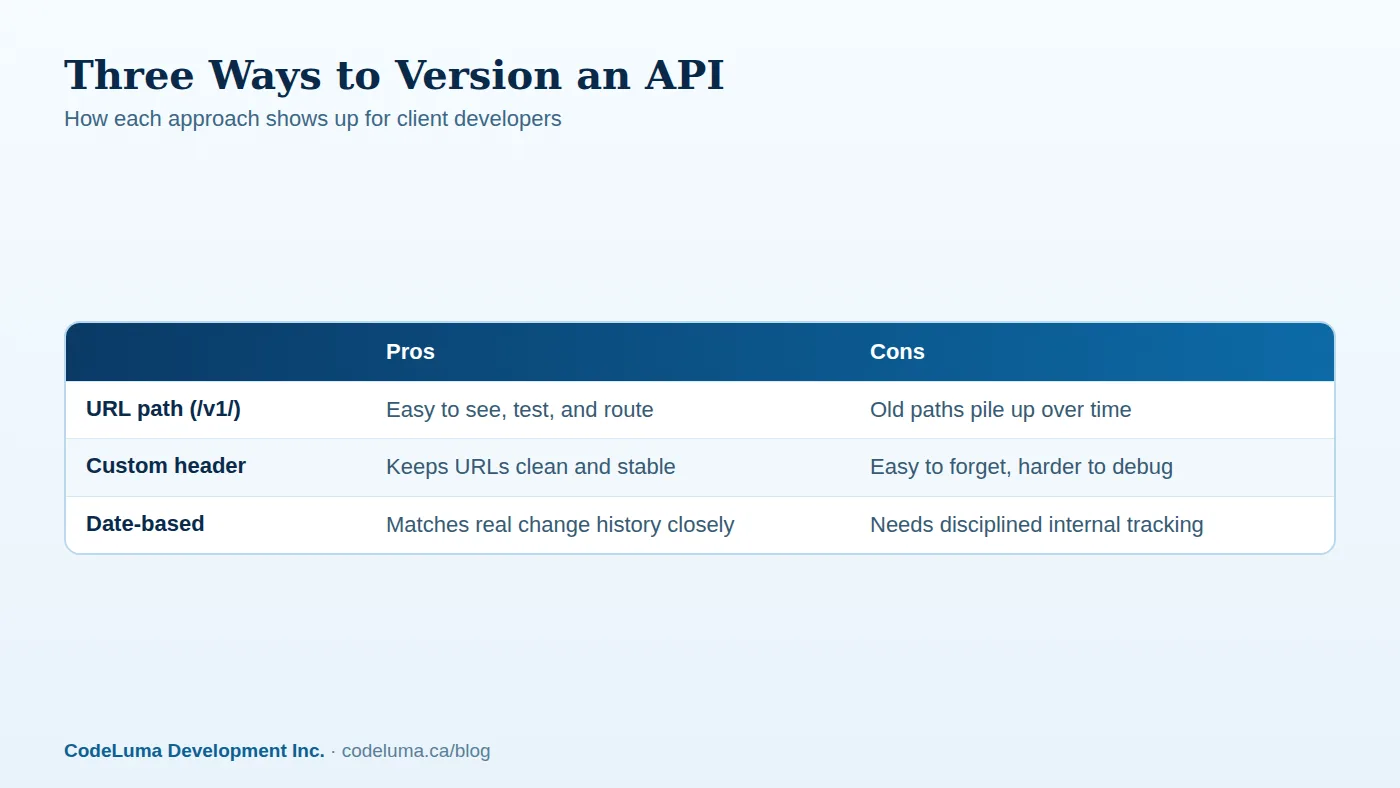
There are three common patterns for telling a client which version of your API it's talking to. None of them is objectively "correct" — they trade off differently depending on who your consumers are and how often you expect to change things.
URL Versioning: Simple and Visible
This is the pattern most developers meet first: the version lives right in the path, like /v1/orders or /v2/orders. Its biggest strength is visibility. Anyone reading a log file, a browser tab, or a support ticket can see exactly which version was called, with no extra inspection required. It's also trivial to route at the infrastructure level — a load balancer or reverse proxy can send /v1/ and /v2/ traffic to entirely different services without touching application code.
The downside shows up over time. Every version you keep alive means duplicate routes, duplicate documentation, and often duplicate logic to maintain side by side. Teams that version aggressively at the URL level can end up running three or four versions in parallel, each with its own quirks, long after they intended to.
Header Versioning: Clean URLs, Hidden Complexity
Header-based versioning keeps the URL identical across versions — /orders stays /orders — and the client specifies a version in a request header, such as Accept: application/vnd.yourapi.v2+json or a custom header like X-API-Version: 2. This keeps your URL structure stable and arguably more "correct" from a REST design standpoint, since the resource identifier doesn't change just because the representation does.
The trade-off is discoverability. A header is invisible unless someone goes looking for it, which makes debugging harder and makes it easy for a client to omit the header entirely and get a default version they didn't intend. It also means caching and logging infrastructure needs to be aware of the header, since two requests to the same URL can now mean two different things.
Date-Based Versioning: Built for Continuous Change
Instead of numbered versions, some APIs tag each release with a date — a client requests a specific date snapshot of the API's behavior, often via a header like X-API-Version: 2026-03-01. This pattern shines when an API changes frequently in small increments rather than in big numbered jumps. It gives you a precise historical record of exactly what behavior existed on any given day, which is useful both for support conversations and for internal auditing.
It does require more internal discipline: you need a changelog that maps every date to the specific behavior differences, and your codebase needs a clean way to serve multiple date-pinned behaviors from the same underlying logic rather than sprawling into if/else branches everywhere.
Which Approach Fits Your Product
If your API has a small number of partners and changes infrequently in large, deliberate jumps, URL versioning is usually the easiest to reason about and the simplest for partners to self-serve against. If you're building something closer to a platform with many external consumers and you want your URLs to stay stable as a long-term contract, header versioning is worth the added debugging overhead. Date-based versioning tends to fit internal or semi-internal APIs that change often and need tight traceability — it's less common for small partner integrations because it asks more of the client's implementation.
There's no requirement to pick only one forever. Many teams start with URL versioning because it's the least to explain to a new partner, and introduce header-based version negotiation later once they have enough consumers that the URL clutter becomes a real cost. If you're also deciding between API styles more broadly, our piece on REST vs. GraphQL covers a related decision that shapes how versioning plays out in practice.

Setting a Deprecation Policy Partners Can Plan Around
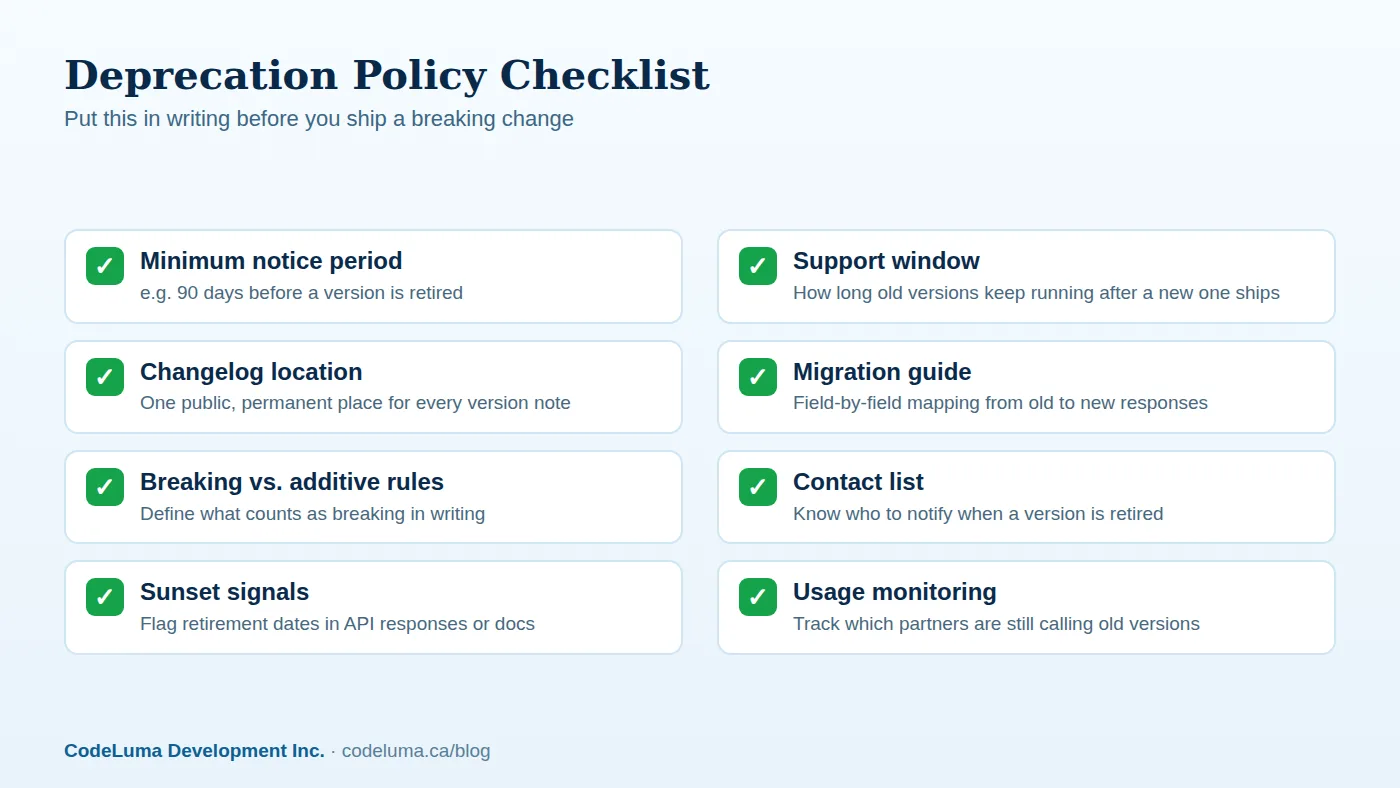
Versioning only solves half the problem. The other half is deciding, in writing, how long an old version stays alive and how you tell people it's going away. Without a stated policy, "deprecated" tends to mean nothing — partners have no way to know whether they have a year or a week before something stops working, so they either ignore your warnings or over-engineer against a timeline you never actually intended.
A workable policy answers a few questions before you ever need to retire a version: how much notice do partners get, where do they find out, and what happens if they miss the deadline. Write this down once, publish it, and apply it consistently — consistency is what makes partners trust the next version bump instead of dreading it.
Steps for Rolling Out a New Version Safely
- Design the new version alongside the old one. Don't retrofit — build v2 as a parallel path so v1 keeps serving traffic untouched while you build and test.
- Publish a migration guide before you announce the deadline. Partners need something concrete to work from, not just a notice that change is coming.
- Add deprecation signals to the old version's responses. A header or field noting a sunset date gives automated monitoring on the partner's side something to catch.
- Track who's still calling the old version. Usage logs tell you whether it's safe to retire on schedule or whether you need to reach out directly first.
- Retire on the date you promised. Slipping the deadline repeatedly teaches partners to ignore your deprecation notices entirely.
This is the kind of ongoing discipline that benefits from a dedicated owner rather than being squeezed in between feature work — it's a big part of why an ongoing maintenance plan tends to catch version-related issues before partners do.
Common Mistakes That Erode Trust
- Treating "beta" or "unversioned" endpoints as safe to change silently. If any partner is calling it, it needs a version and a policy, no exceptions.
- Bundling unrelated changes into one version bump. It makes it harder for partners to isolate what actually affected their integration.
- No changelog, or a changelog scattered across release notes, emails, and Slack messages. Partners need one place to check.
- Removing a version the moment the new one ships. Even a short overlap window avoids turning every release into an emergency for someone.
- Assuming internal tools don't need versioning. Internal dashboards and automation break just as easily as external integrations, and often with less warning.
Rate limits and outages are the other side of the same coin — if you haven't already, it's worth reading our guide to API rate limiting and how to handle third-party API outages gracefully, since a solid versioning policy and a resilient integration strategy usually get built at the same time.
Wrap-Up
None of the three versioning patterns is wrong — URL, header, and date-based versioning all work well for the right kind of API and the right kind of partner base. What actually protects your integrations is pairing whichever pattern you choose with a deprecation policy you write down, publish, and actually follow. That combination is what turns "we shipped a breaking change" from a partner emergency into a scheduled, low-drama event. If you're building an API from scratch or trying to introduce versioning into one that's already live, our custom software development team can help you design a structure that holds up as your product and your partner list both grow.
Put this into practice with CodeLuma
CodeLuma designs and builds APIs with versioning strategies baked in from the start, so your product can evolve without a partner's integration quietly breaking. We also help teams retrofit versioning onto an existing API that's already outgrown its first design.
- Custom software development - tailored systems, integrations and internal tools.
- Maintenance and support plans - updates, monitoring and ongoing improvement.
- CodeLuma support - help from a real team when you need it.
- Managed hosting - monitored, backed-up, Canadian-friendly hosting.
Start a conversation. Tell us about your project and we will reply with practical next steps, or browse all CodeLuma services. CodeLuma Development Inc. is a Canadian company that works with teams in Windsor, Essex, London, Toronto, Mississauga and across Ontario, throughout Canada and remotely.