Modern applications lean on many services you do not control: payment processors, shipping carriers, email and SMS providers, identity platforms, mapping and search services, analytics, AI models. The uptime of your application is therefore bounded by the uptime of everything it depends on, and even excellent providers have bad days. What separates a resilient system from a fragile one is not whether dependencies fail, but what your application does when they do. This guide covers the patterns that turn outages into minor inconveniences.
Assume failure and classify your dependencies
List every external dependency and ask two questions: how critical is it to core functions, and what should happen when it is unavailable? A failed analytics call should never break checkout. A failed payment gateway should never lead to double charges. Classify dependencies as critical, important or optional, and design the behaviour for each failure explicitly. Also consider the different failure modes: total outage, slow responses, partial failures, incorrect data, rate limiting and changed behaviour after an unannounced update. Slow is often worse than down, because slow calls tie up threads and connections and spread the failure through your system.

Timeouts: never wait indefinitely
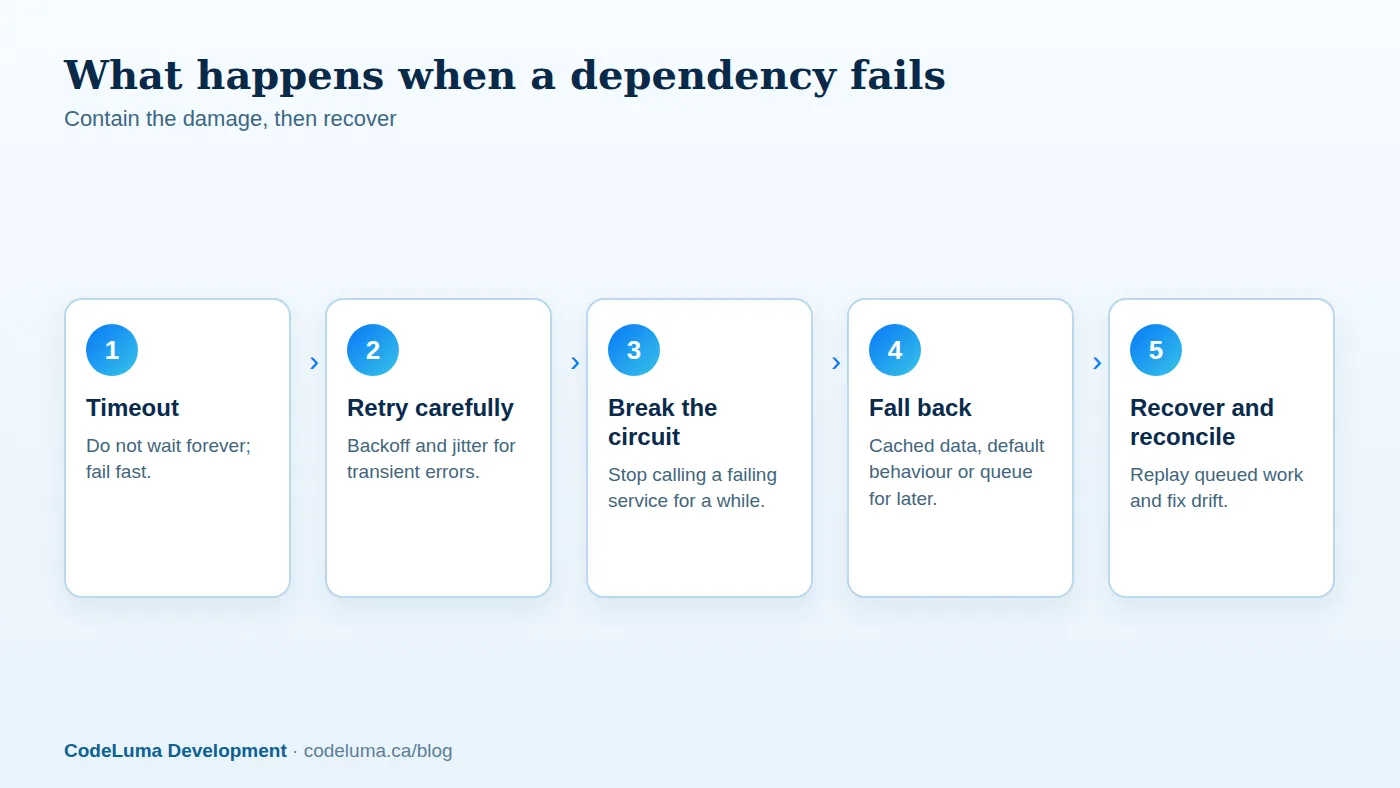
Every network call must have a timeout, for connecting and for reading the response. Without one, a hung dependency can exhaust your servers' worker pool and take your whole application down. Choose timeouts based on the user experience and the dependency's normal performance, generally short for interactive requests, and consider an overall deadline for the entire operation so that chains of calls cannot exceed it. Use the same discipline for database and cache calls.
Retries: helpful when disciplined, harmful when not
Many failures are transient, and a retry succeeds. But naive retries make outages worse by multiplying load on a struggling service. Follow these rules:
- Retry only idempotent operations, or use idempotency keys so repeating a request has no extra effect. This is critical for payments and orders.
- Use exponential backoff with random jitter so retries from many clients do not synchronise into waves.
- Cap the number of attempts and total retry time.
- Retry only errors likely to be transient, such as timeouts and 5xx responses, not validation errors or authorisation failures.
- Respect rate-limit headers and retry-after guidance.
Circuit breakers: stop hammering a failing service
A circuit breaker monitors calls to a dependency. When failures exceed a threshold, it opens, and subsequent calls fail immediately without attempting the network request, giving the dependency time to recover and preventing your resources being consumed by doomed requests. After a cooling period the breaker half-opens, allowing a few trial calls, and closes again if they succeed. Breakers let you switch quickly to fallbacks and make failure cheap. Configure thresholds per dependency, log state changes and surface them in dashboards.
Bulkheads: isolate the damage
Ships have bulkheads so a leak in one compartment does not sink the vessel. Do likewise in software: give each dependency its own connection pool, worker pool or concurrency limit, so a slow shipping API cannot consume all your threads and block unrelated requests. Separate critical paths such as checkout from optional features such as recommendations. Use timeouts and concurrency limits to bound the damage any single dependency can do.
Fall back gracefully
A fallback is what your application does instead. Options include:
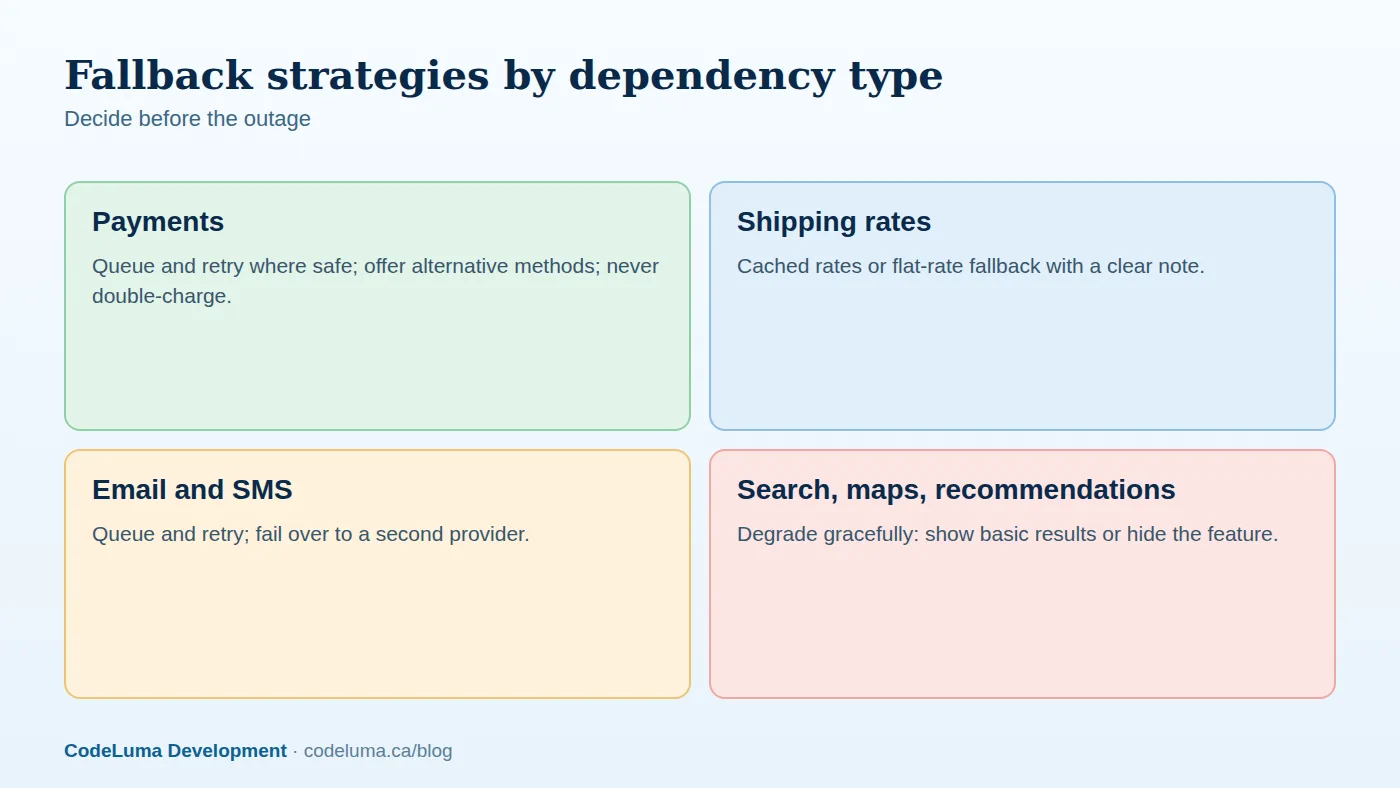
- Serve cached data. Slightly stale product recommendations, exchange rates or shipping estimates beat an error page. Use stale-while-revalidate approaches; see our caching guide.
- Use defaults. A flat shipping rate or a generic delivery estimate, with honest messaging.
- Switch providers. Fail over from one email or SMS provider to another, or from one payment method to another.
- Queue for later. Accept the request, store it durably and process it when the dependency returns, telling the user what to expect. Suitable for emails, webhooks, data syncs and many non-immediate operations.
- Degrade the feature. Hide the map, show basic search results, disable the recommendation carousel.
- Fail clearly. When there is no safe fallback, such as payment authorisation, show a helpful message, preserve the user's cart and inputs and suggest trying again shortly.
Use queues to decouple
Where possible, do not call third parties inside the user's request. Enqueue the work and let background workers handle retries, rate limits and backoff. The user gets an immediate response, and outages become backlogs rather than errors. Monitor queue depth and age, and provide a way to replay or repair failed items. The patterns in our integration guide and our synchronisation guide apply directly.

Make operations idempotent and reconcile afterwards
After an outage, you will find requests whose outcome is unknown: did the payment go through before the timeout? Design so you can find out: store a unique request ID, query the provider by that ID, and use webhooks to learn final states. Run reconciliation jobs comparing your records with the provider's and repair differences. Never assume a timeout means failure; it often means "unknown."
Watch your dependencies
Monitor the health of each dependency from your side: error rates, latency, breaker states and queue depth, and subscribe to providers' status pages and incident feeds. Alert when dependency errors rise, distinguishing your problems from theirs. Track third-party SLAs and incident history when choosing and reviewing vendors. Use synthetic checks of critical flows. See our monitoring guide.
Be transparent with users
When a dependency impacts customers, tell them honestly: a banner explaining that card payments are delayed and offering alternatives, or a status page with updates. Clear communication reduces support load and preserves trust. Prepare templates and decide who can post updates.
Test failure on purpose
Resilience you have not tested is a hope. Simulate failures in staging: block a dependency, add latency, return errors and malformed responses, and expire credentials. Verify timeouts fire, breakers open, fallbacks work, alerts trigger and recovery is clean. Chaos experiments in production, carefully controlled, build confidence for mature teams. Run game days so people practise the response. Our article on surviving traffic spikes describes similar rehearsal practices.
Reduce dependency where sensible
Every dependency is a risk. Ask whether you need it, whether a simpler in-house implementation would be adequate for non-differentiating functions, and whether multiple providers are worth the cost for critical ones. Keep provider-specific code behind interfaces so switching is feasible. Review dependencies regularly and retire the ones no longer justified.
If your application has a habit of going down when someone else does, an architecture review from our software team can identify the weak links and add the protections, and a maintenance plan keeps monitoring and resilience under continuous attention.
Put this into practice with CodeLuma
CodeLuma builds applications that keep working when payment gateways, shipping APIs and other dependencies stumble, using timeouts, circuit breakers, queues and sensible fallbacks, and monitors them so you know before customers do.
- Custom software development - tailored systems, integrations and internal tools.
- Maintenance and support plans - updates, monitoring and ongoing improvement.
- Managed hosting - monitored, backed-up, Canadian-friendly hosting.
Start a conversation. Tell us about your project and we will reply with practical next steps, or browse all CodeLuma services. CodeLuma Development Inc. is a Canadian company that works with teams in Windsor, Essex, London, Toronto, Mississauga and across Ontario, throughout Canada and remotely.