If your API has no rate limiting, it isn't really a public API — it's an open invitation for one misbehaving script, one runaway retry loop, or one enthusiastic integration partner to take down the service for everyone else. Rate limiting isn't about distrust. It's the mechanism that lets you promise a consistent experience to every consumer, including the well-behaved ones who never come close to hitting a limit.
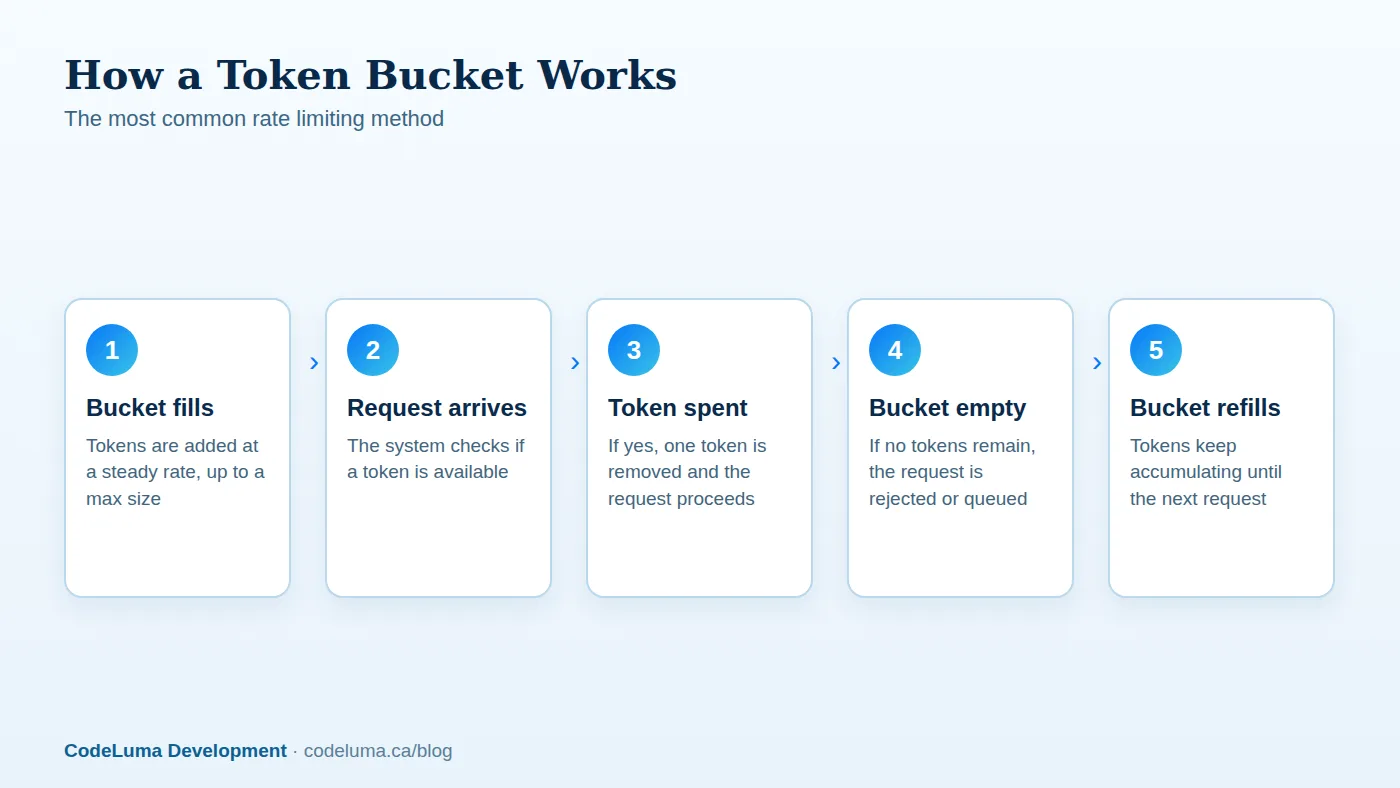
Why Rate Limiting Matters More Than It Looks
A single API endpoint often serves dozens of different consumers at once: your own front end, a mobile app, an internal dashboard, and third-party partners you may not fully control. Without limits, one noisy client can exhaust database connections, saturate bandwidth, or trigger cascading failures in downstream services. Rate limiting turns an unbounded risk into a predictable, manageable one. It also protects your infrastructure costs — unlimited traffic on pay-as-you-go cloud resources is an open-ended bill.

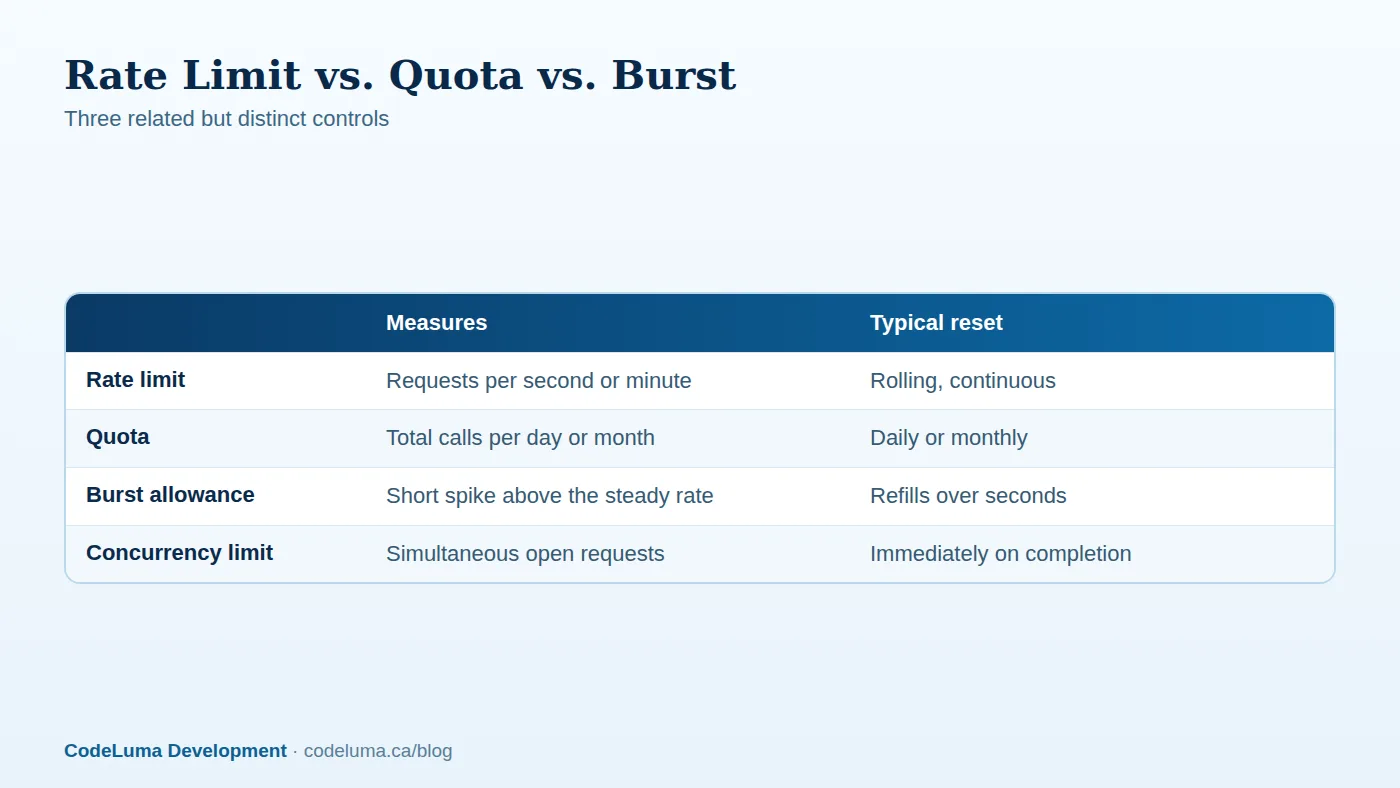
Rate Limits, Quotas, and Burst Allowances Are Different Tools
These terms get used interchangeably, but they solve different problems. A rate limit caps how many requests are allowed in a short rolling window, protecting against sustained overload. A quota caps total usage over a longer period, like a day or billing month, and is often tied to a pricing plan. A burst allowance permits a short spike above the steady rate, which matters because real traffic is rarely smooth — a partner syncing a batch of orders will send requests in a cluster, not evenly spaced one per second.
Common Ways to Implement Limits
The token bucket approach shown above is popular because it naturally allows bursts while still enforcing a long-run average. A sliding window log tracks exact request timestamps for precise enforcement but costs more memory. A fixed window (say, "100 requests per minute, reset on the minute") is simplest to build and explain, but it has a known weakness: a client can send 100 requests in the last second of one window and another 100 in the first second of the next, doubling the intended rate briefly. For most business APIs, token bucket or a short sliding window strikes the best balance of fairness and simplicity.
How to Choose Sensible Limits
Start from real usage, not guesswork. Look at how your busiest legitimate consumer actually behaves today, then set limits with headroom above that — enough to absorb normal growth and occasional retries, but not so generous that a single bad actor can still cause damage. If you don't have usage data yet, model a worst-case legitimate workflow (a bulk import, a nightly sync) and size the burst allowance around it rather than the steady rate. It's easier to raise a limit later for a specific partner than to walk back a public promise you made too generously.
Tiered Limits for Different Partners
Not every consumer needs the same ceiling. A free tier, a paid tier, and an internal service account often warrant different limits, and that's normal — plenty of well-known APIs work this way. The key is to make the tiering logic simple and documented, so partners understand why their limit is what it is and what upgrading actually buys them. Avoid ad-hoc, undocumented exceptions granted over email; they're hard to track and tend to resurface as confusion months later when someone new joins the partner's team.
Communicating Limits So Partners Aren't Surprised
The most common failure isn't the limit itself — it's the silence around it. Document your limits in the same place as your endpoint reference, not buried in a support article. State the numbers plainly: requests per minute, daily quota, burst size, and what happens when a limit is hit. If limits differ by plan or endpoint, say so explicitly with a table rather than prose. Partners who know the rules in advance build around them; partners who discover the rules from a wall of errors in production tend to escalate, and rightly so.
Use Response Headers to Show Live Status
Beyond documentation, your API should tell consumers where they stand on every response. Standard headers like a remaining-requests count, the limit ceiling, and a reset timestamp let well-built client code throttle itself automatically instead of guessing. This is one of the cheapest things you can add that meaningfully reduces support tickets, because good client libraries will read those headers and back off before they ever hit a hard wall.

Handling the 429 Response Gracefully
When a limit is exceeded, return a clear status code (429 Too Many Requests) along with a retry-after value telling the client exactly how long to wait. Avoid vague error bodies that just say "try again later" with no number attached — that forces every integrator to guess and often leads to either hammering your service immediately or waiting far longer than necessary. A precise, machine-readable retry hint is one of the most partner-friendly things you can ship, and it costs almost nothing to implement.
A Short Checklist Before You Ship Rate Limiting
- Limits are based on observed or modeled real usage, not a round number picked arbitrarily
- Rate limit, quota, and burst allowance are each defined separately, even if some values match
- Every response includes remaining-count and reset-time headers
- 429 responses include a retry-after value
- Limits are documented next to the endpoint reference, not only in a separate policy page
- There's a clear, low-friction path for a partner to request a higher tier
- Internal services and monitoring tools have their own limits so they can't starve external partners
Common Mistakes Worth Avoiding
- Setting one global limit for every consumer — a single internal dashboard polling too often can lock out real customers.
- Changing limits without notice — even a sensible tightening can break integrations that were built around the old ceiling.
- No burst allowance at all — this punishes normal, bursty traffic patterns like batch syncs, not just abuse.
- Silent throttling — delaying or dropping requests without a clear error confuses developers far more than an explicit 429.
- Treating rate limiting as "set once, forget it" — usage patterns shift as partners grow, and limits need periodic review.
Where This Fits Into the Bigger Picture
Rate limiting is one piece of a broader resilience story. It works alongside good custom API design and integration work and pairs naturally with the kind of graceful degradation discussed in handling third-party API outages — the same instinct to fail predictably rather than catastrophically applies in both directions, whether you're the API provider or the consumer. If your API sits behind a marketing push or seasonal spike, it's also worth reading how to handle traffic spikes alongside your rate limiting plan, since the two controls need to agree with each other rather than fight.
Keeping Limits Right Over Time
Sensible limits today can become wrong limits in a year as partners grow, new integrations appear, or your infrastructure changes. Treat your rate limiting configuration as something to revisit on a schedule, the same way you'd review any other production setting, and pair it with monitoring so you notice when a partner is consistently bumping against a ceiling before they complain about it. This is the kind of ongoing tuning that fits naturally into a maintenance and support plan, rather than something you configure once at launch and never touch again.
Wrapping Up
Rate limiting done well is almost invisible: your service stays stable, well-behaved partners never notice a ceiling, and the ones who push too hard get a clear, actionable message instead of a mystery outage. The real work isn't the algorithm — it's choosing limits grounded in real usage, communicating them honestly, and giving consumers the information they need to build around them. Get that right, and rate limiting becomes a trust-building feature of your API, not just a defensive wall.
Put this into practice with CodeLuma
CodeLuma designs and implements rate limiting for APIs we build or that you already run, from choosing sane thresholds to writing the response headers and docs partners actually read. We can also review an existing integration that's misbehaving under load and tune it before it becomes a support headache.
- Custom software development - tailored systems, integrations and internal tools.
- Maintenance and support plans - updates, monitoring and ongoing improvement.
- CodeLuma support - help from a real team when you need it.
- Managed hosting - monitored, backed-up, Canadian-friendly hosting.
Start a conversation. Tell us about your project and we will reply with practical next steps, or browse all CodeLuma services. CodeLuma Development Inc. is based in Nova Scotia and works with teams across Canada and remotely.