If you sell online and any meaningful share of your customers are in Quebec, Bill 96 isn't a background compliance detail — it changes what your store is legally expected to show people during a transaction. The law strengthens the existing Charter of the French Language and extends French-language requirements further into commerce, including contracts, product information, and consumer-facing communication. Most online stores we look at have a French toggle on the homepage and call it done. That's rarely enough, and it's worth understanding why before you scope any changes.
What Bill 96 Is Actually About
Bill 96 amends Quebec's Charter of the French Language, and one of its clearest impacts on commerce is reinforcing that consumer contracts — including the kind formed when someone completes a checkout — must be available in French. It also expands requirements around product labelling, packaging, and public-facing communication. The intent isn't to ban English; it's to make sure French is not an afterthought, and that a Quebec consumer can transact entirely in French if they choose to. This matters for how you read the rest of this article: the goal isn't "translate the homepage," it's "make the full transaction path work in French."

Who This Realistically Applies To
If you have a storefront, a physical location, or active marketing in Quebec, this applies to you regardless of your company's home province. Selling nationally from an Ontario or British Columbia office doesn't exempt you if Quebec residents are checking out on your site. The law has historically treated business size as relevant to certain enforcement thresholds, but the safest planning assumption for any business actively marketing to Quebec is that the core consumer-facing experience — not just a brochure page — needs a French equivalent. This is a legal compliance question with real consequences, so treat anything here as a starting point for a conversation with legal counsel familiar with Quebec consumer law, not a substitute for it.
Your Website's Core Pages
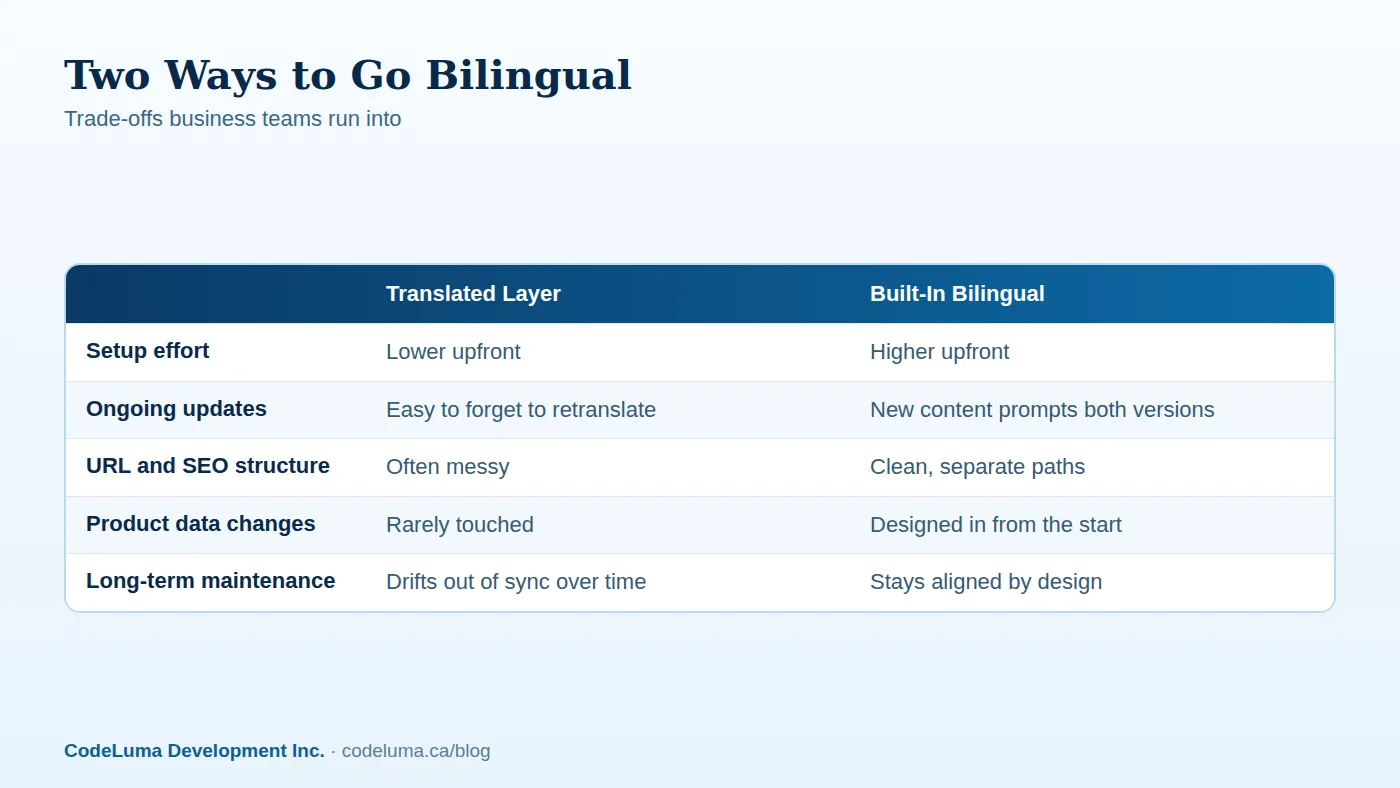
Start with the pages a Quebec shopper would actually read before buying: homepage, category pages, product pages, FAQ, shipping and returns, and your privacy policy. A machine-translated layer bolted onto an English site technically shows French text, but it often reads badly enough that it undermines trust rather than building it. If your catalogue is small, professional human translation is manageable. If you're running thousands of SKUs, you need a content strategy — more on that below — because word-for-word translation doesn't scale and quality really does vary by product category.
Checkout Is Where Most Stores Fall Short
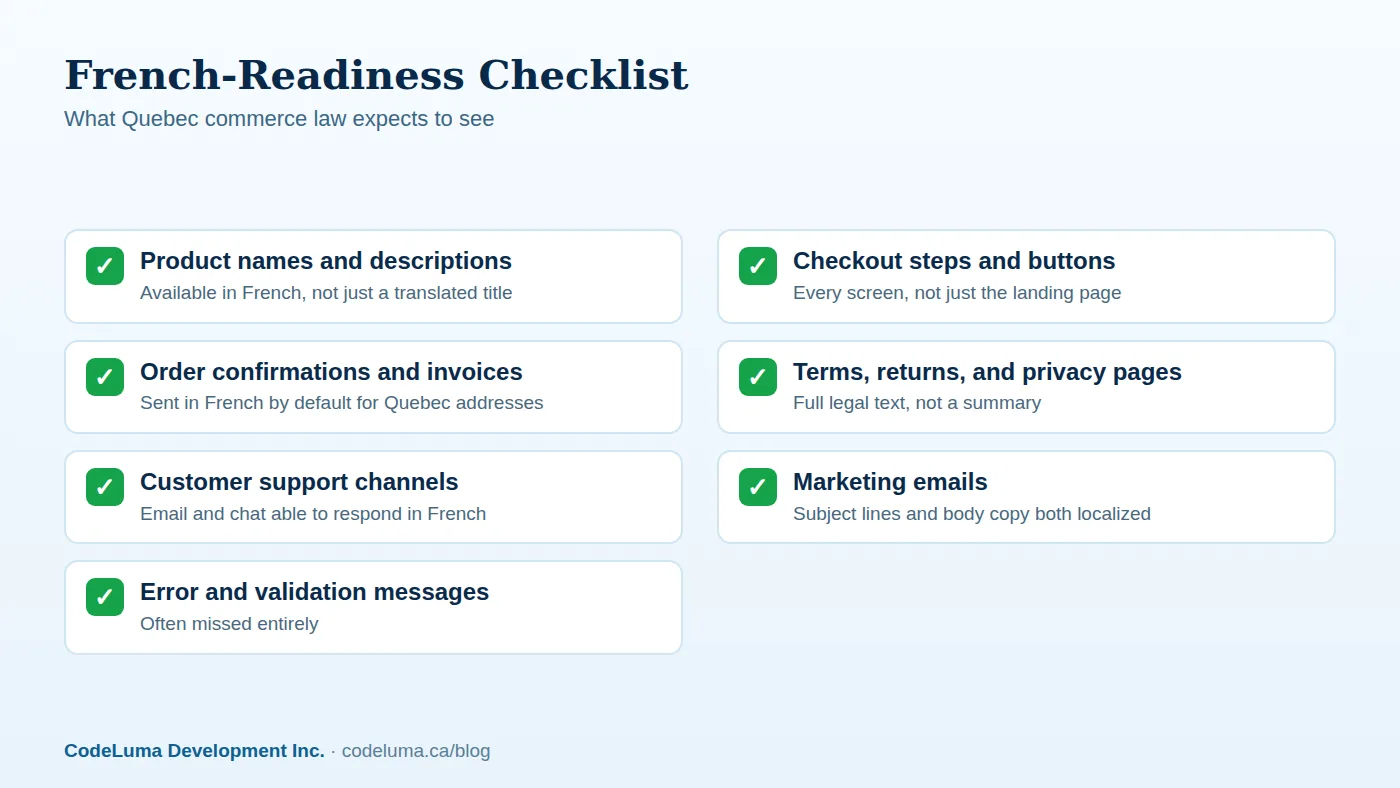
This is the part teams consistently underestimate. A French-language homepage with an English checkout is a common and risky gap, because checkout is exactly where a consumer contract is formed. Every step — cart, shipping options, payment fields, order review, confirmation screen — needs to work in French, including form validation messages, error states, and button labels. It's easy to translate the main checkout page and miss the "your card was declined" message or the "please enter a valid postal code" validation text, because those often live in a different part of the codebase than the visible page copy.
Legal Documents and Terms
Terms of sale, return policies, warranty information, and privacy policies should exist as full French documents, not summaries. If your return policy is three paragraphs in English and one sentence in French, that's a real gap, not a stylistic choice. These documents also need to stay in sync — when legal or ops updates the English terms, there needs to be a process that flags the French version for the same update, or you end up with two policies that quietly disagree with each other.
Product Data Is the Hard Part
For stores with real catalogue depth, product data is where this becomes an engineering problem rather than a translation task. Names, descriptions, variant labels (size, colour, material), specifications, and even SEO metadata need a French counterpart. If your product data is stored as English strings baked into templates, you don't have a translation problem, you have a data structure problem — there's no field to put the French text into. This is usually the point where custom development work pays off: building a proper data model with language-specific fields, so your catalogue can hold both versions cleanly and your team can update one language without breaking the other.
Order Confirmations and Transactional Email
Order confirmations, shipping notifications, invoices, and password resets are consumer communications too, and they're frequently left in English because they're generated by a separate system from the website itself — a payment processor's default template, or a shipping carrier's notification. Audit every automated email a Quebec customer could receive and confirm it has a French version triggered by their language preference or billing province. If your business email and notification setup is handled by whatever your e-commerce platform ships with by default, this is worth checking directly rather than assuming it's covered.

Customer Service and Support Channels
If a Quebec customer emails support, opens a chat widget, or calls a listed number, they should be able to get a response in French. For small teams, this might mean having at least one bilingual staff member handle Quebec inquiries, or using a chat tool that supports templated French responses for common questions. For larger volumes, it may mean a dedicated French support queue. There's no single right answer here — it scales with how much Quebec business you actually do — but "we'll figure it out if it comes up" is not a plan.
Structuring the Site So Both Languages Hold Up
Technically, the cleanest approach is usually separate, properly structured URLs for each language (like a /fr/ path) rather than a JavaScript toggle that swaps text on the same page. Separate paths are easier to maintain, easier to get right for search visibility, and make it obvious when French content is missing because the page simply won't exist yet. This is the kind of structural decision worth settling early in a website or web application build, because retrofitting proper bilingual routing onto a site built for one language is considerably more work than planning for it from the start.
Common Mistakes We See
- Translating the marketing pages but not the transaction path. Checkout, confirmations, and support are the legally sensitive parts, not the homepage.
- Using machine translation for product descriptions and never reviewing it. It reads as careless even when it's technically understandable.
- Letting the French version drift out of date. A new product launches in English and the French catalogue silently falls behind.
- Forgetting third-party tools. Payment processors, shipping widgets, and review plugins often have their own English-only defaults that need to be configured separately.
- Treating this as a one-time project. New content needs a process, not just a past translation effort.
A Practical Way to Scope This
Rather than trying to translate everything at once, walk the actual customer journey end to end in French: land on the site, browse a category, open a product, add to cart, check out, receive the confirmation email, and contact support with a question. Wherever that walkthrough breaks into English, that's your punch list. This also tends to surface which gaps are quick content fixes and which ones need real development work to fix properly, which makes it much easier to scope and budget the project honestly.
Wrapping Up
Bill 96 isn't a reason to panic, but it is a reason to actually check your checkout, your emails, and your product data rather than assuming the homepage toggle covers you. The businesses that handle this well treat it as an ongoing process — new products and new pages get a French version as part of the normal workflow, not as a cleanup project every few years. If you're not sure how big the gap is between where you are and where you need to be, a straightforward audit of the full customer journey is the fastest way to find out. For related territory, see our breakdown of Quebec's Law 25 privacy requirements, which often needs to be addressed alongside this.
Put this into practice with CodeLuma
CodeLuma can audit your current store against Bill 96's practical requirements and build the French-language pieces that are missing — checkout flows, product data structures, and transactional email templates that work in both languages without turning into two separate websites. We can scope this as a focused project or fold it into ongoing {{svc:maintenance|maintenance}} work.
- Website and web application development - fast, accessible, search-friendly builds.
- Custom software development - tailored systems, integrations and internal tools.
- Business email services - reliable, well-configured business email.
- Maintenance and support plans - updates, monitoring and ongoing improvement.
Start a conversation. Tell us about your project and we will reply with practical next steps, or browse all CodeLuma services. CodeLuma Development Inc. is a Canadian company that works with teams in Windsor, Essex, London, Toronto, Mississauga and across Ontario, throughout Canada and remotely.