If you collect names, emails, order details or login data through a website or app, you are handling personal information. In Canada, PIPEDA sets the ground rules for most private-sector businesses. Its ten fair information principles read like legal language, but each one turns into a concrete task for your site or app. This article translates them so you can find your biggest gaps first. It is general information, not legal advice.
Where PIPEDA fits
PIPEDA, the Personal Information Protection and Electronic Documents Act, applies to private-sector organizations that collect, use or disclose personal information in the course of commercial activity. Some provinces, including Quebec, Alberta and British Columbia, have their own private-sector laws that are substantially similar, and Quebec's is notably stricter in several areas. If you sell to customers in more than one province, check which rules apply to you. The ten principles below are the backbone of PIPEDA, so they are a solid framework either way. If you also serve people in Europe, our piece on GDPR for web applications covers the overlap.

Principle 1: Accountability
Someone in your organization must be responsible for personal information, and that responsibility stays with you even when data sits with a vendor. In practice:
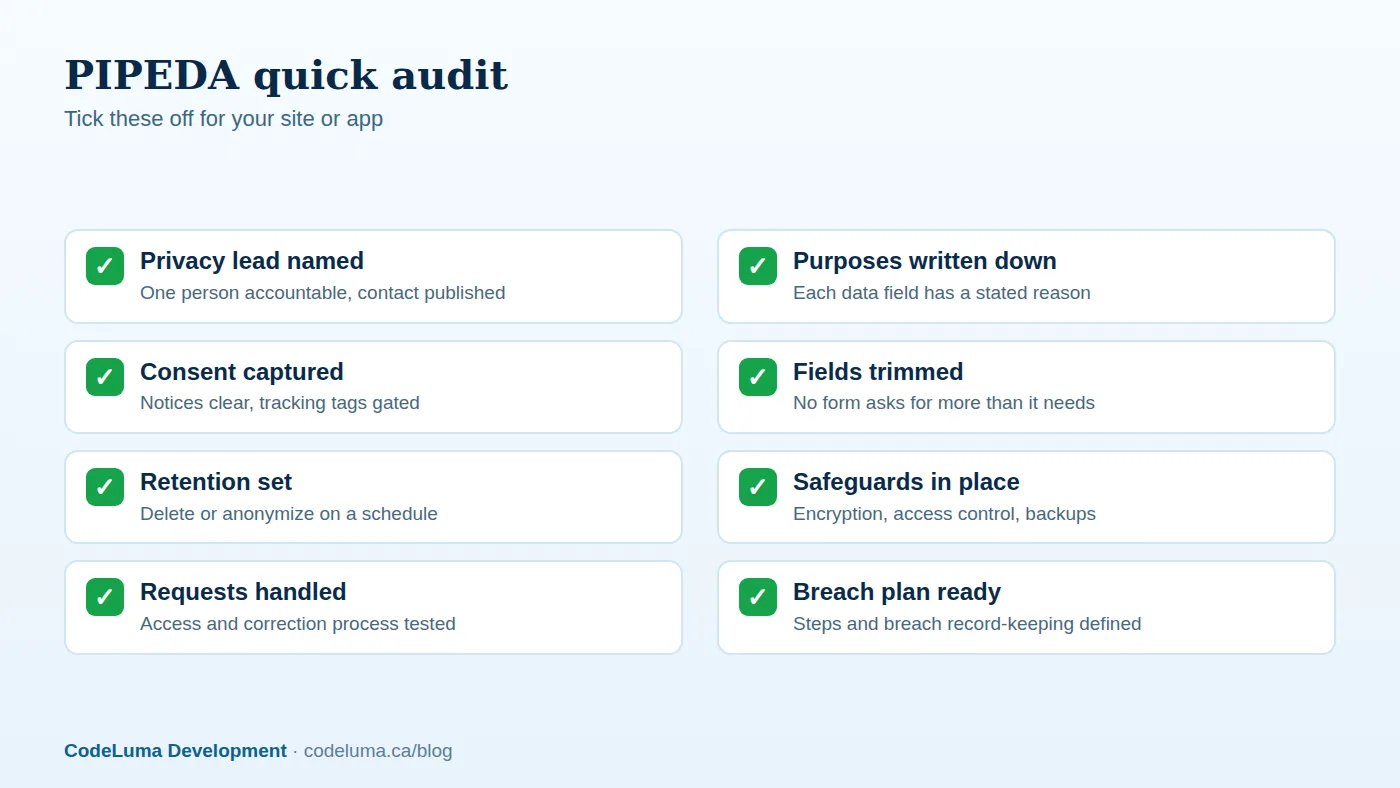
- Name a privacy lead and publish their contact details.
- List every third party that touches customer data: hosting, email tools, payment providers, analytics, chat widgets and CRMs.
- Use contracts that require those vendors to protect data to a comparable standard.
That vendor list often turns out to be longer than anyone expected.
Principles 2 and 3: Purposes and consent
Identifying purposes means deciding, before you collect, why you need each piece of information. Consent means people agree to that use in a way they can actually understand. Check your site for these:
- Sign-up and checkout forms that explain, in plain words, what each piece of information is for.
- Tracking scripts, ad pixels and session recorders that fire before anyone has been told about them.
- Pre-ticked marketing boxes, or newsletter sign-up bundled into an unrelated action.
PIPEDA does not prescribe a specific cookie banner. But it does expect meaningful consent, and the Privacy Commissioner's guidance generally expects stronger, express consent for sensitive information. If you use analytics or advertising tools that track individuals, make sure your notice reflects that and your tag setup matches what you say.
Principle 4: Limiting collection
Collect only what you need for the purposes you identified. This is the cheapest gap to close because it is mostly deleting form fields. Does a newsletter signup need a phone number? Does a quote request need a birth date? Every field you remove is data you never have to secure, retain or explain. The same goes for app permissions: request location, contacts or camera access only when a feature really needs them.
Principle 5: Limiting use, disclosure and retention
Use data only for the purposes people agreed to, and do not keep it forever. This is where many systems fail quietly, because databases just grow. Set a retention period for each data type, such as abandoned carts, inactive accounts, support tickets and old exports. Then automate the deletion or anonymization. Watch the copies too. Backups, staging databases, spreadsheets exported for a one-off report and log files often hold personal data long after the live record is gone.
Principle 6: Accuracy
Information should be accurate, complete and current enough for its purpose. Give users an easy way to update their own details, such as a profile page or a clear contact route. Validate inputs so typos in emails and postal codes do not cause failed deliveries. Where records drive decisions about a person, make sure corrections flow through to every system that holds a copy.
Principle 7: Safeguards
Protect information with safeguards proportionate to how sensitive it is. The technical baseline for a website or app includes:
- HTTPS everywhere, and encryption for sensitive data at rest.
- Role-based access, so staff see only what their job needs. See our guide to role-based access control.
- Secrets kept out of code and shared chats, as covered in managing environment variables and secrets.
- Tested backups, patched software and reliable managed hosting.
- Multi-factor authentication for admin accounts.
PIPEDA also requires you to report breaches of security safeguards to the Office of the Privacy Commissioner, and to notify affected individuals, when there is a real risk of significant harm. You must keep a record of every breach, including ones you did not report, for 24 months. Write your response plan before you need it.

Principles 8 and 9: Openness and individual access
Openness means your privacy practices are easy to find and understand. Link a plain-language privacy policy from your footer and from every form. Say what you collect, why, who you share it with, and how to reach your privacy lead. Be upfront if data is stored or processed outside Canada.
Individual access means people can ask what you hold about them and get a response, generally within 30 days. Ask yourself whether you could find everything about one customer today. If the answer involves five systems and a lot of guessing, build a simple lookup or export tool now.
Principle 10: Challenging compliance
People must be able to raise a concern about how you handle their information, and you must have a process to receive and investigate it. A dedicated email address, a short form, and a named owner are enough to start. Log each complaint and the outcome, and fix the root cause when a complaint shows a real gap.
A sensible order of work
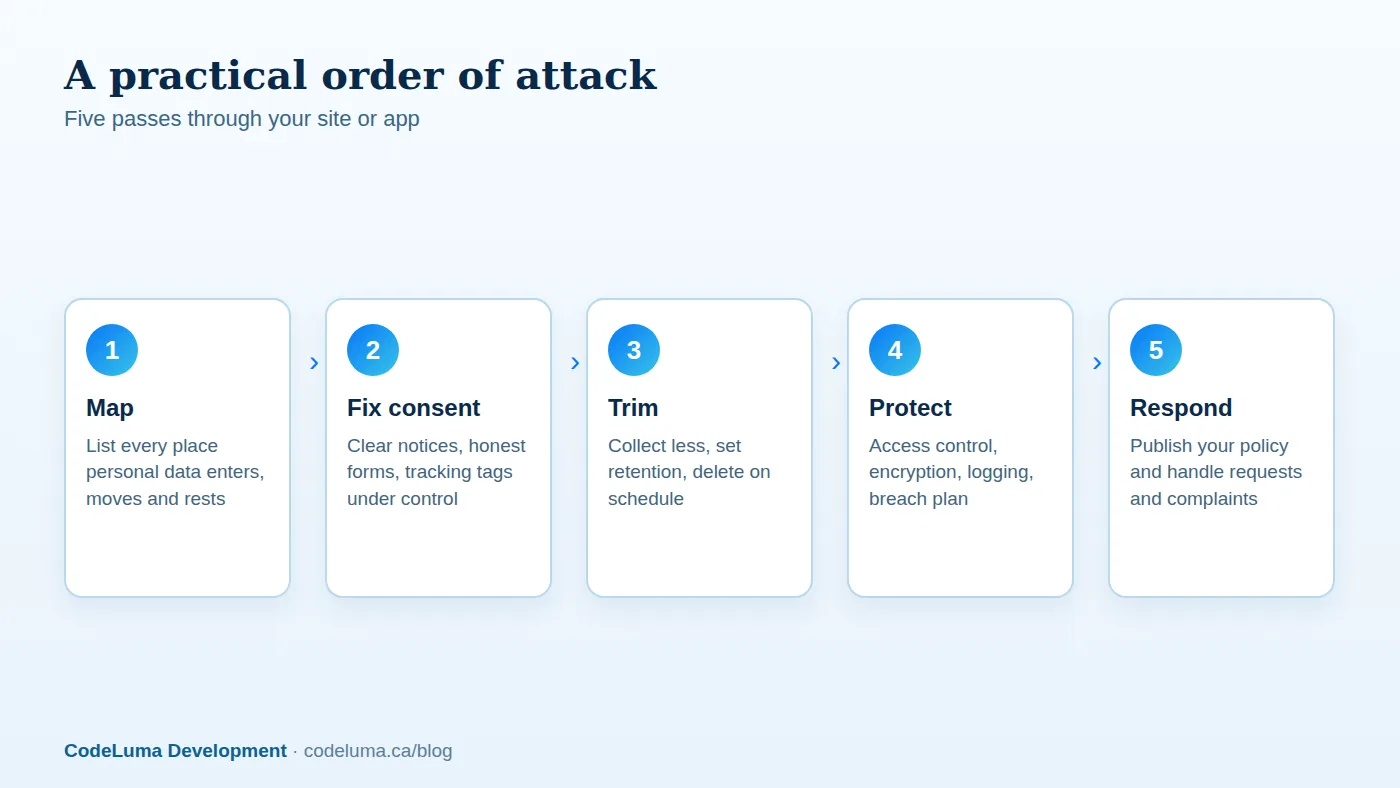
- Map your data. Forms, databases, integrations, backups and analytics tags.
- Trim first. Remove fields and tags you cannot justify.
- Fix consent and notices. Match what you say to what the site actually does.
- Set retention and access. Schedule deletion and prepare for access requests.
- Keep it current. Review after every new feature or vendor. Ongoing maintenance and support helps here, and our post on audit logs for compliance shows how to track who touched what.
Common mistakes
- Copying a privacy policy template that does not describe your real practices.
- Adding a marketing plugin without checking what data it sends and where.
- Keeping every record forever "just in case".
- Forgetting staging databases and backups when deleting data.
- Having no breach plan until the first incident.
Illustrative composite: a small online shop adds a live-chat widget and a retargeting pixel during a busy season. Neither shows up in the privacy policy, and the chat transcripts are never deleted. Nothing has gone wrong yet, but two principles are already off track, and neither would take long to fix.
Wrap-up
PIPEDA compliance is less a one-time project than a habit of asking, for every field, tag and vendor, why you collect it, who can see it and when it goes away. Start with the map, trim aggressively and make your notices honest. If you want a second set of eyes on your build, our website and web application development team can review your site or app. For the legal side, talk to a privacy lawyer.
Put this into practice with CodeLuma
CodeLuma builds and maintains websites and web apps with privacy in mind. That covers lean forms, sensible retention, role-based access and safe hosting. We can walk through your current site or app, point out the practical gaps, and help you close them without turning it into a giant project. We are developers, not lawyers, so we work alongside your legal advisor on the policy side.
- Website and web application development - fast, accessible, search-friendly builds.
- Maintenance and support plans - updates, monitoring and ongoing improvement.
- Managed hosting - monitored, backed-up, Canadian-friendly hosting.
- Custom software development - tailored systems, integrations and internal tools.
Start a conversation. Tell us about your project and we will reply with practical next steps, or browse all CodeLuma services. CodeLuma Development Inc. is based in Nova Scotia and works with teams across Canada and remotely.