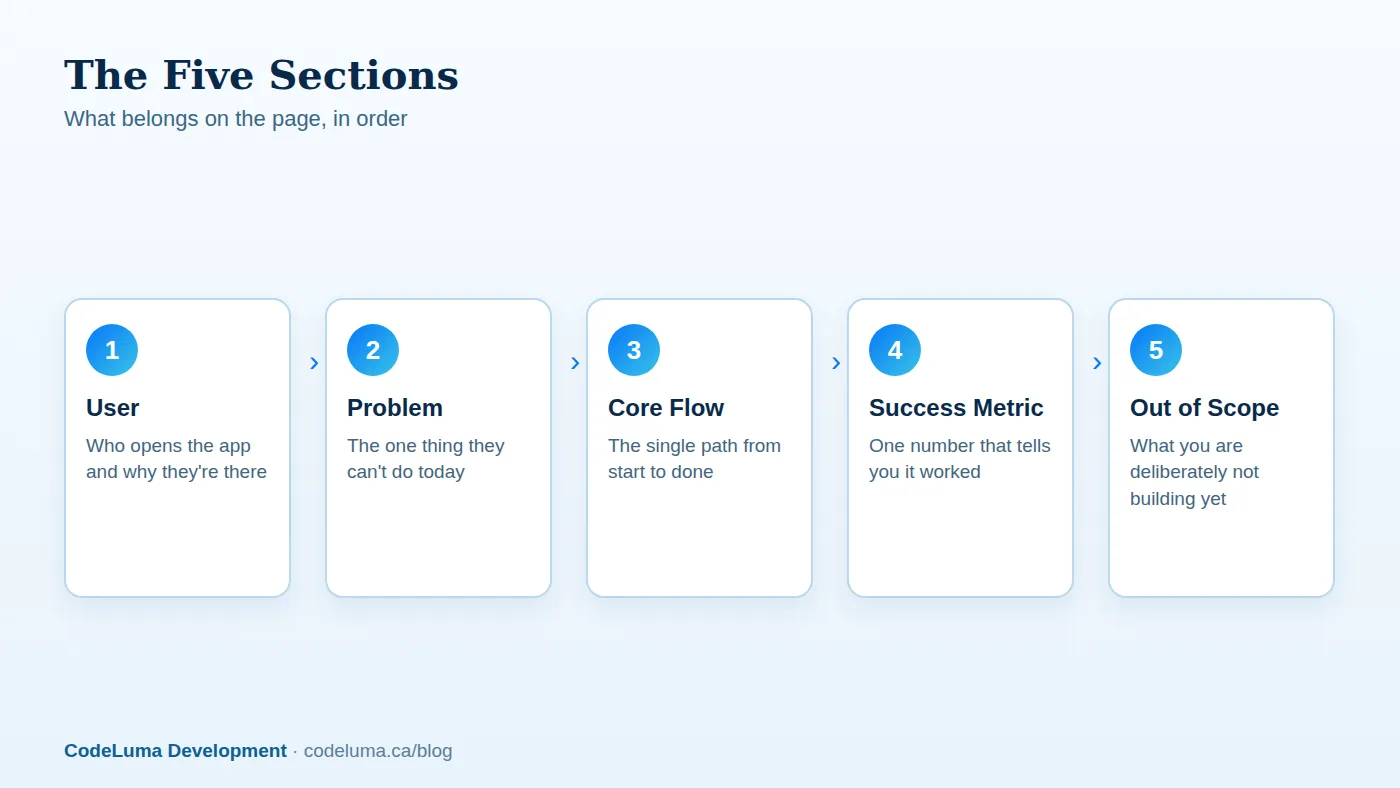
Most MVP projects don't stall because the idea is bad. They stall because nobody wrote down, in plain language, what "done" actually means. Founders send developers a pitch deck, a Notion doc with forty open questions, or a verbal description that changes every time they explain it out loud. The developer can't quote that. They can only guess at it, and guesses turn into change orders later. A one-page brief fixes this by forcing the five decisions that actually determine scope, before a single line of code gets written.
Why one page works better than a long spec
A 20-page requirements document feels thorough, but it usually hides the scope inside paragraphs of context, background, and aspirational features. Developers have to read the whole thing to find the two sentences that matter. A one-page brief does the opposite: it strips everything down to the decisions that change the estimate. If you can't fit your MVP on one page, that's not a formatting problem — it's a sign the scope isn't decided yet.
This isn't about dumbing the project down. A one-page brief sits alongside wireframes, brand assets, or a longer vision document if you have them. But the brief itself is the thing a developer reads first to understand what they're being asked to build and why.

Start with the user, not the product
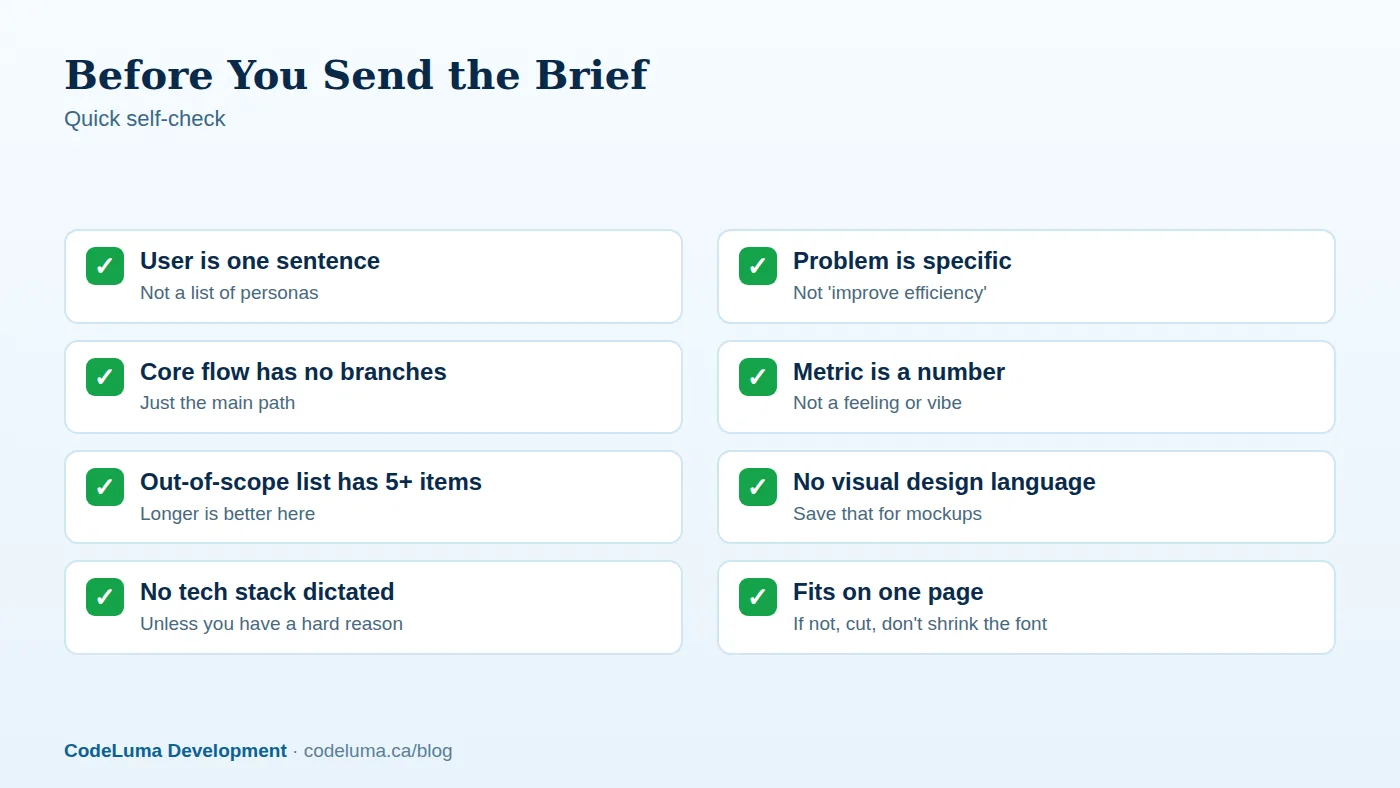
Name one primary user. Not "small business owners and their customers and admin staff" — pick the person whose problem the MVP solves first. If you have three user types, you likely have three products fighting for the same budget. For an MVP, one sentence: "A dispatcher at a small HVAC company who currently schedules jobs on a whiteboard." That sentence alone tells a developer more about scope than a page of market research.
State the problem in one sentence
Write the problem as a specific, observable friction — not a vague goal. "Improve team communication" isn't a problem a developer can build against. "The dispatcher double-books technicians because the whiteboard doesn't show who's already assigned" is. If you can't state the problem in one sentence without using the word "better," keep narrowing it until you can.
Map the core flow, and only the core flow
This is the single path a user takes from opening the product to getting value out of it, with no detours. For a scheduling tool, that might be: dispatcher logs in, sees today's jobs, drags a job onto a technician's slot, technician gets a notification. That's it. Don't document the password reset flow, the settings page, or the reporting dashboard here — those are real, but they're not the core flow, and listing them muddies the one thing you need a developer to focus on first.
Write the core flow as a numbered list of five to eight steps. If it's longer than that, you're probably describing two flows, and you should decide which one is the MVP.
Pick one success metric
Choose a single number that tells you the MVP worked. Not a list of KPIs — one. "Dispatchers complete a day's schedule in under five minutes" or "Zero double-bookings in the first month of use." This does two things: it tells the development team what to optimize for, and it gives you something concrete to check after launch instead of a general feeling about whether the project went well. We've written before about how to separate must-have features from later ones, and a clear success metric is the fastest filter for that decision — if a feature doesn't move the metric, it's not must-have.
Write the out-of-scope list — this is the part people skip
This is the single highest-leverage section on the page, and it's the one most briefs leave out entirely. List everything you're deliberately not building in version one: no admin roles, no mobile app, no payment processing, no multi-language support, no integrations with other tools. Five to ten items is normal. This list does more to prevent scope creep and mid-project disputes than anything else on the page, because it turns "we assumed that was included" into "it's explicitly listed as out of scope, here's when we'll revisit it."
What to leave off the page
A one-page brief should not include a visual design language, a dictated tech stack (unless you have a hard constraint like an existing system you must integrate with), a full competitor analysis, or a long-term product roadmap. Those documents are useful, but they belong elsewhere, and cramming them onto this page buries the five things that actually drive the quote. If a developer needs a tech stack recommendation, that's a conversation to have during a scoping discussion with a development partner, not a line item you decide alone upfront.

A simple template you can copy
Here's a structure you can reuse for any MVP:
- User: one sentence naming the primary user
- Problem: one sentence describing the specific friction
- Core flow: five to eight numbered steps from start to value
- Success metric: one measurable number or observable outcome
- Out of scope: five to ten explicitly excluded items
Add a short line at the bottom for any hard constraints — a launch date tied to an event, a budget ceiling, a platform you must support. Keep it to one line; constraints belong in the brief, but they shouldn't dominate it.
Common mistakes that turn one page into ten
The most common failure is listing features instead of describing a flow. "The app should have user accounts, notifications, a dashboard, and reporting" tells a developer nothing about how those pieces connect or which one matters most. Another frequent mistake is writing multiple success metrics, which forces trade-off decisions onto the development team that should have been made before the brief was written. And a surprisingly common one is skipping the out-of-scope list because it feels negative — like admitting what you're not building. In practice, it's the opposite: a short out-of-scope list signals a team that has actually thought through the project, and it's one of the fastest ways to get a fast, accurate quote instead of a padded one.
What happens after the brief is written
A good one-page brief doesn't replace a conversation — it starts a better one. A development team should still ask follow-up questions, sketch the flow back to you, and flag anything ambiguous before quoting. What the brief does is eliminate the weeks of back-and-forth that happen when nobody has written down the basics. It also gives you a reference point to check scope against later, when someone inevitably asks to add "just one more thing" mid-build. If you want a deeper walkthrough of the discovery conversation that typically follows a brief like this, our piece on running a discovery phase covers what to expect.
Keep it current after launch
The brief isn't a one-time document. Once the MVP ships, the out-of-scope list becomes your backlog for what to build next, and the success metric becomes the number you check to decide if it's time to invest further. Keep the page around — don't file it away. It's useful again every time you're deciding what the next version should include, and it's a quick reference during ongoing maintenance and iteration work after launch.
Wrap-up
A one-page MVP brief isn't about being brief for its own sake — it's about forcing the decisions that matter before anyone starts estimating hours. Name the user, state the problem, map the core flow, pick one metric, and write down what you're not building. That page is worth more than a stack of specs, because every sentence on it is something a developer can actually build against.
Put this into practice with CodeLuma
CodeLuma can take a one-page brief like this and turn it into a scoped estimate within days, not weeks, because the format gives us exactly what we need to ask the right follow-up questions. If you're not sure how to fill in a section, we'll walk through it with you before any quote is written.
- Custom software development - tailored systems, integrations and internal tools.
- Managed hosting - monitored, backed-up, Canadian-friendly hosting.
- Maintenance and support plans - updates, monitoring and ongoing improvement.
- CodeLuma support - help from a real team when you need it.
Start a conversation. Tell us about your project and we will reply with practical next steps, or browse all CodeLuma services. CodeLuma Development Inc. is based in Nova Scotia and works with teams across Canada and remotely.