The most expensive part of many software projects is not the code. It is the misunderstanding: building the wrong thing, discovering hidden requirements late, or agreeing on a price before anyone understands the problem. A discovery phase is a short, focused period of research and planning done before the main build. It turns assumptions into knowledge, replaces guessing with evidence, and gives you a plan you can trust. If you are about to commission software, this is the highest-return money you can spend.
What discovery is, and is not
Discovery is a structured investigation. It is not a sales meeting, a design mock-up alone, or a long requirements document that nobody reads. Its purpose is to answer four questions: what problem are we really solving, for whom, what is the smallest solution that delivers value, and what will it take to build and run it? At the end you should be able to make a confident go, change or stop decision.
Who should be involved
A good discovery includes the people who will decide, the people who will use the system, and the people who will build it. That usually means an executive sponsor, a product owner with the authority to prioritise, representatives of each user group, someone who knows the current systems and data, and the delivery team: a business analyst or product lead, a designer, and a senior engineer or architect. Missing voices create surprises later, especially the people at the front line whose workflows the software will change.
Key activities
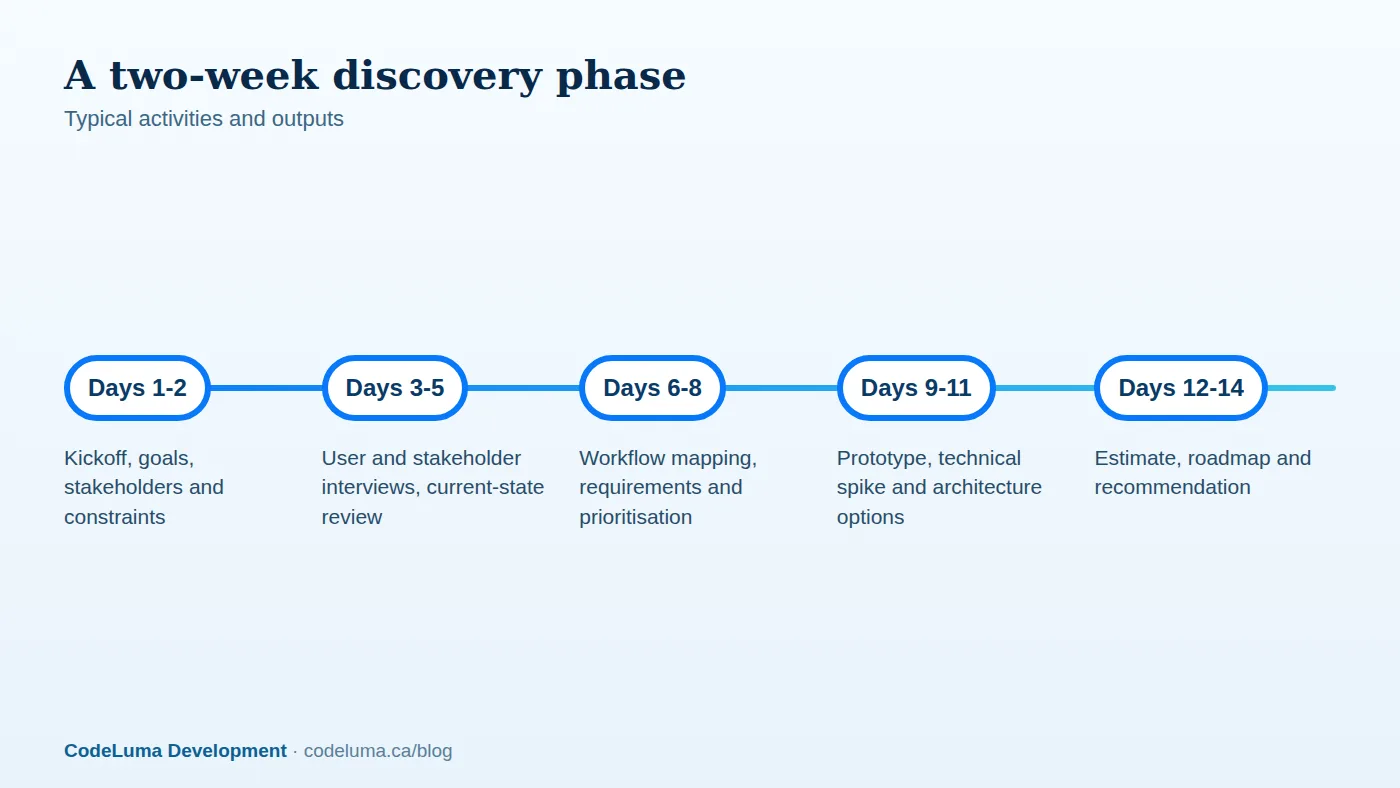
1. Goals and success measures. Agree why the project exists and how you will know it worked. Convert vague aims ("improve efficiency") into measurable ones ("cut quoting time from two days to two hours").
2. Stakeholder and user interviews. Talk to each group, observe real work where possible, and ask about tasks, pain points, exceptions and workarounds. The workarounds are gold: they show where the current process fails.
3. Current-state review. Examine existing tools, spreadsheets, data quality, integrations and constraints. Note what must be migrated and what can be retired.
4. Workflow mapping. Draw the end-to-end processes, including roles, hand-offs, decisions and exceptions. Many hidden requirements appear when you follow a job from start to finish.
5. Requirements and prioritisation. Write user stories and sort them into must, should, could and not now. Insist on a small first release; discovery is where scope gets disciplined.
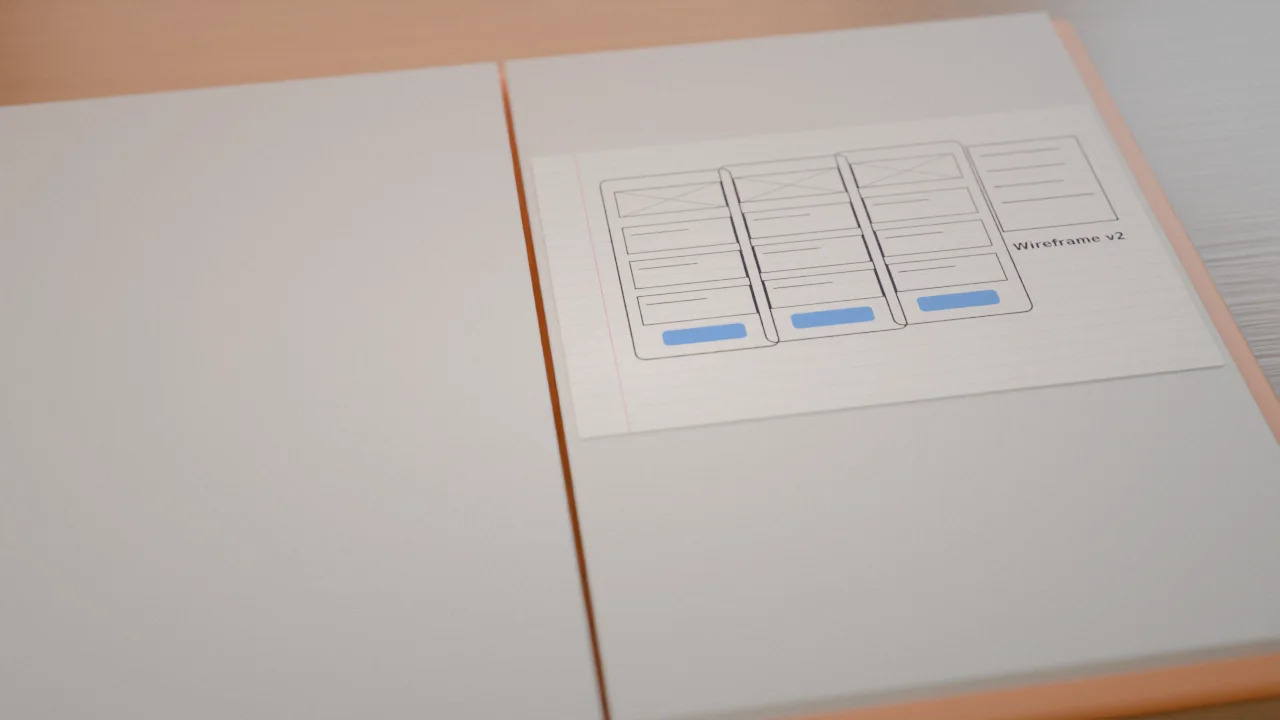
6. Prototype. A clickable prototype of the key workflows lets users react to something concrete. Testing it with five real users often reveals problems that pages of requirements never would.
7. Technical investigation. Explore architecture options, integration feasibility, data migration, security and compliance needs. Run short technical spikes on the riskiest unknowns, such as an unfamiliar API or a performance-sensitive feature.
8. Estimation and roadmap. Produce a phased plan with ranges, assumptions and options rather than a single number. Include ongoing costs: hosting, third-party fees and maintenance.
What a good discovery produces
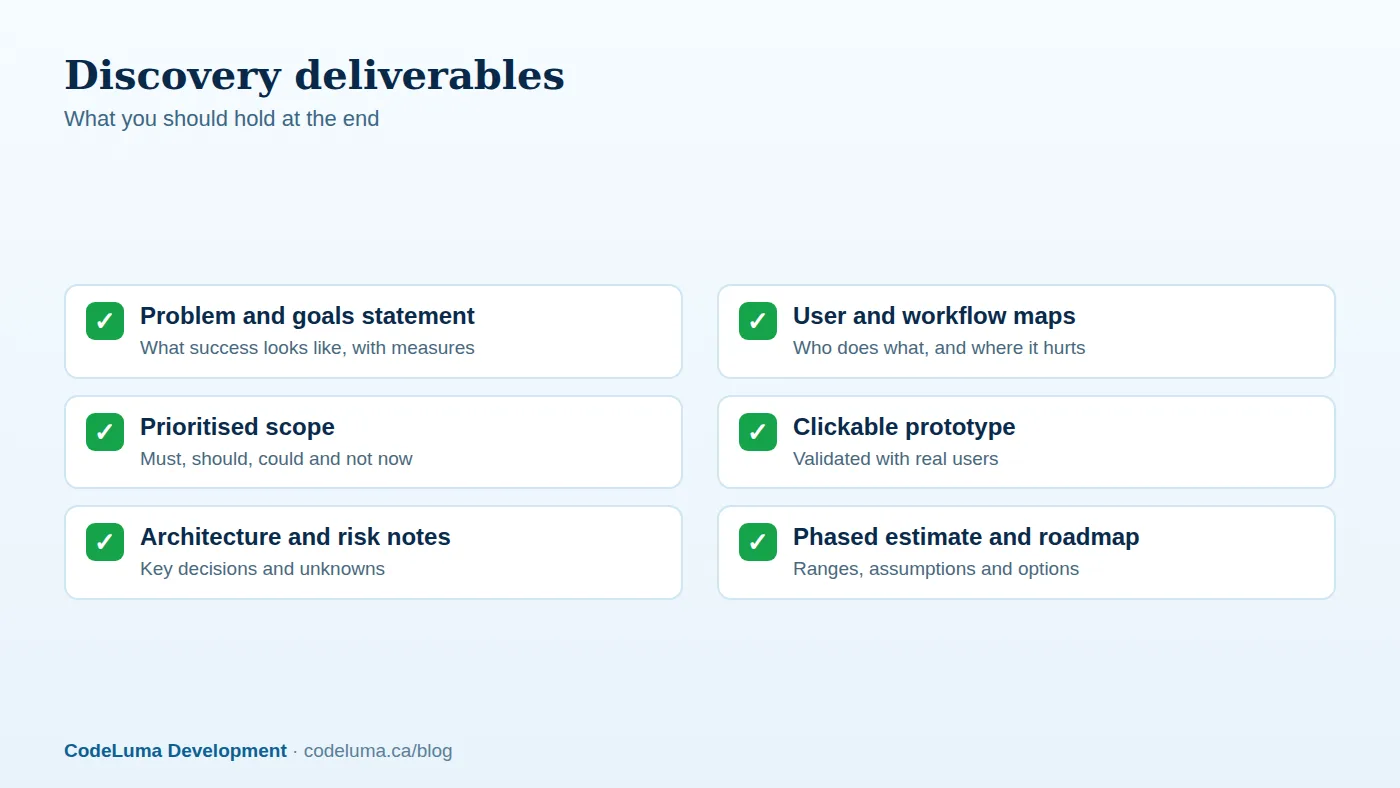
- A one-page problem statement and success measures.
- User personas and journey or workflow maps.
- A prioritised backlog with a defined first release.
- A validated prototype of core screens and flows.
- An architecture outline, integration list, and data migration plan.
- A risk register with mitigations and open questions.
- A phased estimate, timeline and team plan.
- A recommendation, including the option to not proceed or to change direction.
How long does it take, and what does it cost?
For a focused project, discovery typically runs two to four weeks; complex platforms may need longer. It usually represents a modest percentage of the total build budget, often five to fifteen percent, and it routinely saves multiples of that by preventing rework. Treat it as a paid, stand-alone engagement with clear deliverables. You own the outputs and can take them to any team, which keeps the vendor honest and gives you leverage.
Mistakes to avoid
- Skipping it to save money. The saving is illusory: unknowns show up as change orders and delays.
- Letting it become an endless analysis. Time-box the phase and stop when you have enough to decide.
- Talking only to executives. Users know how the work really happens.
- Treating the estimate as a promise. It is a range based on stated assumptions; revisit as you learn.
- Ignoring data. Messy source data is one of the top causes of overruns; profile it early.
- Not deciding. Discovery should end with a clear decision, not a shelf-ware document.
How to prepare
Collect what you already have: process documents, screenshots of current tools, sample spreadsheets, examples of reports, customer complaints, and a list of integrations. Name a product owner who can make decisions. Block time in stakeholders' calendars for interviews and reviews. The quality of discovery depends strongly on how available your people are.
What happens next
With discovery complete you can go forward with the same team, take the plan to other vendors for comparable bids, or pause. Each is a good outcome because the decision is informed. If you proceed, the build starts with a shared understanding, a prototype that has been tested, and a plan with visible phases. We describe what the first weeks look like in detail in our walk-through of the first two weeks together.
Put this into practice with CodeLuma
Every CodeLuma project starts with a structured discovery phase that ends in a scoped plan, a prototype, and a fixed-range estimate, so you can decide with real information before committing to a full build.
- Custom software development - tailored systems, integrations and internal tools.
- Website and web application development - fast, accessible, search-friendly builds.
- Mobile and app development - iOS, Android and progressive web apps.
Start a conversation. Tell us about your project and we will reply with practical next steps, or browse all CodeLuma services. CodeLuma Development Inc. is a Canadian company that works with teams in Windsor, Essex, London, Toronto, Mississauga and across Ontario, throughout Canada and remotely.