If you take card payments, you have heard of PCI-DSS, the Payment Card Industry Data Security Standard. It sounds like a heavy, technical burden reserved for large retailers. In practice, how much it affects you depends almost entirely on how you accept payments. Businesses that choose a well-designed integration can keep their compliance obligations modest, while those who handle card data directly take on significant responsibility. This guide explains it in plain language. It is general information rather than legal or compliance advice; confirm your specific obligations with your payment processor or a qualified assessor.
What PCI-DSS is
PCI-DSS is a security standard created by the major card brands and administered by the PCI Security Standards Council. It sets requirements for organisations that store, process or transmit cardholder data: build and maintain secure networks, protect stored data, maintain vulnerability management, implement strong access control, monitor and test networks, and maintain security policies. It is enforced contractually through your acquiring bank or payment processor, not by a government regulator, although non-compliance can bring fines, higher fees and, after a breach, serious consequences.

Who has to comply
Every business that accepts card payments is in scope, whatever its size. Requirements scale with the number of transactions, classified into merchant levels, and with how you handle data. Small merchants typically complete a self-assessment questionnaire (SAQ) and, in some cases, quarterly vulnerability scans by an approved vendor. Large merchants undergo formal assessments. Your processor will tell you which level and which SAQ applies.
Your integration choice is your scope
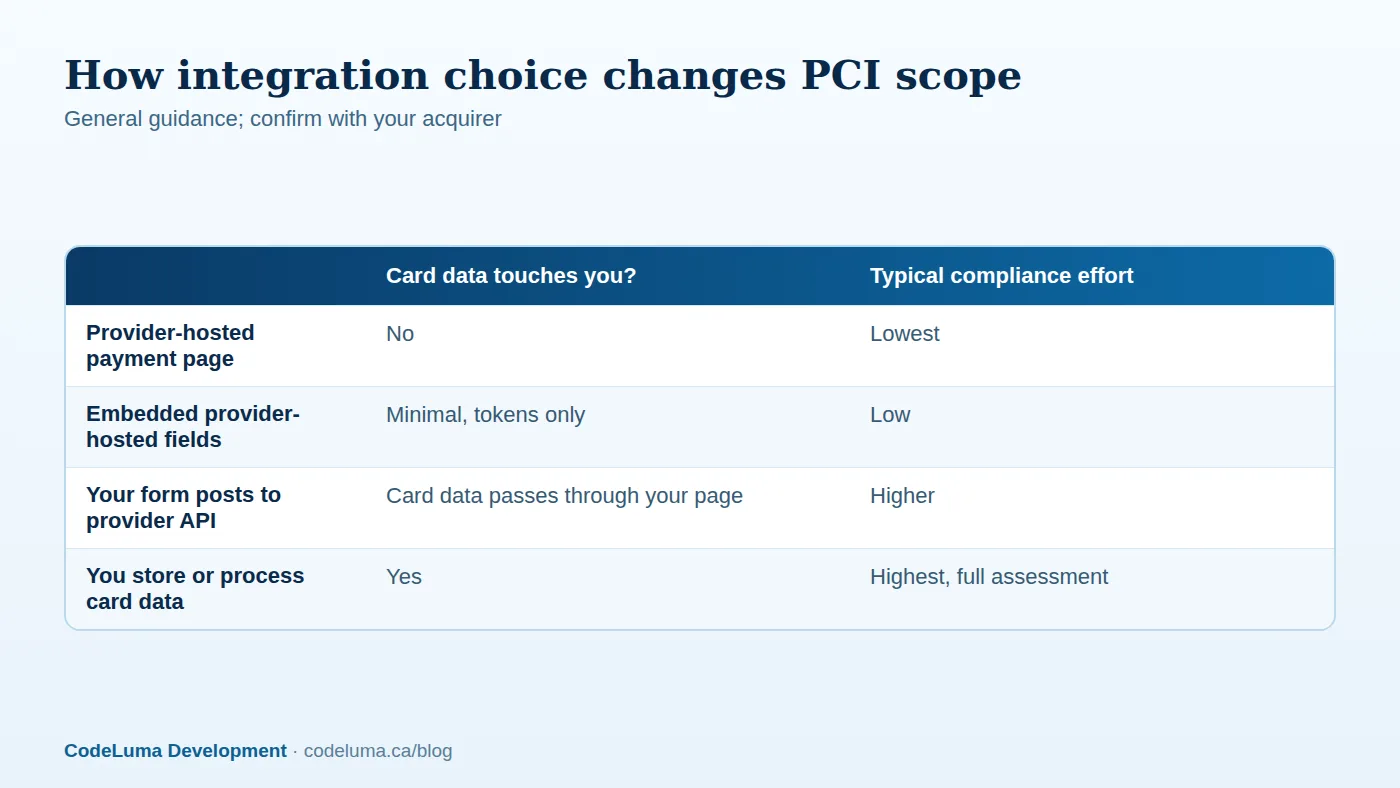
The most important thing to grasp is that the way you collect card details determines your responsibility:
- Fully hosted payment page: the customer is redirected to the provider's page. Your systems never see card data. This yields the simplest self-assessment.
- Embedded provider fields (iframes or hosted fields): the card fields are served by the provider inside your page, and your servers only receive a token. This gives a seamless design with a small scope, and is a sensible default for custom checkouts.
- Your own form sending card data to the provider: card details pass through your page or server. Your scope grows, since your environment is now part of the payment flow.
- Storing or processing card data yourself: the heaviest burden, involving network segmentation, encryption, key management, logging and regular audits. Almost never justified for a small or mid-sized business.
The principle is simple: do not touch card data you do not need. We discuss the integration side in our guide to Stripe, PayPal and Apple Pay.
What you still need to do, even with a hosted setup
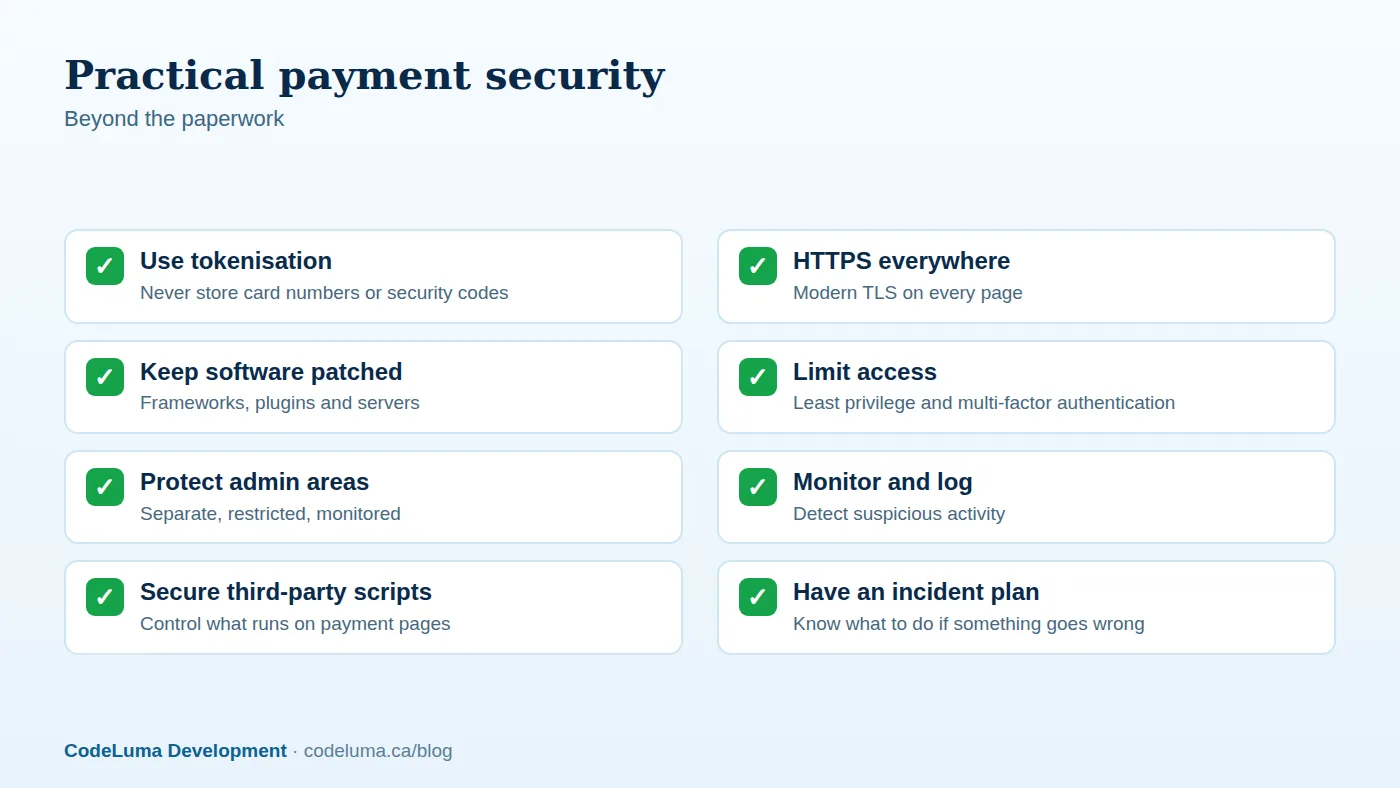
Reducing scope is not the same as eliminating responsibility. Even with hosted fields, you must secure the website that loads them. Recent versions of the standard pay particular attention to scripts on payment pages, because attackers inject malicious JavaScript that skims card details as customers type. Practical steps include:
- Inventory and justify every script that runs on payment pages, and remove the unnecessary ones.
- Use content security policy headers and subresource integrity where practical to limit what can execute.
- Monitor for unauthorised changes to payment pages and scripts.
- Keep the platform, plugins and dependencies patched.
- Complete the appropriate self-assessment questionnaire each year and keep evidence.
Protect stored data of every kind
PCI focuses on card data, but the same principles protect other sensitive information: keep only what you need, encrypt data in transit and at rest, restrict access, and delete what you no longer need. Never store full card numbers or security codes; the latter is prohibited after authorisation. Use tokens for repeat payments. Keep logs free of card data, and check that error messages and support tools cannot expose it.
Access control and administration
- Give people the minimum access needed, use individual accounts and require multi-factor authentication, especially for administrative access.
- Separate admin interfaces from public pages, and restrict them by network where possible.
- Review access regularly and remove it promptly when people leave.
- Use strong password policies and a password manager.

Vulnerability management and testing
Patch systems promptly, scan for vulnerabilities regularly and fix findings in a sensible timeframe. If your processor requires approved scanning vendor scans, schedule them and address failures quickly. Include security review in your development process, and remember the common web vulnerabilities such as injection and cross-site scripting; see our article on preventing SQL injection and XSS. Perform penetration tests when your risk and requirements warrant them.
Logging, monitoring and incident response
Keep audit logs of access to systems handling payments and administrative actions, protect them from tampering and retain them as required. Monitor for suspicious activity and set alerts. Write an incident response plan covering who to call, how to contain and investigate, how to notify your processor, and how to communicate with affected customers and regulators. Rehearse it briefly so it is not being read for the first time during a crisis.
Common mistakes
- Assuming a hosted checkout removes all obligations.
- Storing card details "temporarily" in a database, logs or email.
- Letting marketing tags and third-party widgets run on payment pages unreviewed.
- Using shared admin accounts without multi-factor authentication.
- Ignoring the annual questionnaire until the processor asks for it.
- Failing to update vulnerable plugins or outdated platforms.
A practical roadmap
- Confirm your merchant level and required questionnaire with your processor.
- Choose an integration that keeps card data off your systems.
- Harden and monitor the site that hosts the payment form.
- Document your policies and assign someone responsible for compliance.
- Review annually and after any significant change.
A development partner that designs secure checkouts as a matter of habit can keep this manageable. Our web team builds payment flows with tokenised, provider-hosted fields, and follows secure-development practices so your compliance scope stays small.
Put this into practice with CodeLuma
CodeLuma designs checkouts that keep card data off your servers and your compliance scope small, using tokenised, provider-hosted payment fields and secure development practices.
- Custom software development - tailored systems, integrations and internal tools.
- Website and web application development - fast, accessible, search-friendly builds.
- Managed hosting - monitored, backed-up, Canadian-friendly hosting.
Start a conversation. Tell us about your project and we will reply with practical next steps, or browse all CodeLuma services. CodeLuma Development Inc. is a Canadian company that works with teams in Windsor, Essex, London, Toronto, Mississauga and across Ontario, throughout Canada and remotely.


