Selling to customers in other countries is one of the most powerful growth levers for an online business, and one of the easiest to do badly. Putting a currency switcher and a translation plugin on a store is not the same as being ready for a new market. Shoppers expect to see prices in their own currency, read in their own language, pay in familiar ways, know the total cost including taxes and duties, and receive their order without surprises. This guide covers the technical and commercial decisions behind a sound multi-currency, multi-language setup.
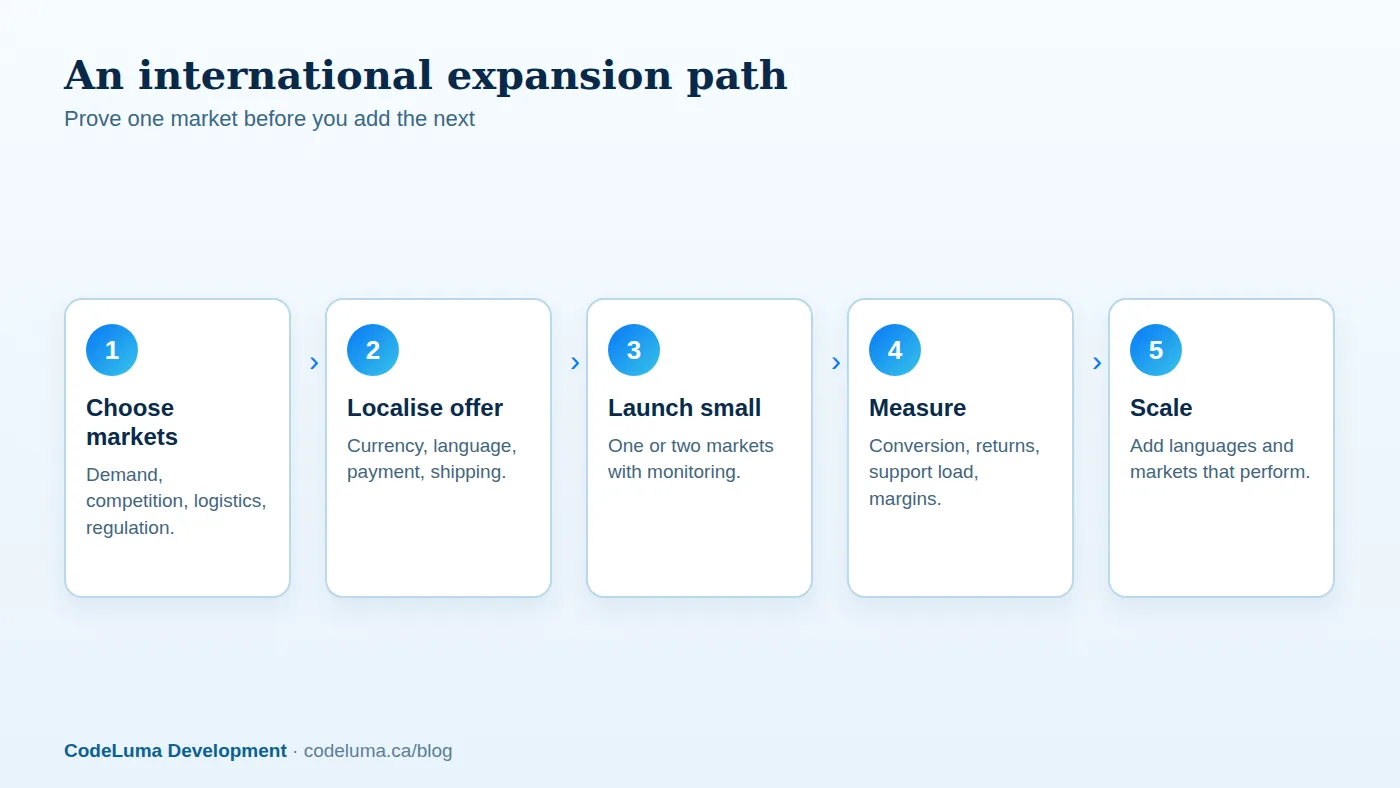
Choose markets before you build
Start with the business case. Which markets show demand in your analytics and search data? What are the logistics, taxes, product regulations and competitive conditions? Consider language coverage: English opens many markets, but French, Spanish, German and others convert significantly better in their own regions. Begin with one or two markets, measure, and expand. The architecture should allow more later, but do not localise for twenty countries on day one.

Currency: display, charge and settle
Three questions define your currency strategy:
- What currency does the customer see? Show local currency prices throughout: listings, cart, checkout and confirmation. Consistency matters; a price that flips to another currency at the last step destroys trust.
- What currency is the customer charged in? Charging in the local currency reduces bank conversion fees and surprises for the shopper. Most payment providers support presentment in multiple currencies.
- What currency do you settle in? Your provider can convert to your home currency, with an exchange margin. Some let you hold balances in several currencies to reduce conversion costs.
Decide whether prices are converted automatically from a base currency using exchange rates or set manually per market. Automatic conversion is simple but produces odd numbers and fluctuates; manual pricing lets you use clean price points, such as 49.99 rather than 47.38, and reflect local competition and margin. Many merchants use rules: convert with a buffer for rate movement, then round to local psychological price points. Refresh rates on a schedule you can defend, and record the rate used on every order for accounting.
Handle money correctly in code
Store amounts as integers in the smallest currency unit, and record the currency with every amount. Currencies differ in decimal places: some have none, some have three. Use well-tested libraries for formatting and rounding, and follow local conventions for symbols, separators and placement. Design refunds and partial captures carefully: a refund should be in the original charge currency, and exchange rate differences need clear accounting treatment.
Language: translation and content strategy
Machine translation is a useful first draft for large catalogues, but customer-facing pages, product descriptions, checkout copy and legal text deserve human review, ideally by native speakers who understand your market. Build a translation workflow: a content management system that supports multiple languages with fallback, a way to mark strings as needing translation, translation memory to keep terminology consistent, and review steps before publishing. Separate content from code so the interface can be translated without redeploying. Plan for text expansion, since German or Finnish strings can be much longer than English, and for right-to-left languages if you enter those markets.
SEO for multiple languages and regions
International SEO needs deliberate structure. Use distinct URLs for each language or region version, through subdirectories, subdomains or country domains, and implement hreflang annotations so search engines serve the right version to the right audience, with reciprocal references and a default. Translate titles, descriptions, headings, URLs and structured data, not just body copy. Avoid automatic redirects based solely on IP address or browser language, which can block crawlers and frustrate users; suggest a version instead. Build local links and content for each market. Our technical SEO checklist covers the fundamentals.
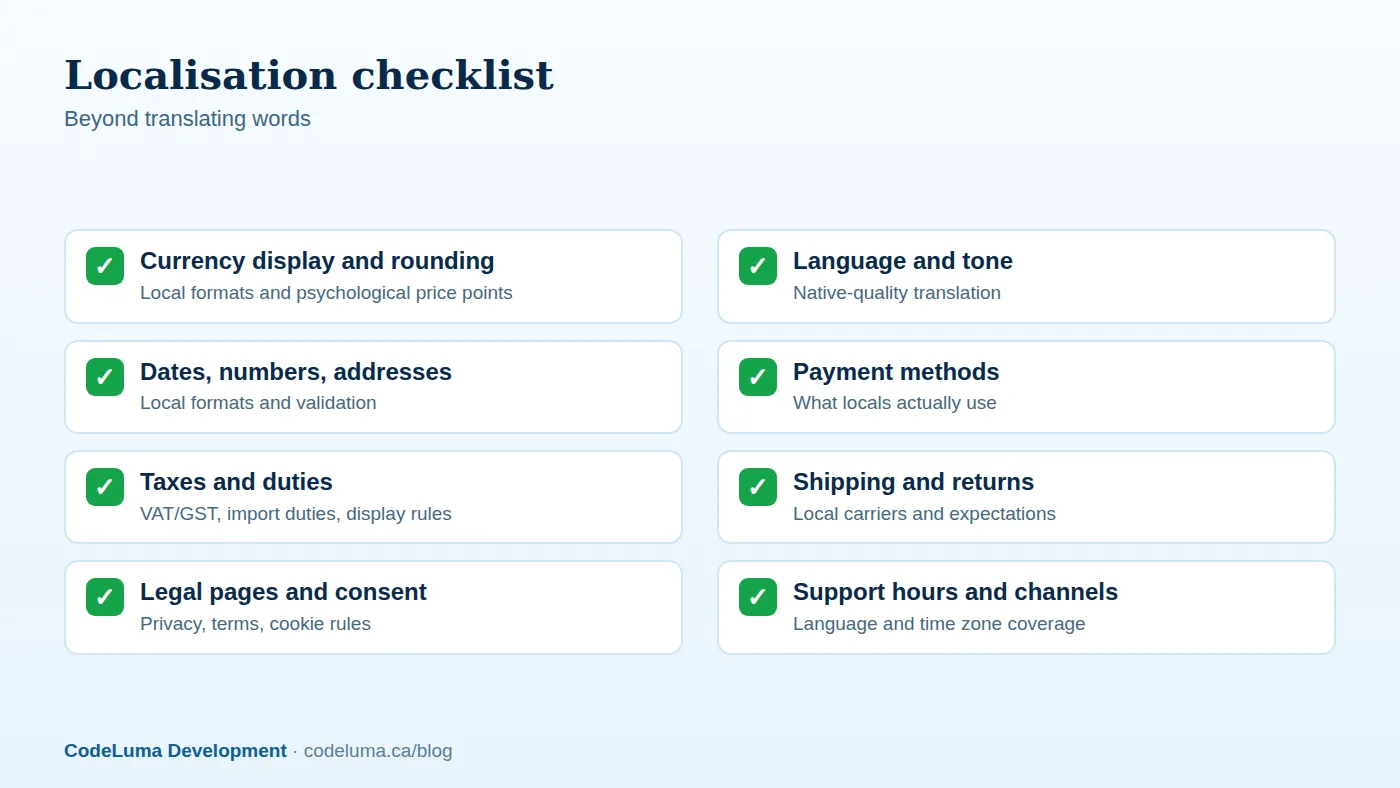
Taxes, duties and pricing display
Consumer prices in many countries are expected to include sales tax or VAT, while in others taxes are added at checkout. Selling into new jurisdictions can create registration and collection obligations, and thresholds vary. Cross-border shipments may attract import duties and customs fees that surprise buyers if not disclosed. Decide whether you will ship on a delivered-duties-paid basis, collecting duties at checkout, or leave them to the recipient, and communicate clearly. Use tax and duty calculation services rather than hand-maintained tables. We look at this in our guide to automated tax calculation, and you should consult a tax professional about your obligations.
Payments people trust locally
Preferred payment methods differ widely: cards dominate in some countries, while bank transfers, direct debit, wallets or local schemes lead in others. Offering the methods shoppers expect can materially increase conversion. Ensure your payment provider supports the countries and methods you need, handle strong authentication requirements, and display familiar logos. Consider fraud risk by region and tune your rules accordingly.

Shipping, returns and support
Show delivery estimates and costs for each destination, integrate regional carriers, and offer tracking. Make returns policies clear and, where possible, local, since the cost and difficulty of international returns strongly affect purchasing decisions. Provide support in the customer's language and reasonable time zones, even if that starts with email and a translated help centre.
Legal and compliance
Each market has consumer protection, privacy, cookie and product regulations. Privacy rules such as the EU's GDPR apply to European visitors regardless of where you are based, and other regions have their own laws. Localise legal pages and consent flows. See our overview of privacy and data-protection compliance. Product labelling, warranties and restricted goods can also vary, so verify before entering a market.
Technical architecture
- Design the catalogue with translatable fields and market-specific pricing, availability and content.
- Keep locale, currency and market as explicit concepts, not guessed from scattered settings.
- Cache pages per locale and currency, and make cache keys reflect them. See our caching guide.
- Use a CDN with global coverage for speed.
- Test with real locales: date formats, name and address forms, sorting rules and special characters.
Measure and iterate
Track conversion, average order value, returns and support volume by market, and compare them with your home market. Underperformance often traces back to unclear delivery costs, missing payment methods or awkward translation. Iterate market by market. A web development partner can build the multi-market foundations once, so each new country becomes an incremental launch rather than another project.
Put this into practice with CodeLuma
CodeLuma builds multi-currency, multi-language storefronts with correct pricing, localised content, hreflang SEO and regional payment and tax handling, so expanding to new markets does not mean rebuilding your store.
- Website and web application development - fast, accessible, search-friendly builds.
- Custom software development - tailored systems, integrations and internal tools.
- Managed hosting - monitored, backed-up, Canadian-friendly hosting.
Start a conversation. Tell us about your project and we will reply with practical next steps, or browse all CodeLuma services. CodeLuma Development Inc. is based in Nova Scotia and works with teams across Canada and remotely.


