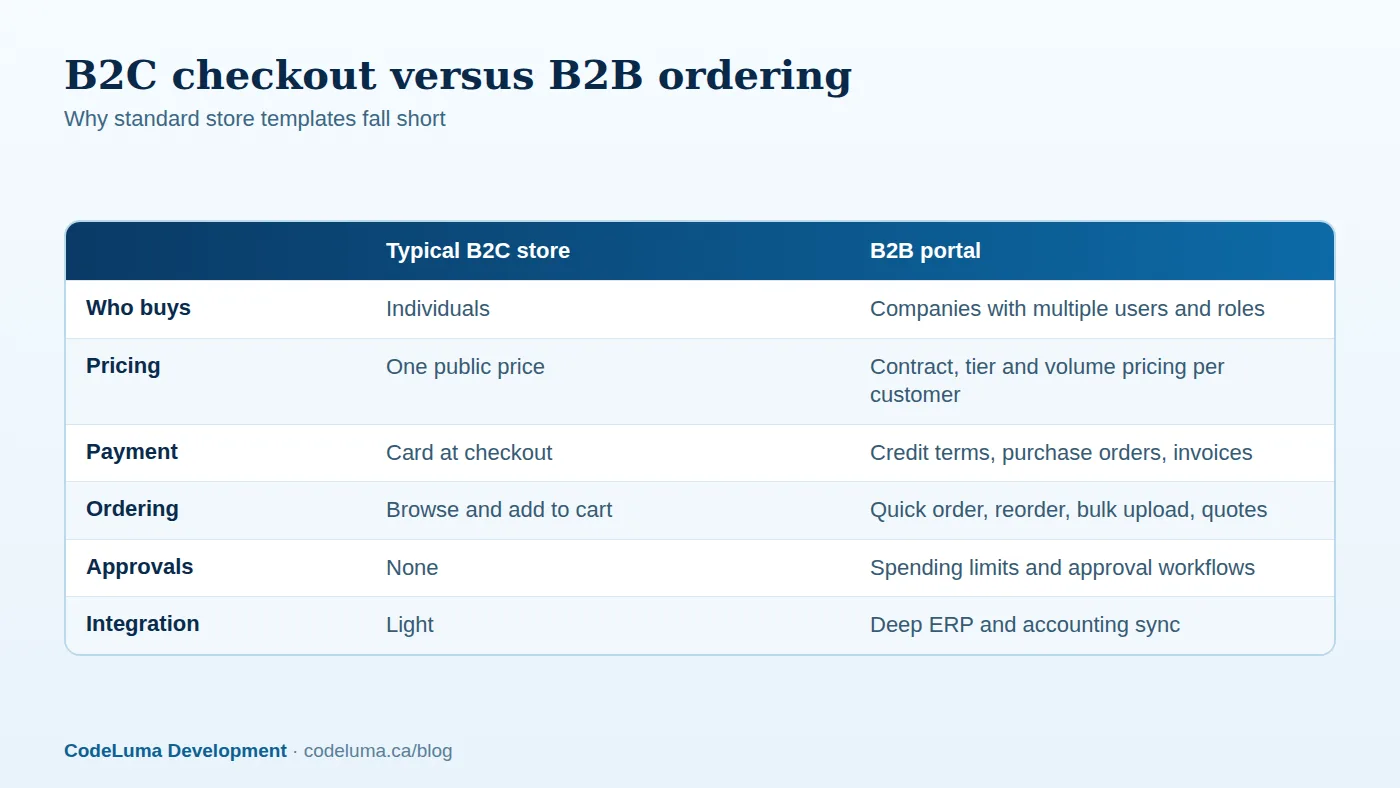
Selling to businesses is different from selling to consumers. Your customers are companies with several people who order, approve and pay. They negotiate prices, buy on credit terms, place large repeat orders and expect the ordering experience to fit their procurement process. Many suppliers still take orders by phone, email and spreadsheet because their website was built for retail. A well-designed B2B portal moves this work online, cutting costs, reducing errors and giving buyers 24-hour self-service. This guide walks through the features that matter and the design decisions behind them.
Start with accounts that mirror how businesses work
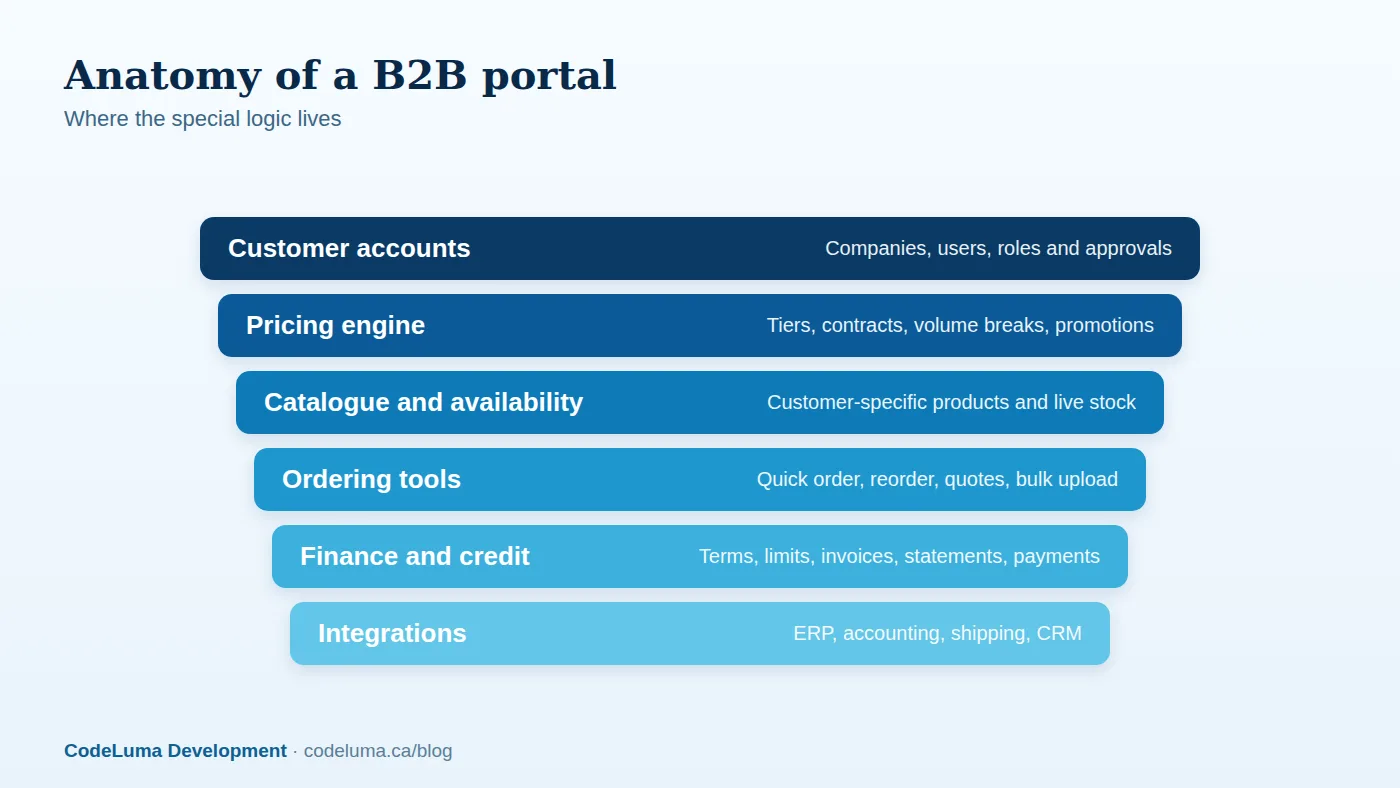
A B2B customer is a company account with several users, not a single login. Model an organisation with multiple buyers, approvers and finance contacts, each with a role and permissions. Support multiple ship-to addresses and bill-to entities, and per-location or per-department budgets. Include spending limits and approval workflows: an order above a threshold routes to a manager before it is placed. Allow buyers to be added and removed without support tickets, using invitations, and give administrators visibility into the account's activity.

Pricing: the heart of the portal
B2B pricing is where standard e-commerce platforms strain. A flexible pricing engine typically supports:
- Price lists per customer or customer group, reflecting negotiated contracts.
- Tiered and volume breaks: buy ten, pay this; buy a hundred, pay less.
- Customer-specific catalogues, so buyers see only approved products and their own part numbers.
- Effective dates and expiry for contract pricing and promotions.
- Unit-of-measure conversions, such as each, box and pallet.
- Rules for precedence, when a customer qualifies for several prices at once: contract price wins over list price, unless a promotion is lower, and so on.
Make the pricing logic explicit and testable, and show buyers clear prices in the currency they expect. When prices live in an ERP, decide whether the portal calls it in real time or receives synchronised price files, weighing accuracy against speed.
Credit terms and payment options
Many B2B buyers pay on account rather than with a card: net 30, net 60 or similar. The portal should show each customer's credit limit, available credit and outstanding invoices, and block or flag orders that would exceed them, according to your policy. Support purchase order numbers on orders, invoices and statements, downloadable invoices and account statements, and online payment of open invoices by card, bank transfer or direct debit, with clear allocation to specific invoices. Early-payment discounts and late fees, if you use them, must be calculated correctly. Integrate with your accounting system so payments and balances stay in sync.
Ordering tools buyers love
Business buyers care about speed and accuracy, and they order repeatedly. Useful features include:
- Quick order forms: type or paste part numbers and quantities to fill the cart instantly.
- Bulk upload: import a CSV of SKUs and quantities, with validation and clear error messages.
- Reorder and saved lists: one-click repeat of previous orders, and shared lists for recurring purchases.
- Quotes and negotiated requests: let buyers request a quote for large or custom orders, receive a priced proposal, and convert it to an order with one click.
- Scheduled and standing orders: automate regular deliveries.
- Order tracking and history: shipments, invoices and documents in one place.
- Returns and claims handled online.
Real-time availability and fulfilment
Buyers want to know if items are in stock at the location that will ship them, with realistic lead times, before they order. Show availability by warehouse, allow backorders where appropriate, and support partial shipments and drop-shipping. Keep the numbers reliable; the techniques in our guide to real-time inventory apply directly.
Integrate with the systems that run your business
The portal is only as good as its connections. Orders flow into the ERP or order management system; customer records, prices, inventory and invoices flow back. Integration with accounting handles invoicing and payments, shipping systems handle rates and labels, and CRM tracks the relationship and support. Design integrations with queues, retries and monitoring so failures do not silently lose orders, and plan for fallback when a system is down. See our article on webhooks and automated workflows for the patterns.

Procurement system compatibility
Large customers may want to buy from their own procurement systems. Options include punchout catalogues (the buyer's system opens your catalogue, the buyer fills a cart and returns it as a requisition), EDI or API-based order exchange, and single sign-on with the customer's identity provider. You may not need all of them at launch, but design the architecture so they can be added without a rewrite.
Security and privacy
Customer pricing and order history are commercially sensitive. Enforce strict tenant isolation so one company can never see another's data, use role-based access control and audit logging, protect accounts with multi-factor authentication, and encrypt data in transit and at rest. We discuss the design of multi-tenant architectures and role-based access elsewhere.
Getting adoption
A portal succeeds only if buyers use it. Involve a handful of key customers early: watch them order today, find the friction, and let them test prototypes. Migrate accounts in waves, train sales and support teams, and offer incentives such as faster service, exclusive online pricing or easier reorders. Track adoption, percentage of orders placed online, order errors and cost per order to show the return. Keep phone support available, but nudge repeat business toward self-service.
Build or buy?
Some commerce platforms offer B2B modules, and they can cover simpler needs. When pricing logic, credit control, approvals and ERP integration are central to your business, a custom or heavily configured portal usually delivers a better fit. A staged rollout, starting with account management, reorder and invoice payment before adding advanced pricing and punchout, gets value to customers quickly. If you are weighing options, our guide to Shopify versus custom headless commerce helps frame the decision, and our custom software team can scope a portal around your real processes.
Put this into practice with CodeLuma
CodeLuma builds B2B portals that encode your real pricing, credit and approval rules, integrate with your ERP and accounting, and give customers self-service ordering they will actually use.
- Custom software development - tailored systems, integrations and internal tools.
- Website and web application development - fast, accessible, search-friendly builds.
- Maintenance and support plans - updates, monitoring and ongoing improvement.
Start a conversation. Tell us about your project and we will reply with practical next steps, or browse all CodeLuma services. CodeLuma Development Inc. is a Canadian company that works with teams in Windsor, Essex, London, Toronto, Mississauga and across Ontario, throughout Canada and remotely.