A roadmap is a promise about the future, and both investors and developers tend to read it differently. Investors want to know where their money is going and when milestones will be hit. Developers know that software estimates are uncertain and that priorities change. When a roadmap is written as a list of features with fixed dates, it is almost certain to be wrong, and the resulting friction damages trust. A better roadmap communicates direction, priorities and confidence, and gives everyone a shared way to talk about trade-offs.

Start with outcomes, not features
The most useful roadmaps are organised around outcomes: things you want to be true for customers or the business. "Reduce onboarding time from ten days to three" or "enable customers to pay by subscription" says why the work matters and leaves room to choose the best solution. A feature-only roadmap ("build dashboard v2") hides the goal, and if the feature ships but the outcome does not move, nobody notices until later.
For each outcome, write a short statement: the problem, the audience, the success measure, and the rough size of the effort. Keep the list short. A team pursuing three outcomes at a time ships more than a team pursuing ten.

Use time horizons instead of exact dates
Precision should match knowledge. We recommend three horizons:
- Now (the next four to six weeks): committed, scoped work with owners. Dates are reliable here.
- Next (one to two quarters): prioritised outcomes with approximate sizing. Order matters; exact dates do not.
- Later (beyond that): themes and bets, explicitly labelled as uncertain.
Investors often push for precise dates for everything. It helps to explain that false precision hurts them: a date that will be missed is worse than an honest range. Offer instead a commitment to update the roadmap on a regular schedule, and to flag changes early.
Prioritise with a simple, transparent method
Every roadmap involves saying no. Use a lightweight scoring approach so decisions are explainable, not political. A common approach scores each item on expected impact, confidence in that impact, and effort, then ranks by impact times confidence divided by effort. The numbers are rough, but the discussion they force is valuable. Add strategic constraints separately: compliance deadlines, contractual commitments, security fixes, and technical foundations that unlock future work. Show these as their own category so stakeholders see that not everything on the roadmap is a customer feature.
Include the work nobody asks for
Many roadmaps ignore maintenance, security, performance, testing and debt reduction because they are hard to sell. Then the team quietly squeezes them out of feature work, and velocity declines. Reserve explicit capacity, often ten to twenty percent, and show it on the roadmap. Investors who understand that a fast team is a healthy team tend to support this, especially when you tie it to measurable results such as fewer incidents and shorter lead times.
Attach confidence and risk
Label every roadmap item with a confidence level, high, medium or low, and list the top risks: unknown integrations, dependencies on third parties, unproven demand, regulatory reviews. Confidence labels turn arguments about dates into conversations about risk reduction. Low-confidence items often deserve a small discovery task first, such as a prototype or technical spike, before they graduate to a committed estimate.
Align on a shared vocabulary
Agree what terms mean: what does "done" mean, what is an MVP, what is a beta, what counts as a launch? Many roadmap disputes are vocabulary disputes. Document a definition of done that covers testing, security review, documentation, and monitoring, so "shipped" means the same thing to everyone.

Report progress in a way investors value
Investors care about outcomes, risk and capital efficiency more than about ticket counts. A monthly update that covers what shipped and what it did to the metrics, what is next, what changed and why, the top three risks, and cash or budget implications builds trust faster than a long status report. Show a short demo whenever possible; a two-minute screen recording of new functionality communicates more than a paragraph. Bad news should travel fast: early warnings, with options, preserve credibility.
Run a regular roadmap rhythm
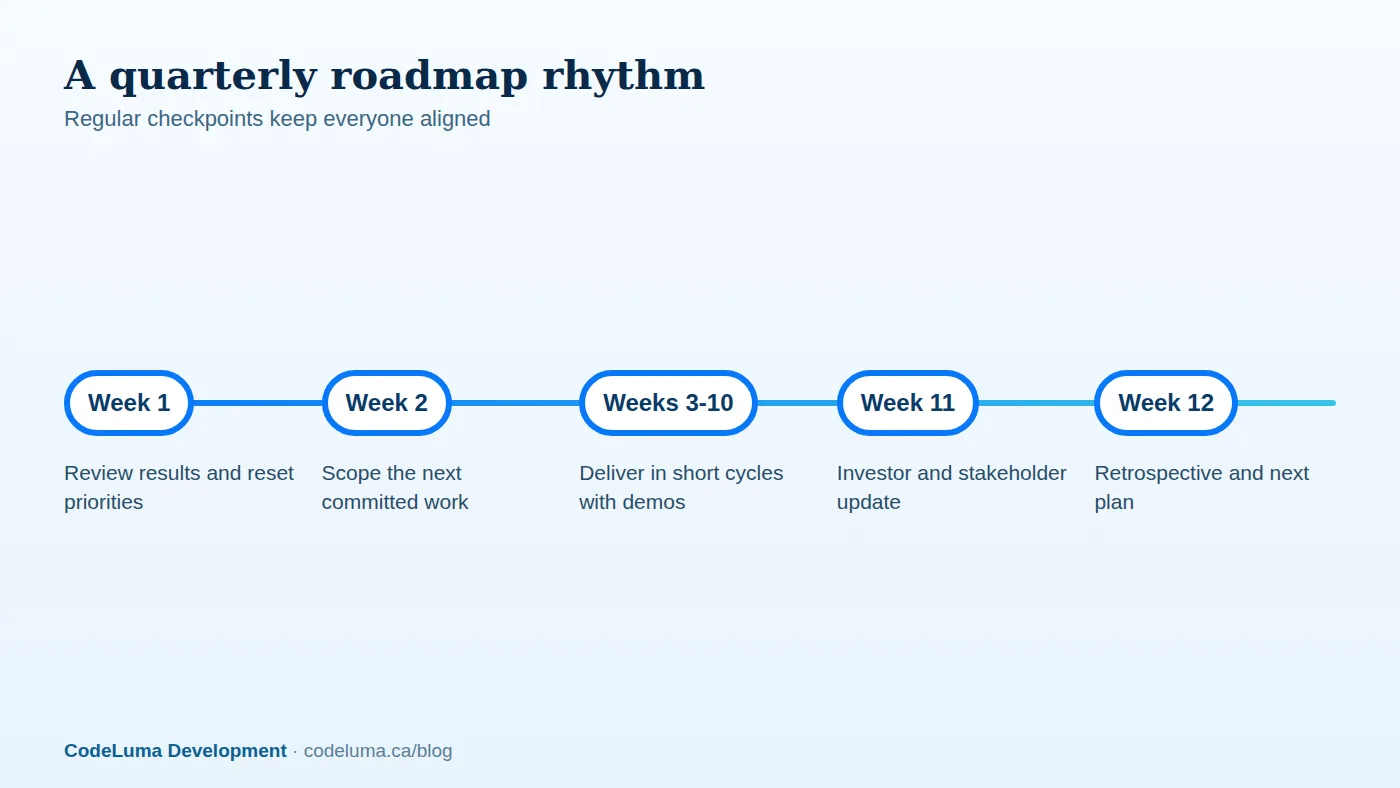
A roadmap is a living document. Review it monthly and reset it quarterly. In each review, ask what we learned, which assumptions were wrong, what changed in the market, and whether the priorities still reflect the strategy. Invite developers into the process; they see technical risks and opportunities others miss, and involvement improves commitment. Keep a visible change log so stakeholders can see how and why the plan evolved.
Common mistakes
- Treating the roadmap as a contract instead of a plan.
- Committing dates to the "Later" horizon.
- Overloading the near term, leaving no room for surprises.
- Ignoring dependencies on other teams, vendors or regulators.
- Never removing anything: a roadmap that only grows is not a roadmap.
How a development partner should help
A good partner does more than estimate tickets. They help you frame outcomes, challenge scope, surface technical dependencies, propose phased delivery, and report progress in terms your investors understand. They should give you ranges with assumptions, flag risks early, and adapt the plan without drama when reality changes. If you are preparing for a funding round, a clear roadmap with a realistic first phase is one of the strongest signals of execution ability you can show.
Put this into practice with CodeLuma
CodeLuma helps founders turn goals into phased, costed roadmaps and then delivers them in short cycles with transparent reporting, so investors see progress and developers keep a realistic pace.
- Custom software development - tailored systems, integrations and internal tools.
- Website and web application development - fast, accessible, search-friendly builds.
- Mobile and app development - iOS, Android and progressive web apps.
Start a conversation. Tell us about your project and we will reply with practical next steps, or browse all CodeLuma services. CodeLuma Development Inc. is based in Nova Scotia and works with teams across Canada and remotely.