WordPress powers a very large share of the web, and for good reason: it is flexible, familiar and backed by a huge ecosystem. Yet many businesses that once relied on it are moving parts of their sites to headless architectures, and articles proclaiming the death of WordPress have become a genre. The truth is more nuanced. Headless content management is a powerful pattern for particular needs, and a needlessly complicated one for others. This article explains what it is, when it pays off, and how to decide.
What "headless" means
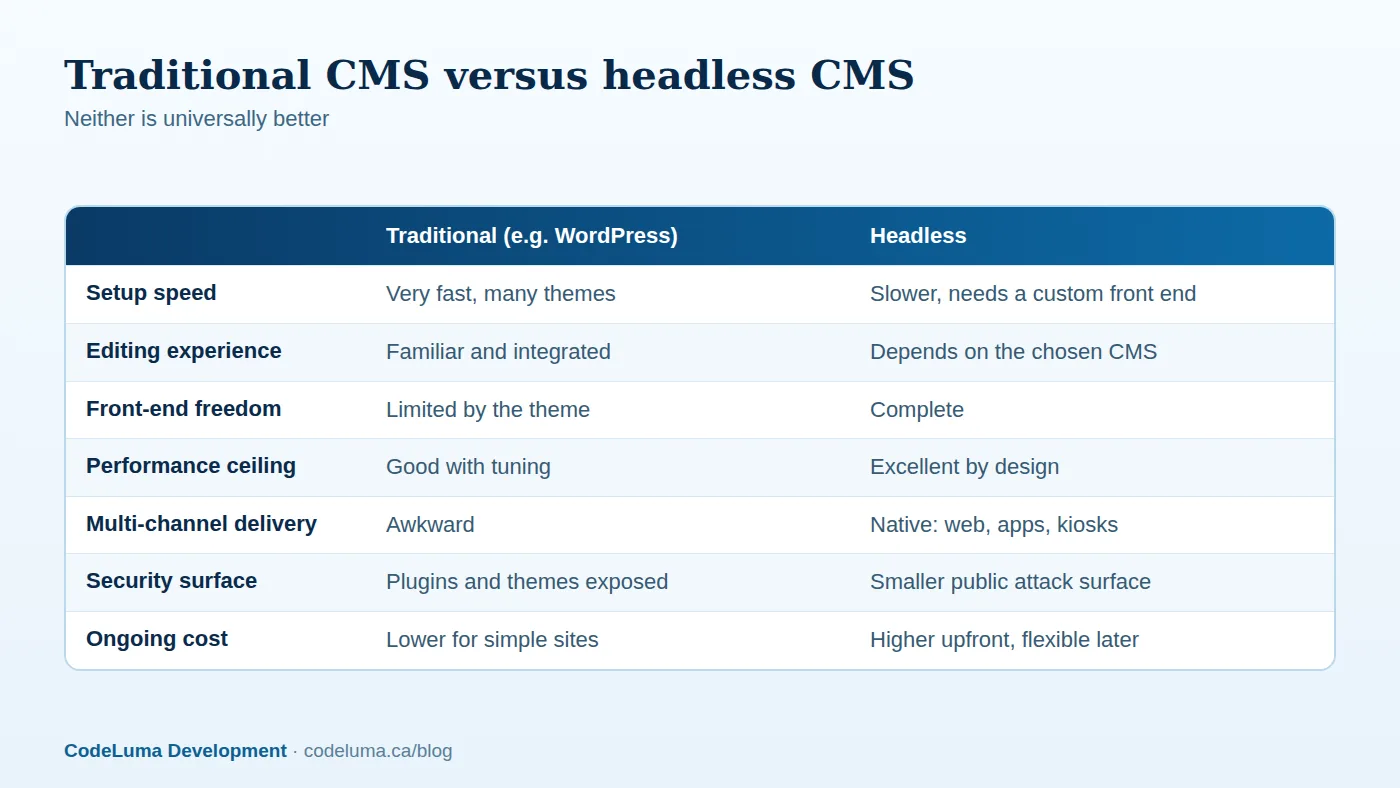
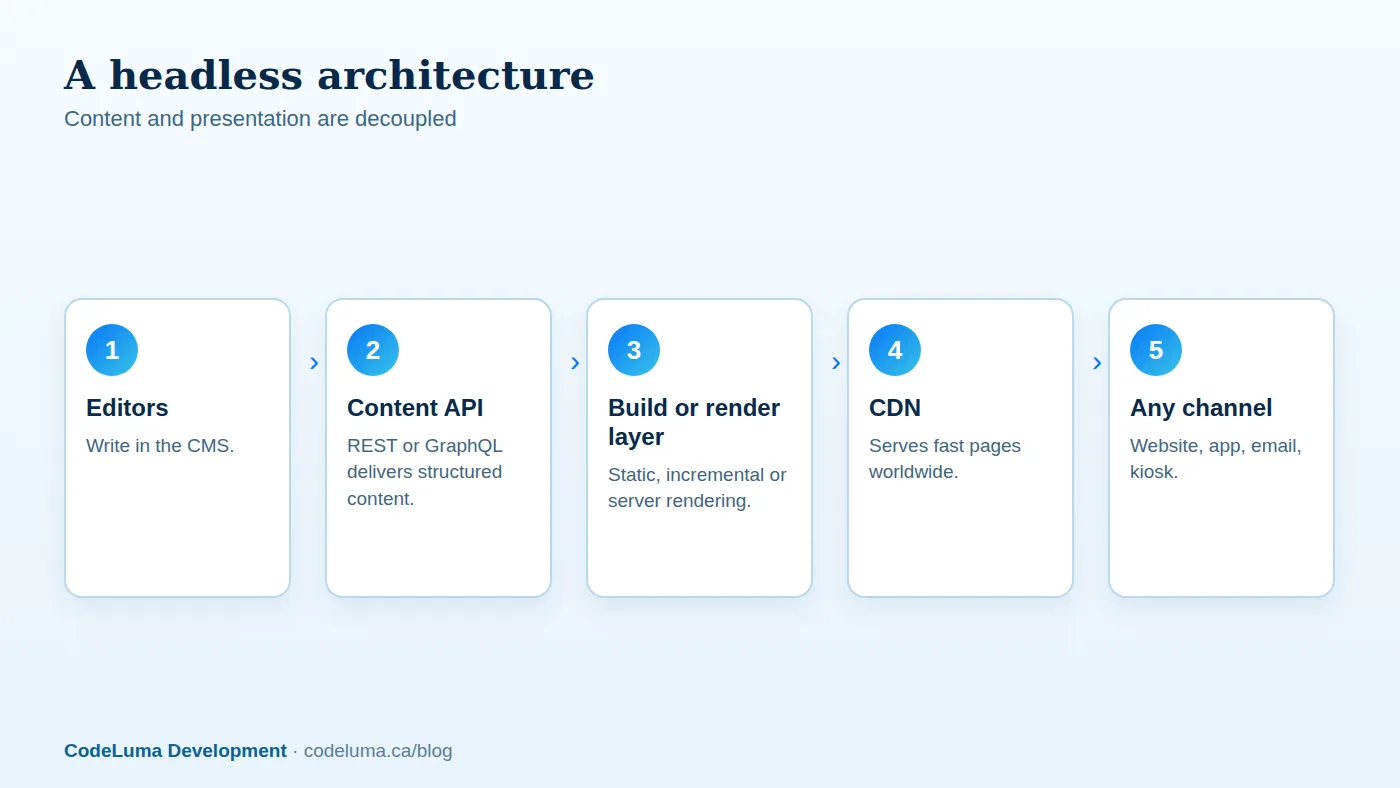
A traditional CMS handles everything: it stores content, manages editors, and also generates the pages visitors see through themes and templates. The content and the presentation are tightly coupled. A headless CMS removes the presentation layer, the "head." It stores and manages structured content and exposes it through an API. A separate front end, built with the framework of your choice, fetches that content and renders it as a website, a mobile app, a digital display or anything else.

Why businesses go headless
Performance and control. With a purpose-built front end, you decide exactly what is sent to the browser. Pages can be pre-rendered and served from a CDN, which produces excellent speed and Core Web Vitals without the layers of theme code and plugins typical of traditional setups. See our notes on rendering strategies for how this works.
Multi-channel publishing. If the same content must appear on a website, a mobile app, a partner portal and in-store screens, a content API means you write once and publish everywhere.
Security. The public site can be static files or a minimal server, and the CMS can sit behind authentication, reducing the exposed attack surface. Many WordPress security incidents come from outdated plugins and themes on public servers, a risk that shrinks considerably when the public site does not run them.
Developer experience and scalability. Modern front-end frameworks, component libraries, testing and version control fit naturally, and the front end can scale independently of the editing system.
Design freedom. You are not constrained by a theme's structure, which matters for brands with distinctive, interactive experiences.
Where headless costs you
- Higher upfront investment. You must build the front end, previews, navigation, search, forms and SEO features that a traditional theme provides out of the box.
- Editor experience. Marketers used to visual page builders may miss "what you see is what you get" editing. Live preview must be built deliberately.
- More moving parts. Two systems, a build pipeline and a hosting setup instead of one installation.
- Plugin ecosystem gaps. Functions that were one click in WordPress, such as SEO plugins, forms and redirects, need to be replaced or rebuilt.
- Vendor considerations. Hosted headless platforms have their own pricing and limits.
When WordPress is still the right answer
A traditional CMS remains an excellent choice when the site is primarily marketing or brochure content, the budget is modest, the team wants to manage layout without developers, the required features are well served by mature plugins, and you do not need multi-channel delivery. A well-built, well-hosted WordPress site with a lightweight theme, minimal plugins, caching and regular updates can be fast, secure and effective. Many of the performance problems attributed to WordPress are really problems of bloat and neglect.
A middle path: headless WordPress
You do not have to abandon WordPress to go headless. Many teams keep it as the editing environment, which editors already know, and use its API to feed a custom front end. This preserves familiarity while gaining the performance and flexibility of a modern front end. The trade-off is that you still maintain WordPress, so keep it locked down and behind authentication.

How to choose a headless CMS
- Content modelling. Can you define structured content types with relationships, validation and localisation?
- Editor experience. Roles, workflows, scheduling, media management and live preview.
- API quality. Clean REST or GraphQL APIs, webhooks for build triggers, and good documentation.
- Hosting model. Fully managed SaaS, or self-hosted open source? Consider cost, data residency and lock-in.
- Ecosystem and longevity. Active development, community and integrations.
- Total cost. Include seats, API calls, bandwidth and environments.
Migrating without losing SEO
A migration is a chance to improve content, but it carries SEO risk if done carelessly. Inventory every URL and its traffic; preserve URLs where possible and implement one-to-one 301 redirects where they change. Migrate titles, descriptions, headings, structured data, canonical tags, image alt text and internal links. Keep XML sitemaps and robots rules correct. Test the new site on a staging environment with a crawler, compare it against the old one, and monitor Search Console closely after launch. Our approach to technical SEO applies directly here.
Making the decision
Ask three questions. First, how much do performance, design freedom and multi-channel reuse matter to the business? Second, who will edit content, and what experience do they need? Third, what can you afford to build and maintain? If the answers point to simplicity, optimise your existing CMS. If they point to flexibility and scale, a headless architecture is worth the investment. A web development team that works with both can give you an unbiased comparison based on your actual goals.
Put this into practice with CodeLuma
CodeLuma builds both: well-tuned traditional CMS sites and headless architectures. We recommend whichever fits your team and goals, and we handle the content migration and SEO safeguards either way.
- Website and web application development - fast, accessible, search-friendly builds.
- Custom software development - tailored systems, integrations and internal tools.
- Managed hosting - monitored, backed-up, Canadian-friendly hosting.
Start a conversation. Tell us about your project and we will reply with practical next steps, or browse all CodeLuma services. CodeLuma Development Inc. is a Canadian company that works with teams in Windsor, Essex, London, Toronto, Mississauga and across Ontario, throughout Canada and remotely.