Distance is a real cost on the internet. Light in fibre is fast, but a request from Halifax to a server in Singapore still needs hundreds of milliseconds for the round trip, and a page load involves many round trips. For users far from your servers, that delay is the difference between a snappy site and a sluggish one. Edge computing addresses the problem by moving content and computation closer to the people using it. This guide explains the concept without the jargon and shows where it pays off for ordinary business websites and applications.
What "the edge" actually is
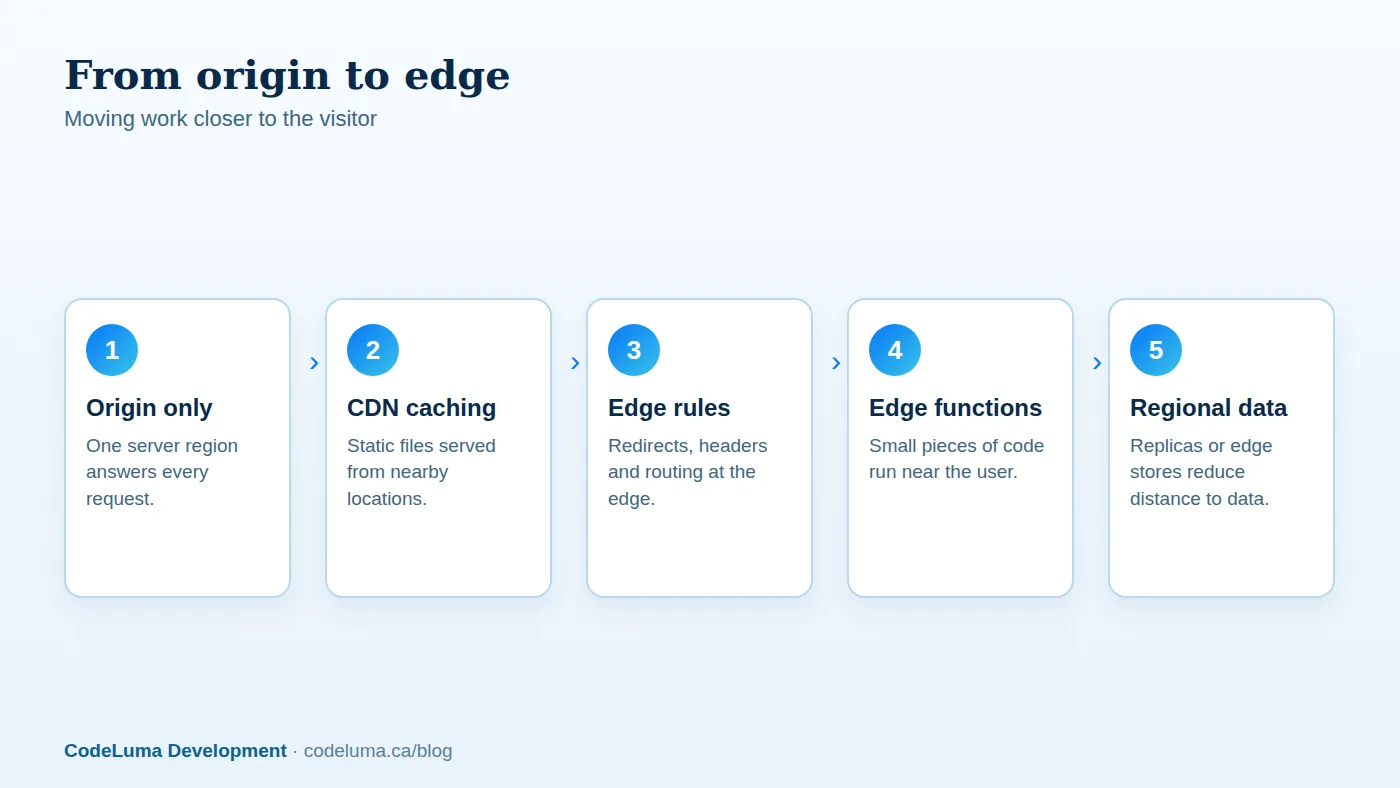
Your traditional server, the origin, sits in one data centre. The edge is a network of many smaller locations spread around the world, operated by CDN and cloud providers, each close to a large population of users. Requests reach the nearest edge location first. Depending on what you configure, the edge can answer from cache, transform the request or response, or run your own code, only forwarding to the origin when necessary.

Level one: CDN caching
The simplest and most valuable use of the edge is caching static assets and, where possible, whole pages. A visitor in Sydney loading your logo, styles and scripts from a nearby edge node instead of a Canadian origin saves substantial time on every request. We describe practical cache design in our guide to Redis and CDN caching. For most content-driven sites, this step delivers most of the benefit with very little complexity.
Level two: edge rules
Many CDNs let you define rules that run at the edge without writing code: redirects, header changes, URL rewrites, security headers, geographic routing and simple bot or rate limiting. Handling a redirect at the edge avoids a round trip to the origin, and blocking obviously hostile traffic before it reaches your servers reduces load and cost.
Level three: edge functions
Edge functions, sometimes called edge workers, let you run small pieces of JavaScript or WebAssembly at the edge locations. Typical uses include:
- Personalisation. Choosing which version of a page or banner to show based on country, language or cookie, without a trip to the origin.
- Authentication checks. Validating a token before allowing a request to proceed.
- A/B testing. Assigning visitors to variants and serving the right cached page.
- Request shaping. Adding headers, normalising URLs, or composing responses from multiple APIs.
- Image and content adaptation. Serving the right image format and size for the device.
Edge functions typically have tight limits on execution time, memory and available libraries, and cold starts are usually very short. They are excellent for small, fast, stateless tasks.
Level four: data at the edge
The hard part is data. Running code near the user is little use if every request must then travel to a database on the other side of the planet. Options include read replicas in several regions, globally distributed key-value stores for configuration and small records, edge caches with stale-while-revalidate for API responses, and databases designed for multi-region reads. The trade-off is consistency: data in multiple places can be briefly out of sync. You must decide which data can be slightly stale, such as product descriptions, and which cannot, such as payment state.


Benefits worth caring about
- Lower latency for global audiences, improving load and interaction times.
- Resilience. Cached content can keep serving even when the origin has a problem.
- Origin protection. The edge absorbs traffic spikes and hostile traffic.
- Cost savings. Fewer requests reach your servers, and bandwidth at the edge is often cheaper.
- Security features, such as web application firewalls and DDoS mitigation, closer to the source of attacks.
Limits and traps
- Complexity creep. Logic scattered between the edge, the origin and the browser is hard to debug. Keep edge code small and well documented.
- Cache correctness. Serving the wrong personalised page from a shared cache is a serious bug. Vary cache keys carefully.
- Vendor lock-in. Edge runtimes differ. Isolate provider-specific code behind small interfaces.
- Testing. Behaviour can differ by location; test from multiple regions.
- Data residency and privacy. Processing at global edge locations can conflict with rules about where personal data may be handled. Check requirements before moving personal data processing to the edge.
- Not a fix for a slow origin. If your uncached responses are slow, the edge only helps the cached fraction.
Who needs it?
If your customers are mostly in one region and your hosting is in that region, a good CDN plus solid caching is usually enough. If you serve a national or global audience, sell online, run marketing campaigns that drive bursts of traffic, or operate an application where latency affects usability, a more deliberate edge strategy pays off. Businesses with customers across Canada and internationally often find that adding a CDN, edge redirects and cached pages improves both speed and resilience at modest cost.
How to start
- Measure real-user performance by country and region to see who is suffering.
- Put a CDN in front of the site and cache static assets and cacheable pages.
- Move redirects, security headers and simple routing rules to the edge.
- Introduce edge functions only for a specific, measured need.
- Consider regional data replicas when database latency dominates.
- Monitor cache hit rates, edge errors and origin load.
A well-designed hosting and delivery setup puts these layers together sensibly, so visitors anywhere get a fast site without your team managing a global network.
Put this into practice with CodeLuma
CodeLuma helps businesses use the edge where it genuinely helps, from CDN configuration to edge functions for personalisation and redirects, without turning a simple site into a distributed-systems project.
- Website and web application development - fast, accessible, search-friendly builds.
- Custom software development - tailored systems, integrations and internal tools.
- Managed hosting - monitored, backed-up, Canadian-friendly hosting.
Start a conversation. Tell us about your project and we will reply with practical next steps, or browse all CodeLuma services. CodeLuma Development Inc. is based in Nova Scotia and works with teams across Canada and remotely.


