Choosing where to host an application used to mean picking a server. Today it means choosing among enormous cloud platforms with hundreds of services, developer-friendly platforms that hide the infrastructure, and traditional managed hosting. The wrong choice, either too complex or too limited, costs money and time for years. This guide compares the main options in plain language and offers a framework for growing businesses to decide. It deliberately avoids declaring a universal winner, because there is not one.
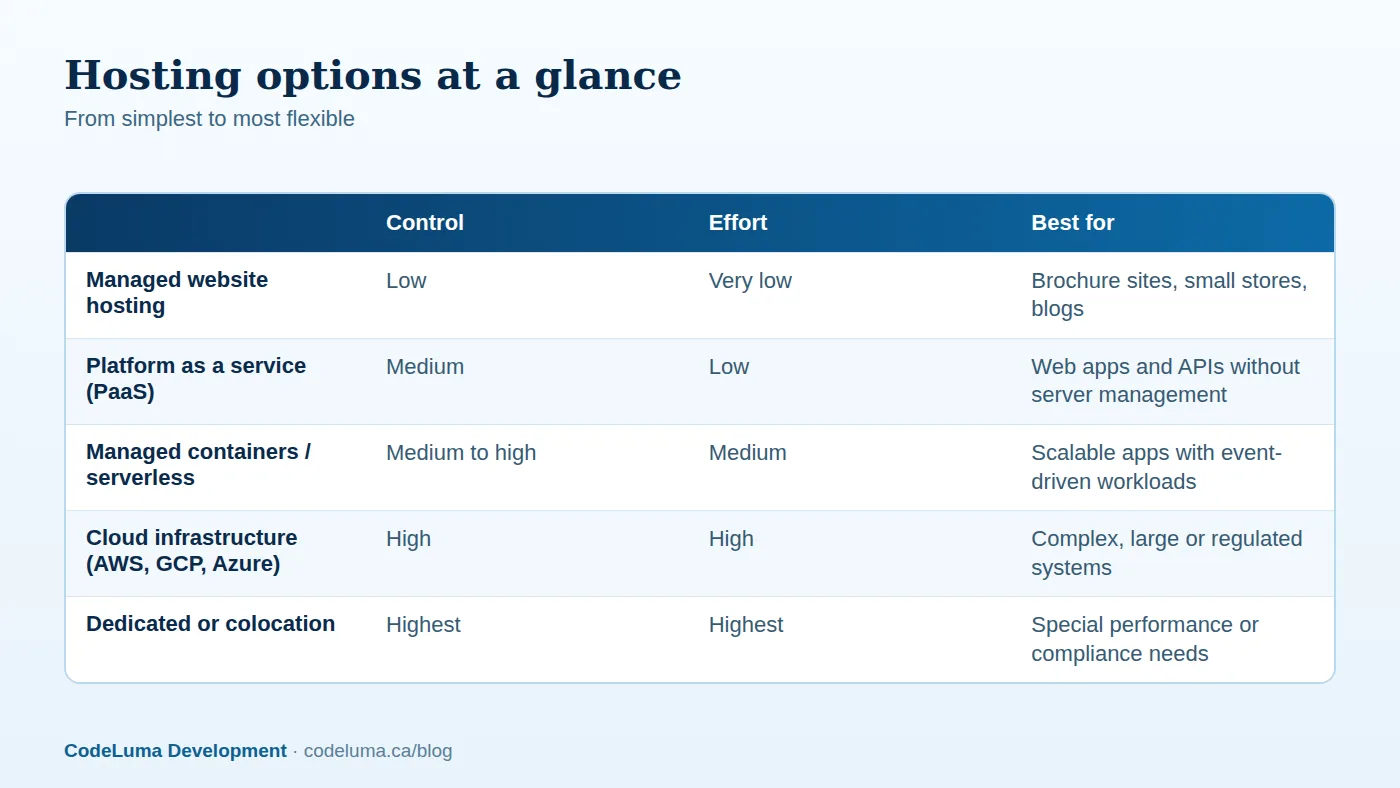
The spectrum of hosting
Managed website hosting. A provider runs the servers, updates, backups and support for websites and common applications. It is inexpensive, simple and perfectly adequate for many brochure sites, blogs and small stores, though performance and flexibility are limited at high traffic or with unusual requirements.
Platform as a service (PaaS). You push code, and the platform builds, runs, scales and monitors it. Examples include developer-focused platforms and the PaaS features of the major clouds. PaaS dramatically reduces operational work and is excellent for small teams building web apps and APIs, with the trade-offs of somewhat higher unit costs and less control over the underlying environment.
Containers and serverless. You package applications as containers, run them on managed services, or write functions triggered by events, paying per use. These options scale well and offer flexibility with moderate operational overhead, although architecture and debugging are more involved.
Cloud infrastructure from the major providers. Amazon Web Services, Google Cloud Platform and Microsoft Azure offer virtual machines, managed databases, storage, networking, queues, analytics, machine learning and much more. They provide almost unlimited flexibility and global reach, but the complexity and the potential for misconfiguration, security gaps and surprise bills are significant, and skilled people are required.

How the big three differ
All three are mature, reliable and broadly capable, with many equivalent services under different names. Differences that matter in practice:
- Amazon Web Services has the broadest catalogue, the largest ecosystem of tools, partners and talent, and a long track record. Its breadth can also mean complexity.
- Microsoft Azure integrates tightly with Microsoft identity, productivity and enterprise software, which makes it attractive for organisations already invested in that ecosystem.
- Google Cloud is strong in data analytics, machine learning and Kubernetes, and is often praised for developer experience and networking.
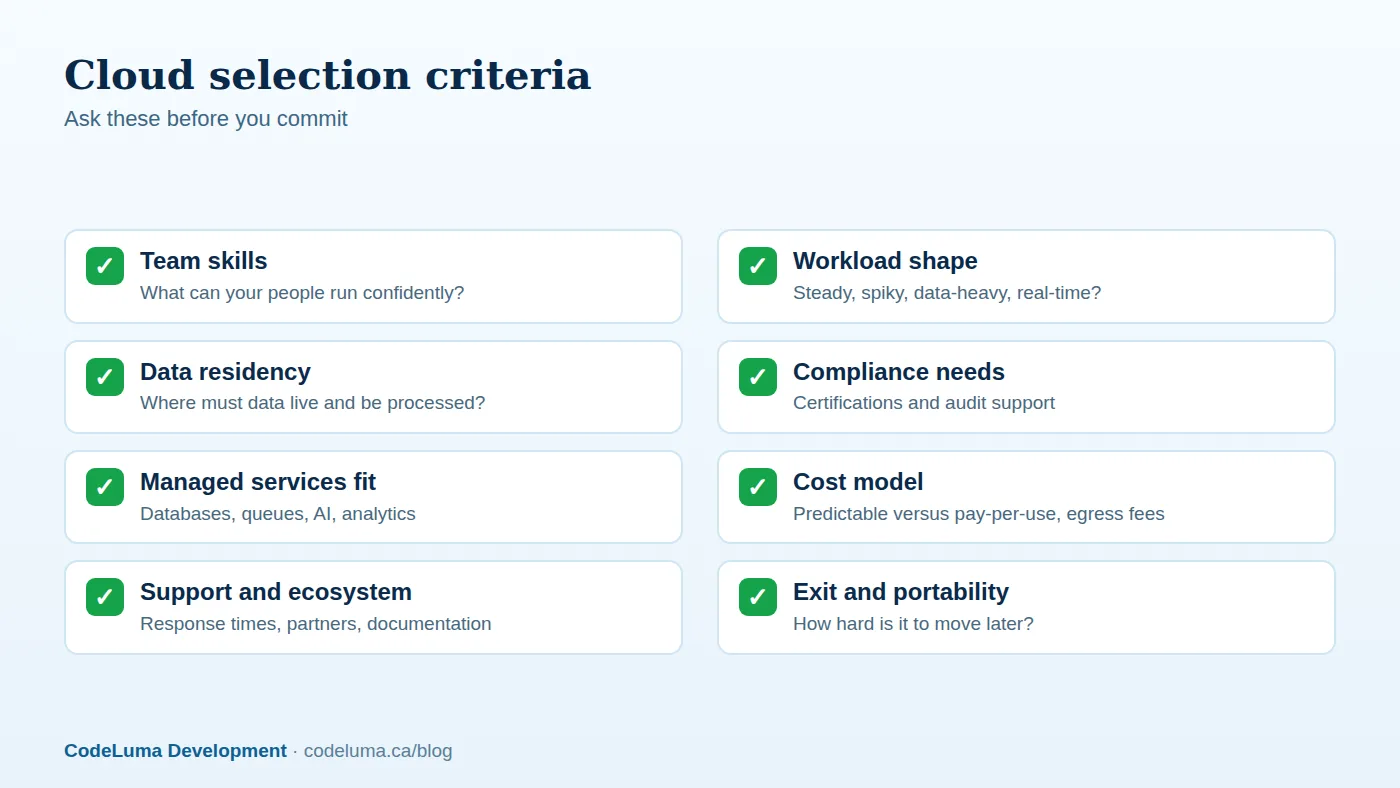
For most growing businesses, the choice among them should be driven by team skills, existing relationships, specific managed services required and pricing for your workload, not by abstract rankings.
Cost: understand the model, not just the price
Cloud pricing is complex. Many costs scale with use: compute time, storage, requests, data transfer out of the cloud, managed database sizes and support plans. Pay-as-you-go is flexible, but it can produce surprises when traffic or data volumes grow, when resources are left running or when architecture generates heavy network transfer. Committed-use discounts and reserved capacity reduce cost for steady workloads. Compare total cost of ownership, including engineering time: a slightly more expensive PaaS may cost far less overall than a cheaper raw infrastructure that requires an engineer to run it. We give practical savings advice in our guide to lowering your cloud bill.
Location and data residency
Where your data lives matters for latency and law. Canadian businesses often need data stored or processed in Canada for contractual, regulatory or customer-preference reasons, particularly in health, government and finance. The major clouds operate Canadian regions, and some managed hosts operate Canadian data centres. Check not only where primary data resides but also where backups, logs, support access and third-party services process it. See our privacy overview for the compliance context.
Complexity and skills
The most underrated selection criterion is what your team can operate confidently. Running production systems on raw cloud infrastructure requires skills in networking, security, identity, monitoring and cost management. If you do not have them, either hire, partner with someone who does, or choose a higher-level platform that handles them. Misconfigured storage buckets and over-permissive access policies are behind many high-profile breaches. Operating infrastructure through code, as described in our IaC guide, reduces risk and improves repeatability.

Lock-in and portability
Every platform creates some dependency. The more you use proprietary managed services, the more convenient your life is and the harder it is to leave. Decide consciously which lock-in you accept. Using standard technologies, such as relational databases, containers, open-source frameworks and standard protocols, keeps options open. Keep infrastructure defined in code, backups exportable and application logic separate from provider-specific features where practical. For most businesses, moderate lock-in is acceptable in exchange for productivity, provided you have an exit plan for the most critical pieces.
Reliability, backup and recovery
Clouds provide the building blocks for high availability, such as multiple zones and regions, replicated storage and managed failover, but you must design and pay for them. A single instance in a single zone is not highly available just because it is in the cloud. Define recovery time and recovery point objectives, and build backups and failover to meet them; see our backup and disaster recovery guide and our high-availability article.
Security is shared
Cloud providers secure the underlying infrastructure; you are responsible for what you build on it: identity and access, network configuration, data protection, patching of what you manage, and application security. Enable multi-factor authentication on all accounts, follow least privilege, turn on logging and alerting, encrypt data, and review configurations regularly. The audit practices in our security audit guide apply.
A decision framework
- Start simple. If managed hosting or a PaaS meets your needs, use it. Complexity is a cost.
- Match the workload. Content sites, transactional apps, data pipelines and real-time systems have different needs.
- Consider growth. Pick a platform that can carry you through the next two or three years, with an understood path to more control if needed.
- Evaluate skills and support. Who will run it at 2 a.m.? What support do you get?
- Model the cost at current, doubled and tenfold scale.
- Check compliance and residency.
- Pilot before committing, deploying a real slice of the workload and measuring performance, cost and operational effort.
Many organisations end up with a blend: PaaS or managed hosting for most applications, and specific cloud services where they add value. Our managed hosting is designed for the many businesses that want performance, backups and monitoring without running infrastructure, and our software team can design and operate cloud architectures when your requirements outgrow it.
Put this into practice with CodeLuma
CodeLuma helps businesses choose and run the right hosting, from managed hosting for straightforward sites to cloud architectures and PaaS for growing applications, and keeps costs, security and backups under control.
- Managed hosting - monitored, backed-up, Canadian-friendly hosting.
- Custom software development - tailored systems, integrations and internal tools.
- Maintenance and support plans - updates, monitoring and ongoing improvement.
Start a conversation. Tell us about your project and we will reply with practical next steps, or browse all CodeLuma services. CodeLuma Development Inc. is a Canadian company that works with teams in Windsor, Essex, London, Toronto, Mississauga and across Ontario, throughout Canada and remotely.