Acquiring a new customer usually costs far more than keeping an existing one, and repeat customers tend to buy more often and spend more per order. A well-designed loyalty and referral program can turn one-time buyers into regulars and customers into advocates. A badly designed one gives away margin, attracts abuse and adds complexity without changing behaviour. This guide explains how to design programs that pay back, and how to build them so they are reliable, auditable and hard to game.
Start with the behaviour you want to change
A loyalty program is a tool for shifting behaviour, so define the target: increase repeat purchase rate, raise average order value, extend the time between lapses, bring customers back after a lapse, increase reviews and referrals, or encourage adoption of a higher tier of product. The goal determines the mechanics. A store selling consumables benefits from points that reward frequency. A brand with high-value, infrequent purchases needs engagement between purchases, such as community access, early releases or maintenance reminders.
Choose a model that fits
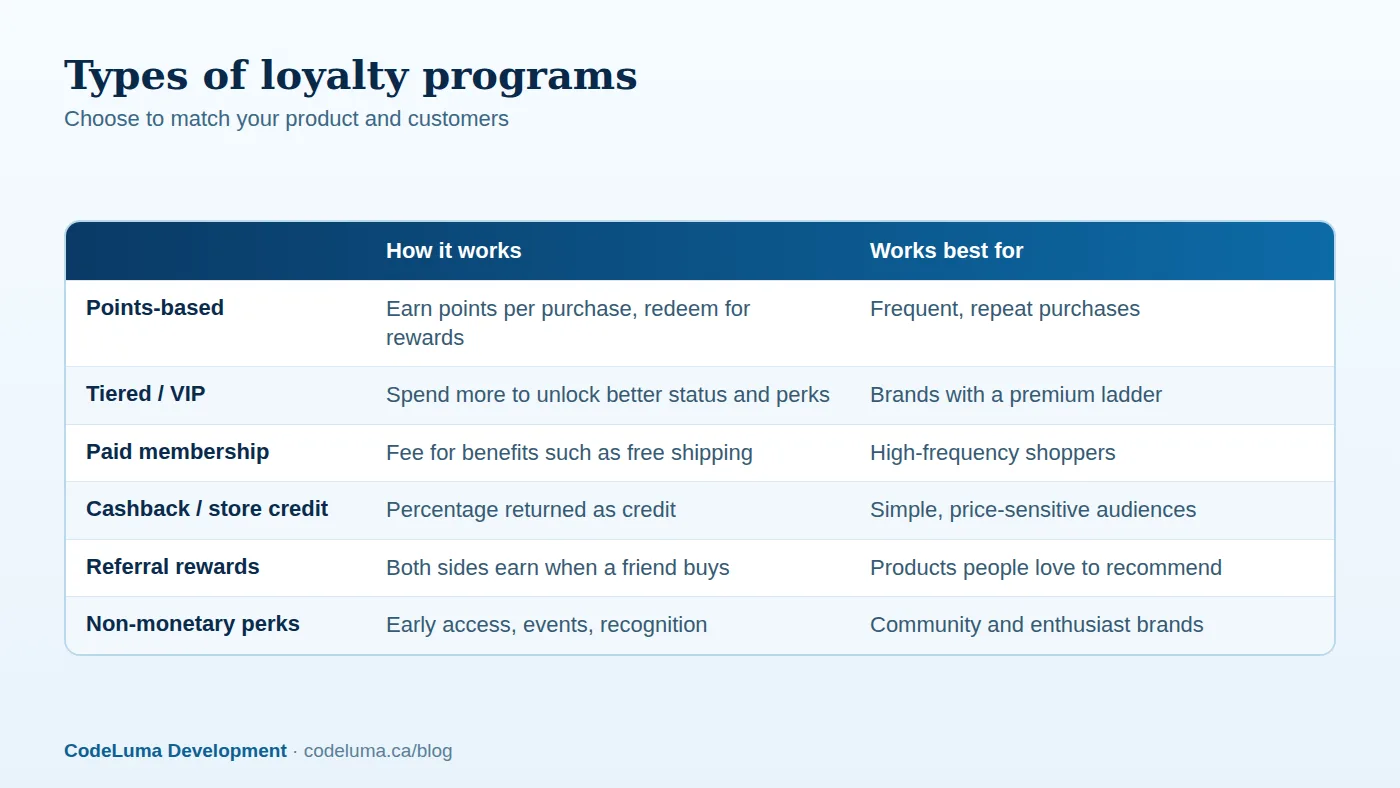
Points systems are familiar and flexible: customers earn points on spend and redeem them for discounts or products. Tiered programs add status levels that motivate additional spending. Paid memberships, such as free shipping for a yearly fee, create commitment and predictable revenue. Cashback and store credit are simple but tend to attract discount-seekers. Non-monetary perks build emotional loyalty for enthusiast brands. Keep the design simple enough to explain in one sentence; complexity hurts adoption.
Work out the economics first
Model the program before you launch. Estimate the cost of rewards as a percentage of revenue, the share of points that will actually be redeemed, and the incremental revenue you expect from changed behaviour. Remember that some rewarded purchases would have happened anyway, so measure incremental lift against a control group. A common reward rate is a low single-digit percentage of spend, and the design should ensure margin stays healthy after redemptions. Consider breakage, meaning unredeemed points, but do not build a program that depends on customers forgetting; regulators and customers dislike it. Plan expiry rules fairly, and consult local law on gift cards and stored value.
Design the rules clearly
- Earning: what actions earn rewards: purchases, reviews, referrals, birthdays, social sharing, account creation? Weight actions by their business value.
- Redeeming: minimum thresholds, what rewards are available, whether points combine with other offers, and how they apply to taxes and shipping.
- Returns and cancellations: reverse earned points when orders are refunded.
- Expiry and inactivity: fair, clearly disclosed rules.
- Tiers: how customers qualify, how long status lasts and what benefits apply.
- Combining with promotions: avoid unintended stacking that destroys margin.
Referral programs that work
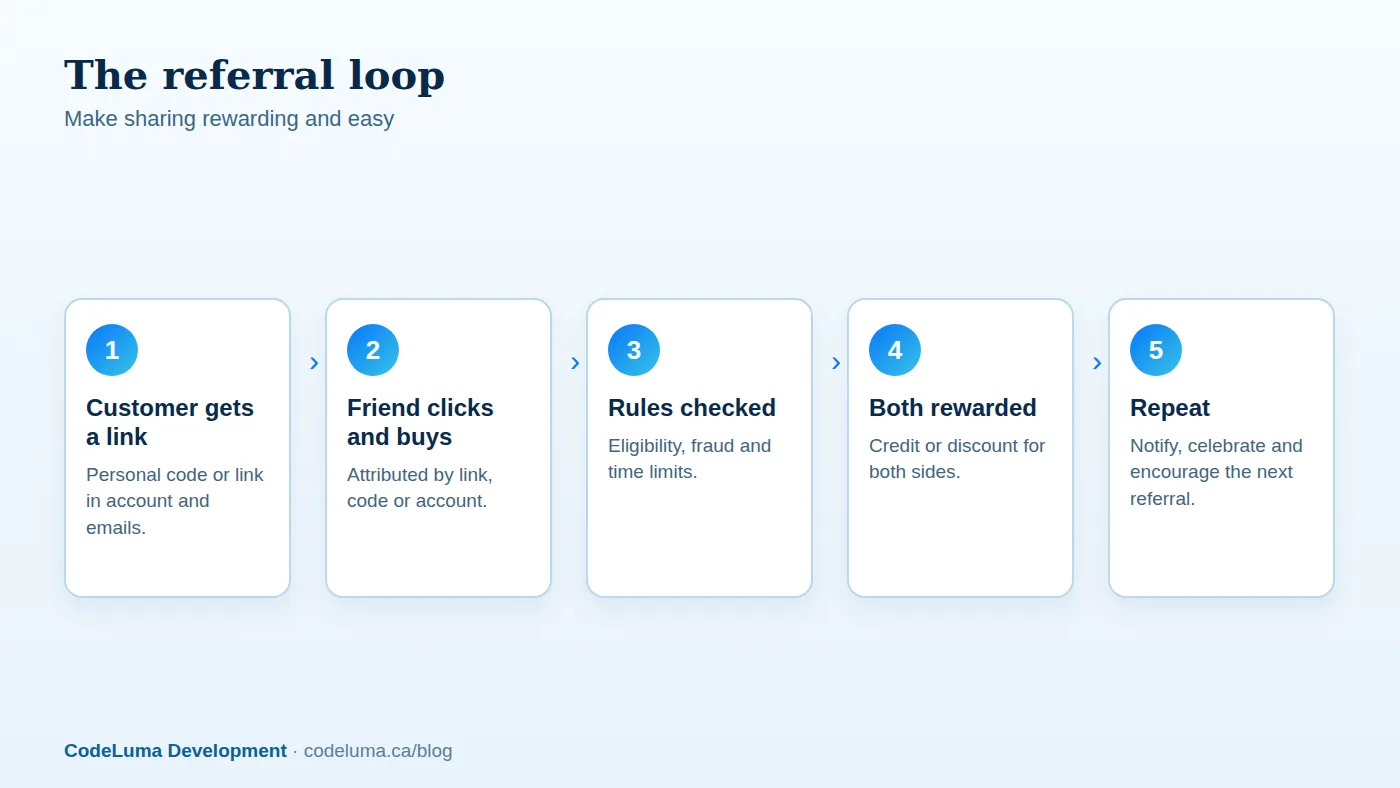
Referrals convert well because they come with a trusted recommendation. Make the offer attractive for both sides: the friend gets a reason to try, and the referrer gets rewarded when it happens. Make sharing effortless with a personal link and code, one-tap sharing on mobile and pre-written messages. Attribute reliably with links, codes and account matching, and reward only after a qualifying purchase, and after the return window if relevant, to avoid paying for returned orders. Communicate progress: notify referrers when a friend joins and when rewards arrive.
Prevent fraud and abuse
Any program that gives rewards attracts people trying to game it: self-referrals with duplicate accounts, coupon farming, fake reviews for points and reselling accounts. Defences include verifying identity via email or phone, limiting rewards per household, payment method or device, delaying rewards until orders are fulfilled and not returned, blocking self-referral through address and payment matching, and monitoring unusual patterns. The same principles as in our guide to fraud and bot defence apply. Keep terms and conditions clear so you can act against abuse.

Build the system properly
A reliable loyalty engine has a few technical characteristics:
- A ledger of point transactions, not just a balance field. Every earn, redeem, expiry and adjustment is a record with a reason, so balances can be audited and disputes resolved.
- Atomic redemption that prevents spending the same points twice, especially under concurrent requests.
- Event-driven integration with the store: order paid, refunded, delivered. See our integration guide.
- A clear customer identity across channels, so in-store and online activity combine.
- Configurable rules, so marketing can run campaigns such as double points weekends without code changes.
- Accounting integration, since outstanding points are a liability that finance needs to track.
- Privacy controls, including consent and data access requests.
Communicate the value
A program customers do not understand will not change behaviour. Show balances and progress in the account area, cart and checkout, email receipts, and on the product page where relevant. Send timely reminders: points about to expire, one purchase away from the next tier, a reward waiting. Personalise with purchase history, and make redemption frictionless with one click at checkout. Train support staff to explain and adjust.
Measure what matters
- Enrolment rate and active member rate.
- Repeat purchase rate and purchase frequency for members versus similar non-members, using a control group to isolate incremental effects.
- Average order value and customer lifetime value.
- Reward cost as a percentage of revenue and redemption rate.
- Referral conversion, cost per acquisition through referrals and referral fraud rate.
- Program-related support contacts.
Start small, then evolve
Launch a simple version, measure the effect, and refine. Test reward levels, thresholds and messaging. Add tiers or paid membership only after the basic loop proves valuable. If off-the-shelf loyalty apps cover your needs, use them; if you need custom rules, unusual rewards or tight integration with your systems, a custom build gives you control and a cleaner customer experience. Pair it with thoughtful social media and email communication so members hear about their rewards and share the program with friends.
Put this into practice with CodeLuma
CodeLuma builds custom loyalty and referral systems that integrate with your store, CRM and email, with rules you control, clean accounting for points and protection against abuse.
- Custom software development - tailored systems, integrations and internal tools.
- Website and web application development - fast, accessible, search-friendly builds.
- Social media management - content systems tied to business goals.
Start a conversation. Tell us about your project and we will reply with practical next steps, or browse all CodeLuma services. CodeLuma Development Inc. is a Canadian company that works with teams in Windsor, Essex, London, Toronto, Mississauga and across Ontario, throughout Canada and remotely.