For most new online stores, Shopify is an excellent starting point. It is proven, secure, quick to launch and supported by a large ecosystem. Yet as brands grow, some find themselves asking whether a custom or headless build would serve them better. The answer depends on your stage, your business rules, your budget and your ambitions. This guide sets out the trade-offs honestly, because the worst outcome is spending heavily on custom software you did not need, or staying on a platform that is quietly limiting your growth.
What each option means
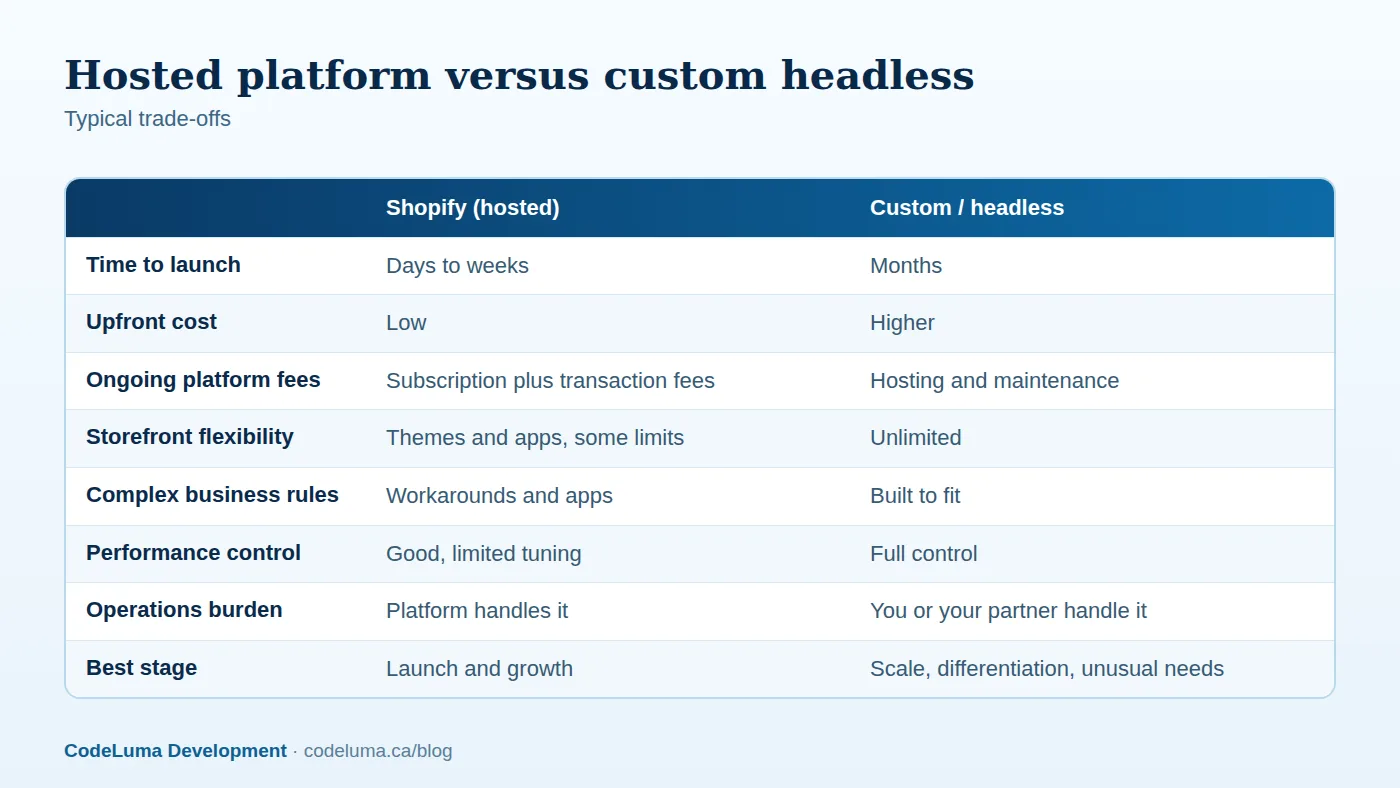
Hosted platform (Shopify, and similar). The platform provides the catalogue, cart, checkout, payments, hosting, security updates and admin in one product. You customise through themes, apps and, on higher plans, some checkout extensibility. You trade some control for speed, reliability and lower operating burden.
Headless commerce. The commerce engine, whether Shopify itself, another platform or your own, runs behind an API, and you build a custom storefront with any framework. You keep the platform's back office and checkout capabilities while gaining full control of the customer experience and performance.
Fully custom commerce. A purpose-built application handles catalogue, pricing, orders and checkout to your exact rules. It offers maximum flexibility and maximum responsibility, including security, payment compliance and maintenance.

Why hosted platforms are so effective early on
- Speed to market. You can be selling within days.
- Reliability and security. The platform handles hosting, scaling, PCI compliance for checkout and updates.
- Ecosystem. Thousands of themes and apps for reviews, subscriptions, shipping and marketing.
- Lower risk. Predictable costs and no infrastructure to run.
If your business is validating demand, or your requirements are conventional, this is usually the right call. Spending six figures on a custom build before you have proven the model is rarely wise.
Where limits start to show
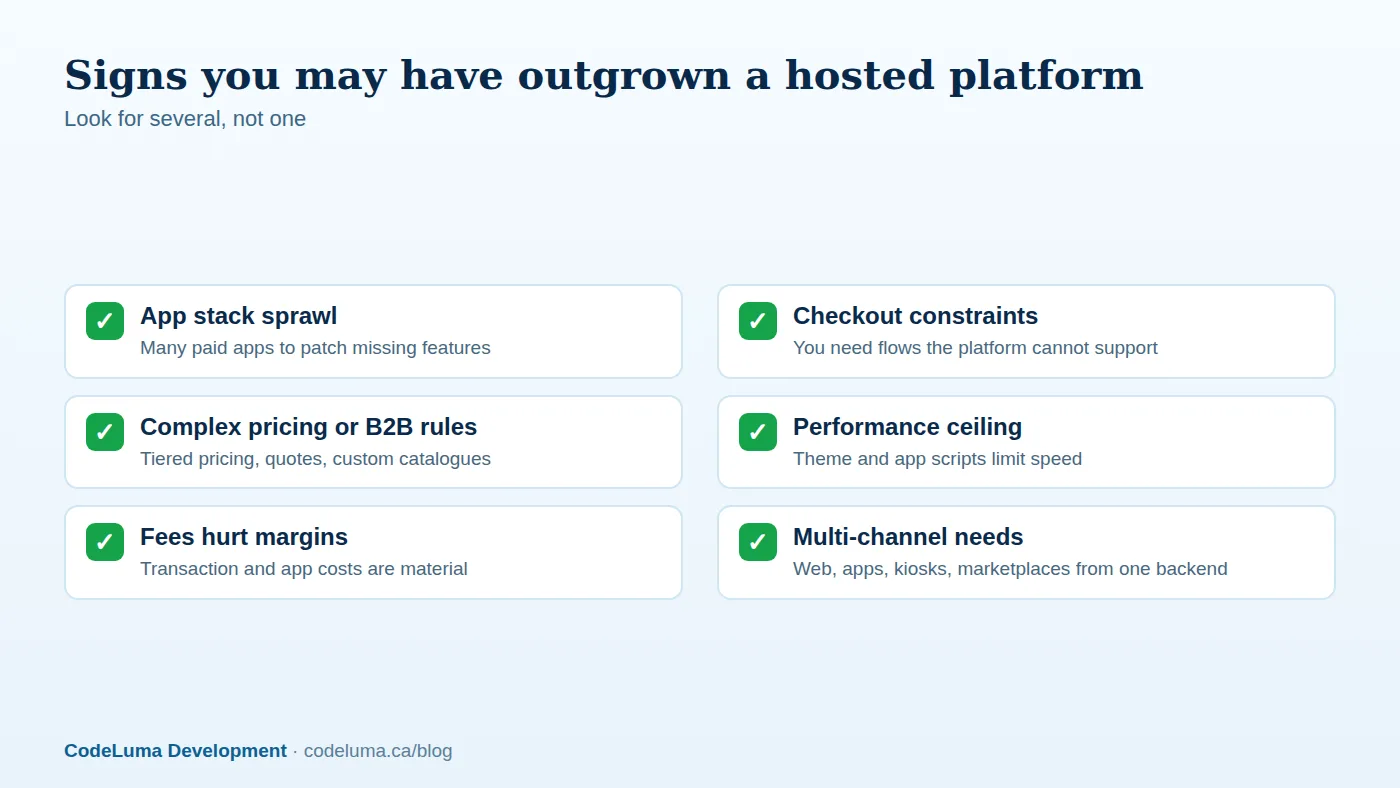
App sprawl. Each app adds cost, scripts and potential conflicts. A store running twenty apps to approximate one custom workflow pays in performance and complexity.
Unusual business rules. Tiered wholesale pricing, negotiated quotes, made-to-order products, bundles with complex logic, rental or subscription hybrids and multi-warehouse allocation can be hard to model. Workarounds accumulate.
Checkout and experience constraints. While hosted checkouts convert well and are secure, brands with special requirements may need more control over the flow, validation or payment methods.
Performance ceilings. Themes and third-party scripts can limit how fast you can go. Some of this is fixable by discipline; some is inherent to the platform.
Cost structure. Subscription tiers, transaction fees when not using the platform's own payments, and app fees can become significant at scale, though they should be compared honestly against the cost of running your own system.
What headless gives you
- Front-end freedom for distinctive brand experiences and interactive product configuration.
- Speed. A pre-rendered, edge-cached storefront can be extremely fast, as we explain in our comparison of rendering strategies.
- Multi-channel reach. One commerce backend feeding a website, a mobile app, in-store displays and marketplaces.
- Composable architecture. Best-of-breed pieces for search, content, reviews, recommendations and payments.
The costs are real. You rebuild storefront features that themes provided, such as cart, search, account pages, previews and SEO tooling, and you maintain two systems. Total cost of ownership is higher, and so is the team skill required.
When fully custom makes sense
Custom commerce is warranted when your business rules are the differentiator, when you sell in ways platforms do not support, when integration with ERP, warehouse or manufacturing systems is central, or when volume makes platform fees a serious drag. It is also common for B2B portals, marketplaces and subscription businesses with distinctive logic. See our guide on building a custom B2B portal for an example of the kind of requirements that push teams this way.

A decision framework
- Stage. Are you validating a model or scaling a proven one?
- Uniqueness. What do you do that a standard store cannot?
- Pain. List the concrete limitations you hit, and estimate their cost in lost sales and staff time.
- Cost comparison. Model three years: platform subscription, apps, fees and workarounds versus build cost, hosting, maintenance and payment fees.
- Team. Do you have, or can you access, the skills to run a custom system?
- Risk. How disruptive would a migration be, and how will you protect SEO and customer data?
A staged path
You do not have to choose once. Many brands start on Shopify, optimise it, then introduce a headless storefront while keeping the platform's back office, and only later replace components with custom services where they hurt most. This staged approach limits risk, spreads cost and lets evidence guide each step. Preserve URLs, redirects and structured data throughout, and rehearse data migrations; our guide to migrating your store without losing SEO covers this in detail.
Getting an unbiased opinion
Be wary of advisers who only sell one option. Ask for a comparison of at least two approaches with three-year costs, risks and a migration plan. A team that builds on hosted platforms and custom stacks alike, such as our web development team, has no incentive to push you toward the more expensive one.
Put this into practice with CodeLuma
CodeLuma builds on Shopify and other platforms when they fit, and designs custom or headless commerce when your brand outgrows them, with a migration plan that protects your catalogue, customers and search rankings.
- Website and web application development - fast, accessible, search-friendly builds.
- Custom software development - tailored systems, integrations and internal tools.
- Managed hosting - monitored, backed-up, Canadian-friendly hosting.
Start a conversation. Tell us about your project and we will reply with practical next steps, or browse all CodeLuma services. CodeLuma Development Inc. is a Canadian company that works with teams in Windsor, Essex, London, Toronto, Mississauga and across Ontario, throughout Canada and remotely.