Many successful local businesses run on relationships, reputation and a lot of manual effort. A plumber with a full calendar, a bakery with a devoted following, a clinic that grows by referrals: they work, but they hit a ceiling. Phone calls pile up, scheduling lives in someone's head, invoices are typed by hand, and the owner cannot take a week off. Moving the business onto a digital platform is not about abandoning what makes you good locally. It is about removing the friction that limits how much of that quality you can deliver.
Start with the customer's journey
Map how a customer finds you, contacts you, buys, receives the service, pays and comes back. Note every step where they wait, ask a question that could have been answered online, or where staff repeat the same manual task. These friction points are your opportunities. A typical local service business finds the same handful: people cannot find accurate hours or prices, they cannot book outside office hours, quotes take days, payment means a cheque or a phone call, and follow-ups depend on memory.

Stage 1: get the foundations right (weeks 1 to 4)
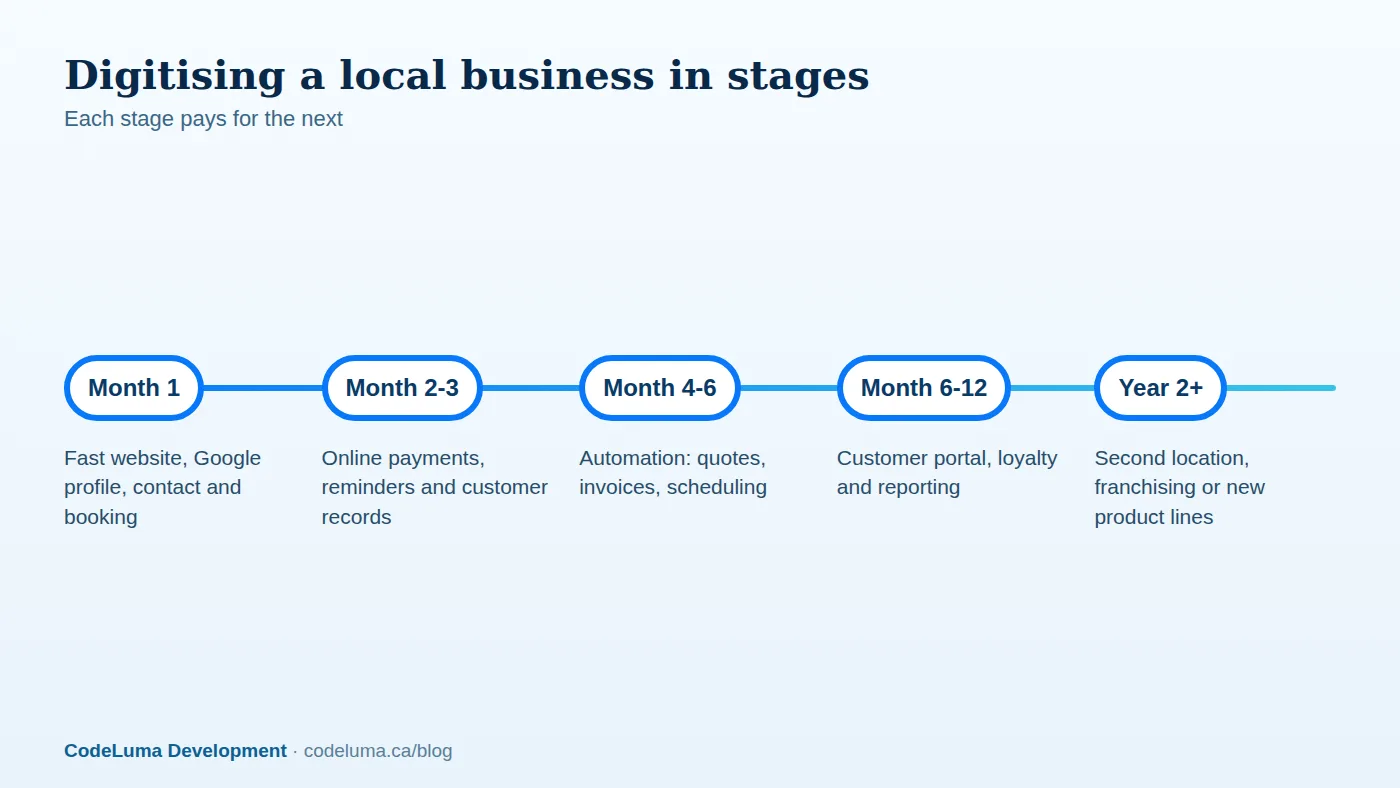
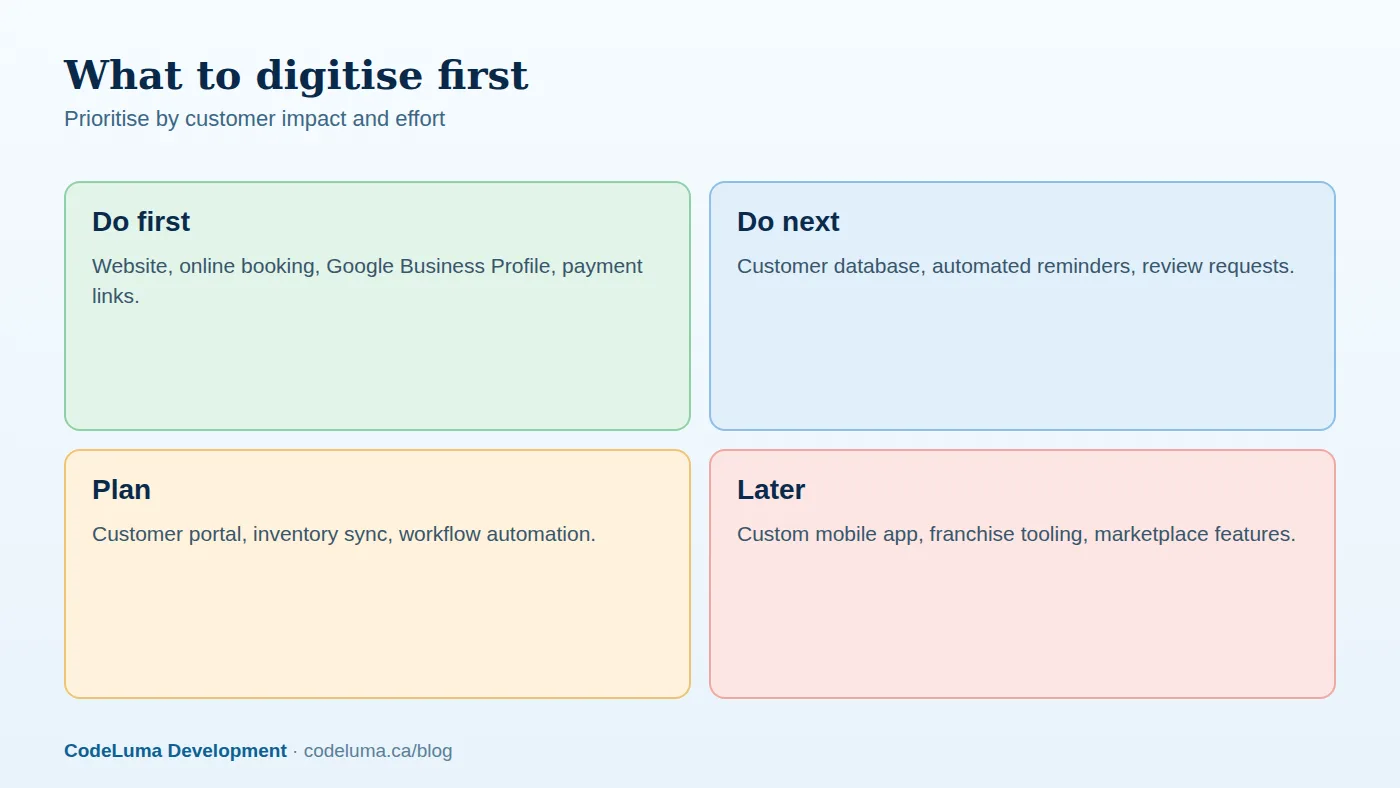
- A fast, mobile-friendly website. Most local searches happen on phones. The site should load quickly, explain what you do and where, show prices or price ranges where possible, and make contacting or booking obvious. Our guide to Core Web Vitals and speed covers what "fast" means.
- A complete Google Business Profile. Accurate hours, categories, photos, services and links; reply to reviews. This is often the single highest-return marketing task for a local business.
- Consistent listings. Business name, address and phone number the same everywhere.
- Professional email on your own domain, properly configured so messages reach inboxes.
- A clear contact and booking path. Even a simple form with automatic confirmation email beats a phone-only process.
Stage 2: take bookings and payments online (months 2 to 3)
Online booking reduces phone tag and no-shows, especially when paired with automatic reminders. Accepting payments online, through card processors and payment links, shortens the time to get paid and reduces bookkeeping. Start with a deposit or full prepayment for services prone to cancellations. Record every customer in one place, a simple customer database or CRM, so you can see history, preferences and past invoices. At this stage, off-the-shelf tools are often the right choice; the goal is to learn what you actually need.
Stage 3: automate the repetitive work (months 4 to 6)
Once the basics work, look for repeating manual tasks: turning an enquiry into a quote, converting a quote into a job, scheduling crews, sending invoices, chasing late payments, requesting reviews. Automations save hours every week and reduce errors. Some can be built by connecting off-the-shelf tools; others reveal that your business logic is specific enough to justify custom software, for example a scheduling system that respects travel time, skill sets and equipment, or a quoting tool that follows your exact pricing rules.
Stage 4: give customers a portal (months 6 to 12)
A customer portal lets clients see upcoming appointments, past work, invoices and documents, request service, approve quotes and pay, all without calling you. It cuts admin, improves satisfaction and creates a natural place for loyalty offers and referrals. Portals are also a strong differentiator against competitors who still rely on email and phone.
Stage 5: build for scale
When you are ready to add a second location, expand to new regions, or offer new lines of business, the systems you have built determine how easily you can do it. Standardised processes, central customer data, automated scheduling and reporting make it possible to add staff and locations without adding chaos. Some businesses discover that the internal tools they built can even become products in their own right, for example software for others in the same trade.
Measure what matters
- Enquiries and bookings per week, and the source of each.
- Conversion from enquiry to paid job.
- Average time to quote and time to payment.
- No-show and cancellation rates.
- Repeat customers and referrals.
- Hours of admin per week.
Review these monthly. They tell you which investments are working and where the next bottleneck is.
Common mistakes local businesses make
- Buying tools before understanding the process. Map the workflow first, or you will digitise chaos.
- Too many disconnected tools, so data is copied by hand between them.
- Ignoring the team. Staff need training and a say; adoption fails when tools are imposed.
- Neglecting the website after launch. Hours, prices and content go stale.
- Skipping backups and security for customer information.
Budgeting realistically
Stage one can be modest. Automation and custom software are larger investments that should be justified by the hours and revenue they free up. A useful test: if a piece of software saves five hours of admin a week and your time is worth $40 an hour, it delivers over $10,000 a year in value, which frames the investment. Phase the work so each stage pays for the next, and keep ownership of your data and accounts throughout. If you are unsure where to begin, a short discovery conversation focused on your customer journey will usually reveal the highest-value first step.
Put this into practice with CodeLuma
CodeLuma helps local and regional businesses in Windsor, London, Toronto, Mississauga, across Ontario and across Canada move online in stages, from a fast website and online booking to custom software that automates the way you actually work.
- Website and web application development - fast, accessible, search-friendly builds.
- Custom software development - tailored systems, integrations and internal tools.
- Social media management - content systems tied to business goals.
Start a conversation. Tell us about your project and we will reply with practical next steps, or browse all CodeLuma services. CodeLuma Development Inc. is a Canadian company that works with teams in Windsor, Essex, London, Toronto, Mississauga and across Ontario, throughout Canada and remotely.