Most failed software products do not fail because the code was bad. They fail because nobody needed them badly enough to change how they work and pay for something new. The cheapest way to discover that is not to build the product at all. In this guide we walk through a two-week validation sprint that a solo founder or a small team can run with almost no code, a few hundred dollars, and a lot of conversations.
The goal of the sprint is narrow and honest: to find out whether a specific group of people has a specific problem urgently enough to pay for a specific solution. If the answer is yes, you will also leave with the language, the price expectations, and the first customers you need to build the right thing. If the answer is no, you will have spent two weeks instead of six months.
Before day one: write the bet down
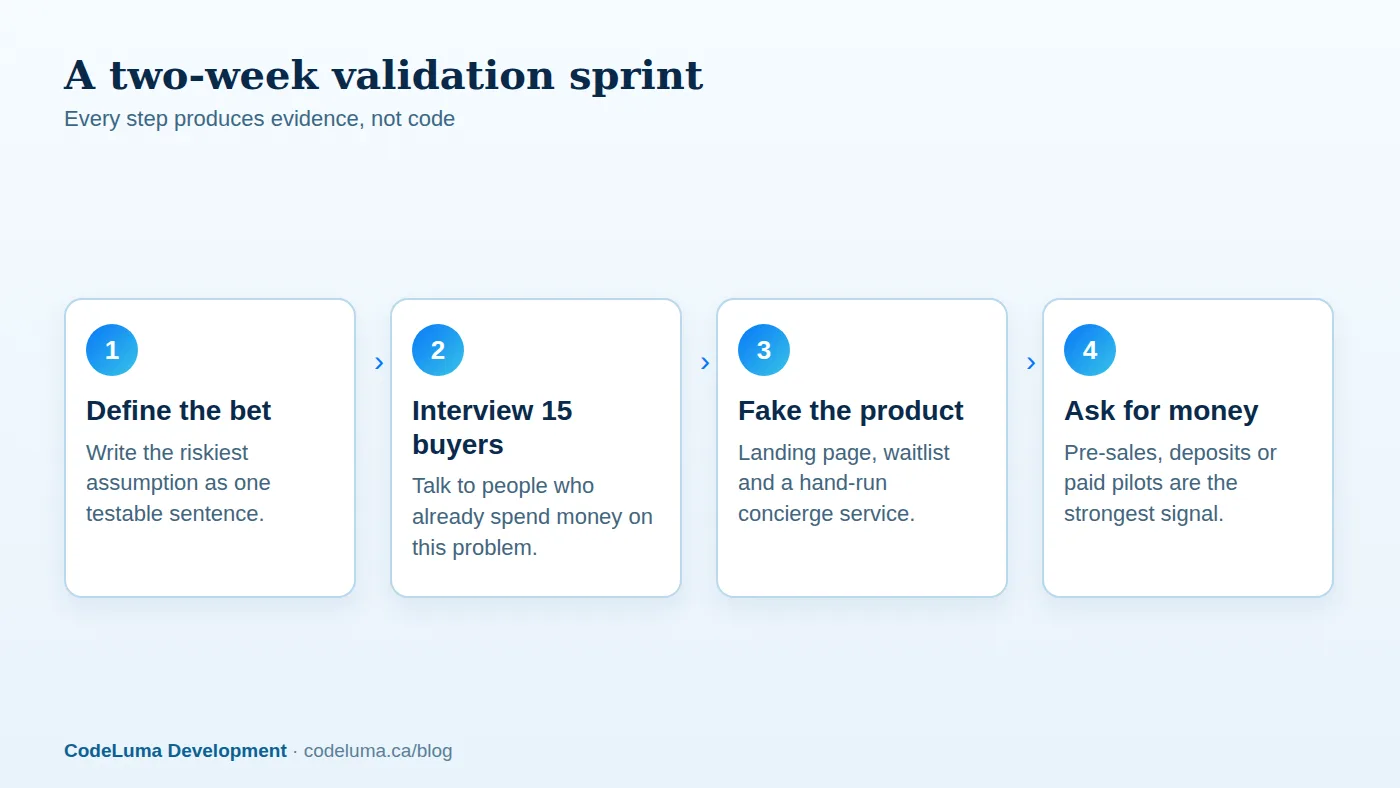
Validation fails when it is vague. Before you talk to anyone, write your idea as a testable bet in this shape: "[Type of buyer] at [type of company] struggles with [problem] and will pay [amount] per [period] for [outcome]." Every part of that sentence is an assumption you can be wrong about. Underline the riskiest one; usually it is the willingness to pay, not the existence of the problem.
Then decide in advance what would count as a pass. For example: at least five of fifteen interviewees describe the problem unprompted, at least three agree to a paid pilot or a deposit, and at least one gives you access to real data or a real workflow. Writing the bar before you start protects you from moving the goalposts after the first friendly conversation.
Days 1 to 3: find the right fifteen people
Skip friends and family. Build a list of fifteen to twenty people who match your buyer profile and who already spend money on the problem. Good sources are LinkedIn searches by job title, niche forums and Slack groups, industry associations, local business networks, and the customer reviews of competing products, where unhappy users describe their pain in their own words.
Send a short, non-salesy request: you are researching how teams handle a specific task, you are not selling anything, and you would value twenty minutes of their time. Offer something in return, such as a summary of what you learn or a gift card. Expect a response rate of roughly ten to twenty percent from cold outreach, so contact more people than you need to interview.
Days 3 to 7: interview for behaviour, not opinions
Customer interviews are easy to do badly. The most common mistake is pitching your idea and asking whether people like it, which invites politeness. Instead, ask about the last time the problem happened and follow the story:
- "Walk me through the last time you had to do this. What happened first?"
- "What did you try? What did it cost in time or money?"
- "Who else was involved, and who decided what to buy?"
- "If this vanished tomorrow, what would break?"
- "What are you using today, and what do you dislike about it?"
Record the sessions with permission and copy exact phrases into a shared document. Those phrases become your landing page headline. Tag each interview with the problem severity, the current workaround, the budget owner, and any sign of urgency. After ten interviews patterns appear quickly; after fifteen you can usually tell whether the problem is real, whose problem it is, and whether they already pay to solve it.
Days 5 to 10: fake the product
While interviews are running, build the smallest possible version of the experience. You do not need a backend. You need something that lets a stranger express intent, and a way to deliver the value manually. Three approaches work well:
- A focused landing page. One headline in your customers' words, three benefits, a screenshot mock-up or short walkthrough video, and a single call to action: join the waitlist or book a demo. Drive a small amount of targeted traffic, from outreach, communities, or a modest ad budget, and track the conversion rate from visitor to sign-up.
- A concierge service. Deliver the outcome by hand. If your idea is an automated weekly report, produce the report yourself in a spreadsheet for three pilot customers. You learn what data they actually care about and what they will pay for, before any automation exists.
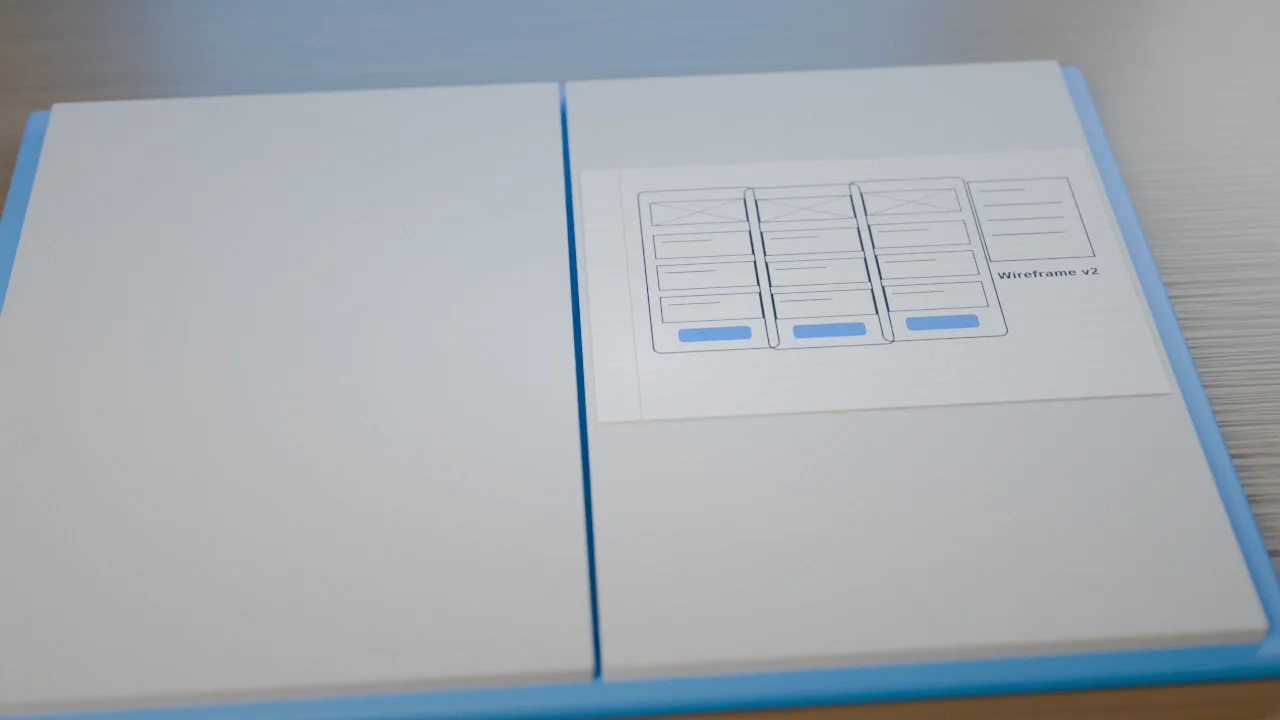
- A clickable prototype. Tools like Figma let you build a realistic interface in a day. Put it in front of five prospects and watch them try to complete a task. Where they hesitate is where your real product needs the most design work.
If you eventually need a real prototype, keep it small: one workflow, one user type, and no accounts beyond a simple login. A focused web build can be in front of testers within weeks and is designed to be extended, not thrown away.
Days 10 to 14: ask for money
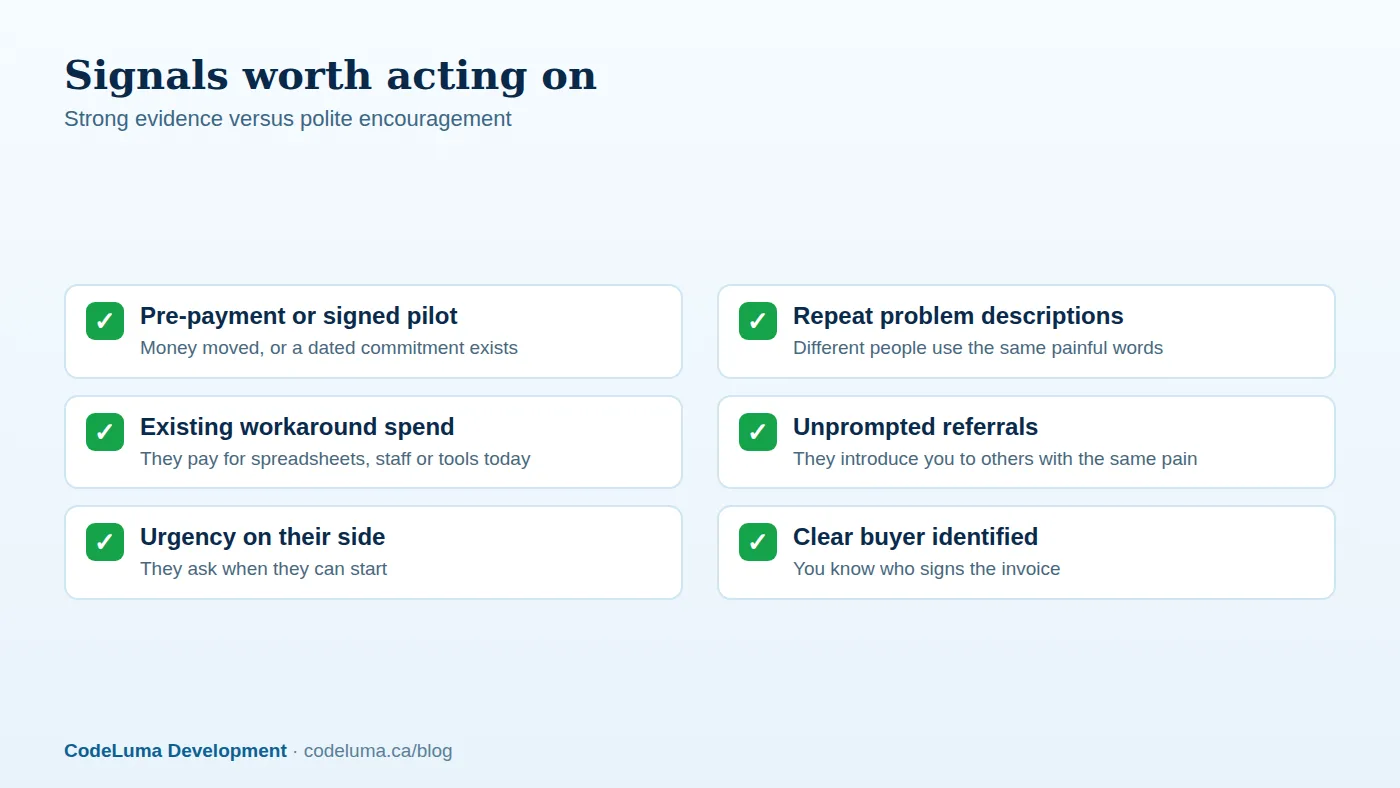
Compliments are free; commitment is not. In the second week, convert interest into a financial signal. Offer a paid pilot at a discounted founding rate, request a refundable deposit, or ask for a signed letter of intent that states a price and a start date. Do not hide the price. A prospect who says "send me a quote when it is ready" has told you very little; a prospect who asks "how do we pay?" has told you a lot.
Track a few numbers: interview-to-pilot conversion, landing page visitor-to-signup rate, waitlist-to-conversation rate, and the price points people accept without negotiation. There is no universal benchmark, so compare against your own pre-written bar. A landing page that converts a few percent of well-targeted visitors is generally encouraging; a page that converts almost nobody, after honest traffic, is a warning.
Reading the results honestly
At the end of day fourteen, sit down with your notes and score the bet. There are three outcomes:
- Pass. The problem is severe, buyers exist, and some have paid or committed. Move to a scoped build, using what you learned to define the smallest release that delivers the promised outcome.
- Pivot. The problem is real but the buyer, the price, or the workflow differs from your assumption. Adjust one variable and run a shorter second sprint.
- Stop. Nobody cares enough to pay. Celebrate: you saved months and money, and you now know how to test the next idea quickly.
Common mistakes to avoid
- Talking to people who are not the budget owner. A helpful analyst cannot sign the purchase order.
- Asking hypothetical questions such as "would you use this?" instead of behaviour questions about the past.
- Building features to win one prospect. Look for patterns across at least three.
- Treating no-code as a permanent answer. It is a great learning tool, but plan the path to custom software before your workflow becomes a tangle of automations. We cover that trade-off in our guide to no-code versus custom development.
- Skipping the pricing conversation until launch.
What to do with a passing result
Turn the evidence into a one-page brief: the buyer, the problem in their words, the workflow you will support first, the price range, and the three pilot customers. That brief is what a development partner needs to estimate and plan an MVP accurately, and it dramatically reduces the risk of scope creep and rework. Bring your interview notes and prototype to your first technical conversation; they are worth more than any specification document.
Put this into practice with CodeLuma
When your two weeks of evidence say go, CodeLuma turns the validated core of your idea into a lean, well-architected first release, so you spend build budget only on what customers already asked for.
- Custom software development - tailored systems, integrations and internal tools.
- Website and web application development - fast, accessible, search-friendly builds.
- Mobile and app development - iOS, Android and progressive web apps.
Start a conversation. Tell us about your project and we will reply with practical next steps, or browse all CodeLuma services. CodeLuma Development Inc. is a Canadian company that works with teams in Windsor, Essex, London, Toronto, Mississauga and across Ontario, throughout Canada and remotely.