No-code and low-code platforms have changed how quickly a business can put software in front of customers. Tools for building websites, databases, workflows and internal apps let non-developers create genuinely useful systems in days. At the same time, custom full-stack development remains the right answer for many products. The mistake is treating this as a religious question. It is a business decision with predictable trade-offs, and the right answer often changes as your company grows.
Where no-code shines
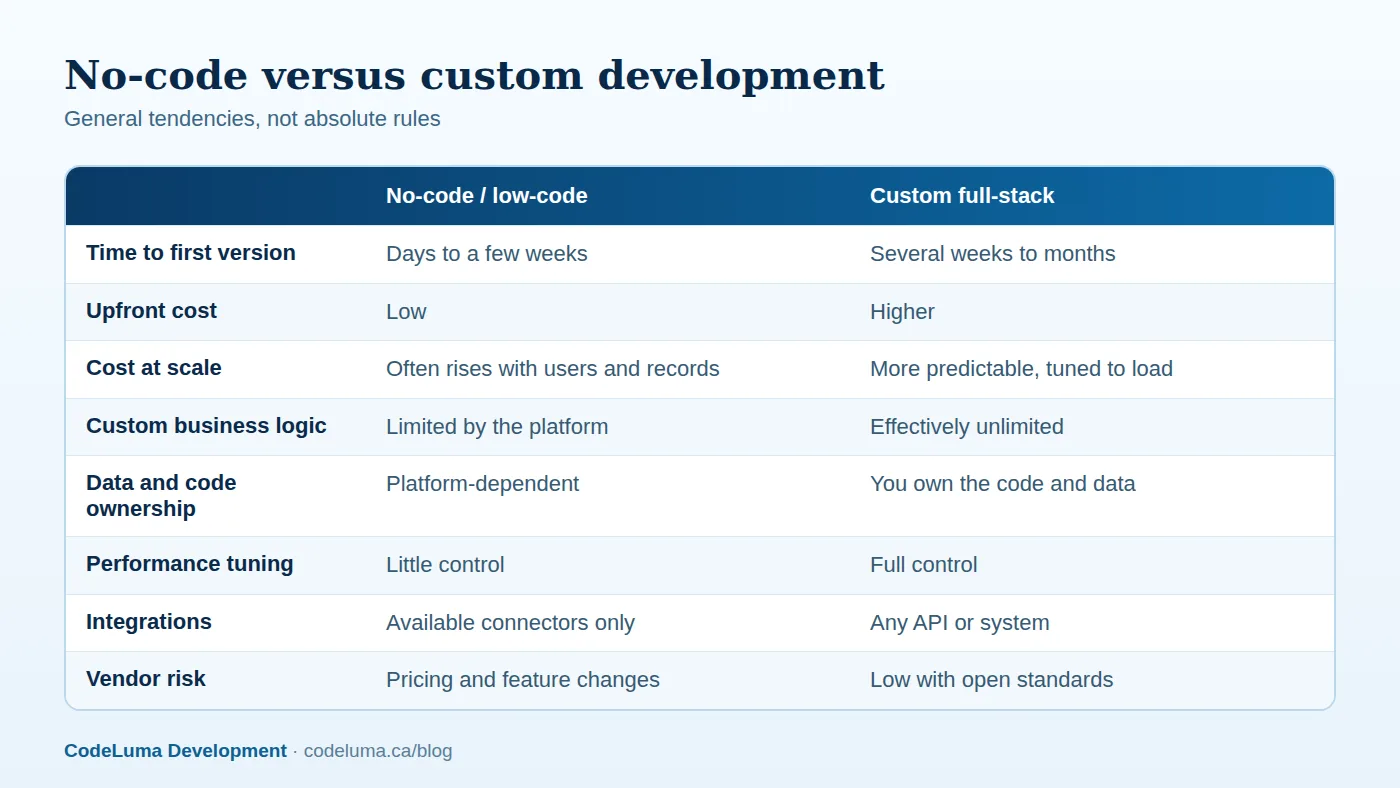
No-code is at its best when you are testing an idea, automating a small internal process, or building a tool whose requirements are well matched to what the platform offers. It excels at:
- Speed to learning. A working prototype in a week lets you test demand before investing in engineering.
- Low upfront cost. Subscription pricing beats a build invoice when you have ten users.
- Internal tools. Approval flows, simple dashboards and intake forms often fit no-code perfectly.
- Marketing sites and simple stores with standard requirements.
Used well, no-code is a research tool. It lets a small team discover what customers need without hiring developers first.
Where no-code starts to hurt
The limits appear predictably as usage and complexity grow:
- Pricing that scales with success. Many platforms charge by seat, record or workflow run. A product that costs a few dozen dollars at prototype scale can cost thousands monthly at real scale.
- Business logic ceilings. Complex pricing rules, multi-step approvals, or unusual permissions become tangled or impossible.
- Performance. You cannot tune queries, caching, or infrastructure you do not control. Large datasets and heavy reports slow down.
- Data portability. Exporting everything, including relationships, files and history, can be difficult, and rebuilding logic elsewhere is manual.
- Vendor dependency. A feature change, price increase or discontinued product becomes your problem.
- Compliance and security. Specific residency, audit or access-control requirements may not be supported.
Where custom development wins
Custom full-stack development means a purpose-built application: a server, database, user interface and integrations designed around your workflow. It is the better choice when the software is the product, when your rules are unusual, when you expect meaningful scale, or when you need control over performance, security, data and integrations. You own the code, choose the hosting, and can evolve the system in any direction. The cost is higher upfront and the timeline longer, but the cost curve is flatter as usage grows.
A practical decision framework
Ask these questions, in order:
- Is the software your core differentiator? If customers buy you because of it, own it.
- How unusual are your rules? If a platform template covers ninety percent of your process, use it. If you keep saying "except when...", think custom.
- What will it cost at ten times your current volume? Model platform pricing at that scale beside a build-plus-hosting estimate.
- What are your data and compliance obligations? Sensitive or regulated data often needs controls a general platform cannot guarantee.
- How long will this system live? A six-month experiment and a ten-year backbone deserve different investments.
The hybrid path most businesses should take
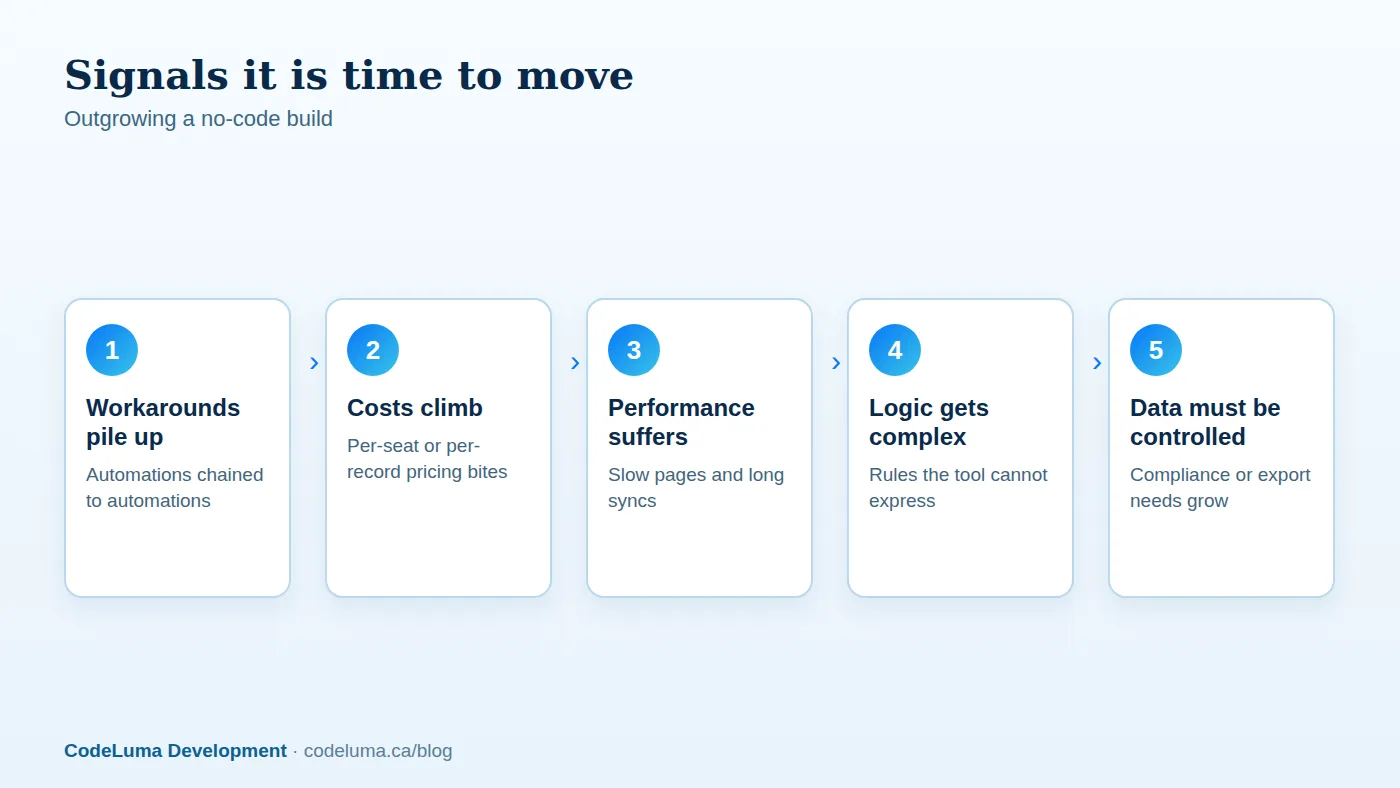
The smartest pattern is to start no-code and plan the exit. Use a platform to validate the idea and learn your real requirements, but keep the data clean and documented, avoid burying business rules inside dozens of fragile automations, and keep a written list of the workflows you have built. When signals appear that you are outgrowing the tool, you can migrate in a controlled way, often keeping the no-code system for low-risk internal tasks and moving the customer-facing core to custom software.

Migration without drama
Moving from no-code to custom is easier when you prepare:
- Export data regularly and verify that exports can be re-imported.
- Document each automation: trigger, conditions, outcome and owner.
- Identify the one workflow that creates the most value and rebuild that first.
- Run old and new systems in parallel for a period, comparing results.
- Migrate customers in stages and keep communication clear.
A custom software team can do much of the discovery from your existing workflows, because a running no-code system is effectively a living specification of what the business needs.
Cost expectations, honestly
No-code can be extremely cheap at the start and surprisingly expensive later; custom is the reverse. Neither is universally cheaper. What matters is total cost over the life of the system, including subscriptions, workarounds, staff time spent on manual steps, opportunity cost when the tool blocks a feature, and eventual migration. When we help clients compare, we build a simple three-year model of both options with realistic growth assumptions. Very often the answer is clear once the numbers are on one page.
The bottom line
Use no-code to learn fast and automate the simple. Use custom development where your software is your advantage, your rules are unusual, or your growth would make platform pricing painful. Above all, keep your options open: clean data, documented workflows and a realistic view of scale will let you move when the time comes.
Put this into practice with CodeLuma
CodeLuma helps you choose honestly, and when you outgrow no-code we plan the migration so your data, workflows and customers move across without a painful rebuild.
- Custom software development - tailored systems, integrations and internal tools.
- Website and web application development - fast, accessible, search-friendly builds.
- Mobile and app development - iOS, Android and progressive web apps.
Start a conversation. Tell us about your project and we will reply with practical next steps, or browse all CodeLuma services. CodeLuma Development Inc. is a Canadian company that works with teams in Windsor, Essex, London, Toronto, Mississauga and across Ontario, throughout Canada and remotely.