Almost every established business runs something old: an ERP installed fifteen years ago, a custom database built by someone who has since retired, a line-of-business application that nobody dares touch. These systems often hold decades of critical data and encode important business rules, and they usually work. But they were not built to talk to web portals, mobile apps, cloud services or partners. Rewriting them is expensive and risky. Middleware offers a third path: wrap the legacy system in a modern interface so that new applications can use it while it continues to do its job. This guide explains how.
Why not just replace it?
Replacement projects can take years, cost enormous sums and fail spectacularly when hidden business rules are missed. Meanwhile the business cannot stop. There are times when a replacement is right, and we outline how to decide in our rewrite versus refactor guide. But often the pragmatic move is to make the legacy system more useful now, reduce risk by isolating it, and modernise gradually, one capability at a time, as budget and evidence allow.

What middleware does
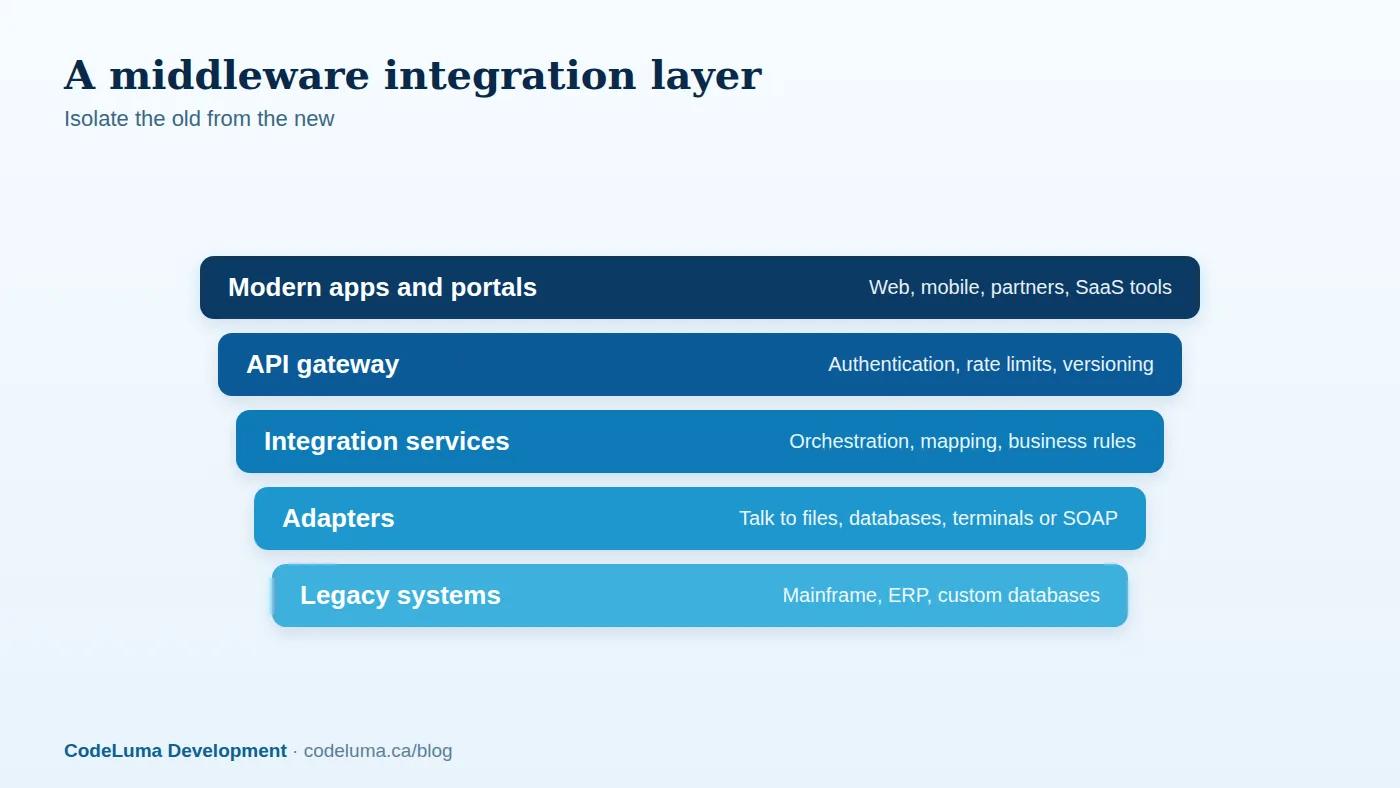
Middleware is a layer of software between systems. In this context it does four jobs:
- Connectivity. It knows how to talk to the legacy system, whether via a vendor API, files, a database, message queues or even a terminal session.
- Translation. It converts between the old system's formats, such as fixed-width files, cryptic codes and proprietary XML, and modern JSON APIs, hiding the oddities.
- Orchestration. It coordinates multi-step processes across systems, applies business rules and handles errors and retries.
- Protection. It provides authentication, authorisation, rate limiting and monitoring, and shields the fragile legacy system from load and misuse.
Choose the safest access path
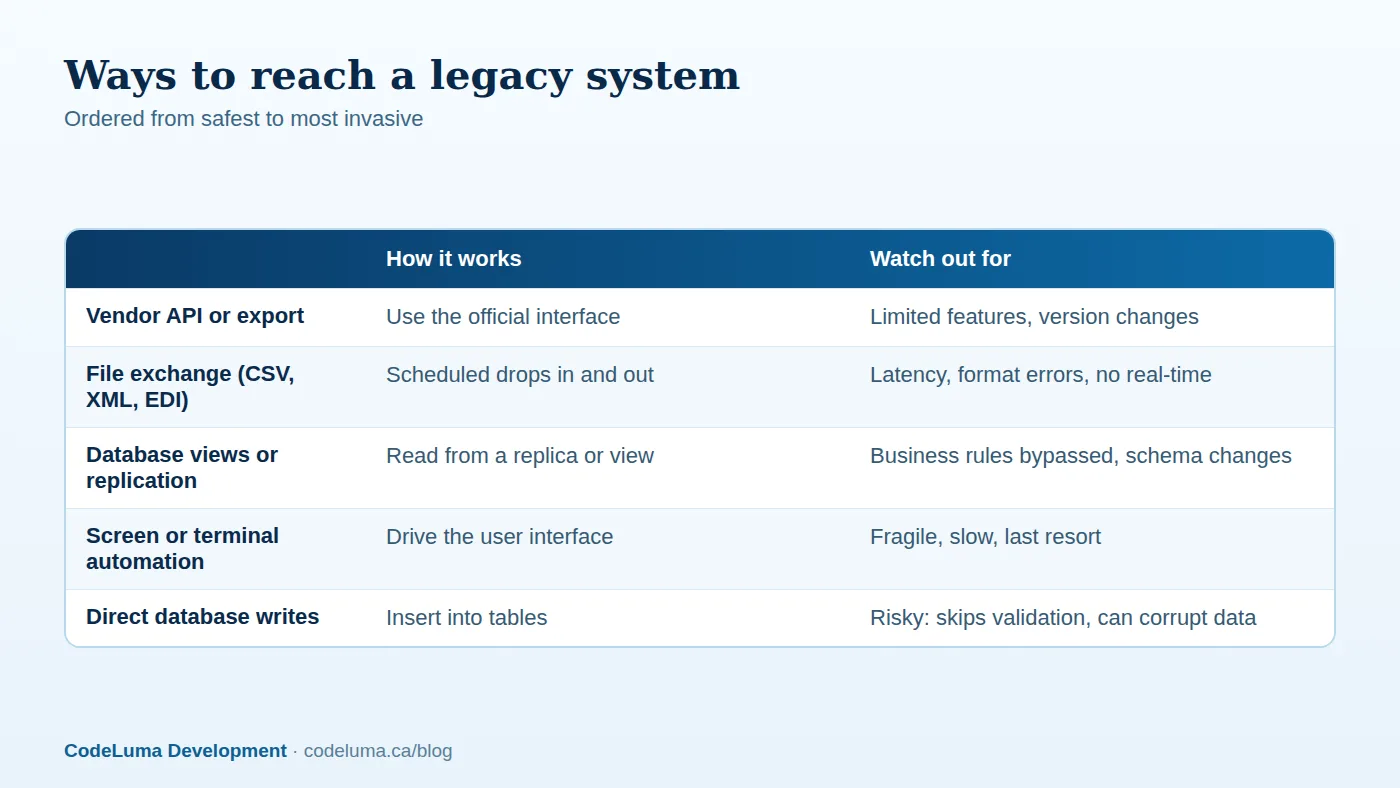
How you connect matters greatly. In rough order of preference:
- Official APIs or export tools. If the vendor supports them, use them. They respect the system's business rules.
- Structured file exchange. Many older systems can produce and consume CSV, XML or EDI files on a schedule. It is not real-time, but it is stable and well understood.
- Read-only database access, ideally from a replica or through views, for reporting and lookups. This avoids load on the production database and accidental changes.
- Screen or terminal automation as a last resort when nothing else exists. It is brittle and slow, but sometimes the only way.
- Direct writes to the database. Avoid. Bypassing the application's validation and business rules can corrupt data in ways that surface months later.
Expose a clean, modern interface
Design the API your new applications wish the legacy system had. Use resource-oriented endpoints, consistent naming, sensible error responses and pagination. Present modern concepts, such as ISO dates, UTF-8 text and clear status names, even if the legacy system uses two-digit years and numeric codes. Hide internal quirks. Document the API and version it, so consumers are insulated from later changes on either side. An API gateway in front provides authentication, throttling and analytics. Our guide to building a secure public API covers the design principles.
Handle the mismatches
- Data formats and encodings: character sets, date formats, decimal conventions and field lengths.
- Identifiers: map legacy keys to stable external IDs, and keep a cross-reference table.
- Batch versus real-time: if the legacy system only processes in batches overnight, present asynchronous interfaces, with statuses such as "received," "processing" and "complete," and avoid pretending it is instant.
- Concurrency and locking: old systems may not tolerate parallel requests; queue and throttle calls.
- Data quality: legacy data is often inconsistent. Validate and normalise on the way out, and report issues rather than propagating them.
Keep a source of truth
Decide clearly which system owns each piece of data. For a long time the legacy system will remain the master of many records; the middleware may cache or replicate data for fast reads, but writes should flow to the owner. Use change events, polling or database change capture to keep caches fresh, with reconciliation jobs to detect drift. Patterns for event-driven synchronisation are described in our real-time data sync article and our integration guide.

Security and compliance
Legacy systems were often designed for trusted internal networks and may lack modern authentication, encryption or logging. Do not expose them directly to the internet. Place middleware and an API gateway in front, enforce strong authentication and authorisation, encrypt traffic, restrict network paths, and log every access. Use least-privilege service accounts for connections into the legacy system. This can significantly improve your security posture even before any modernisation.
Test with production-like reality
Legacy behaviours are often undocumented. Capture real requests and responses, including odd cases, and build automated tests around them. Run the middleware in parallel with existing processes and compare outputs before switching. Monitor performance carefully, since the old system may slow under new load, and add caching and rate limits where needed.
Modernise gradually with the strangler approach
Once the middleware provides a stable interface, you can replace legacy capabilities behind it one at a time. New applications call the same API, so they are unaffected when, for example, the customer module moves from the old system to a new service. Over time the legacy system shrinks until it can be retired. Each step is small, reversible and measurable, which removes most of the risk of a big-bang replacement.
When it is worth it
Middleware pays off when the legacy system still fits the business but is locked away from modern channels: customer portals, mobile apps, marketplaces, analytics, partner integrations. It is a poor investment if the system is failing, unsupported and unfixable, where replacement should be planned. A short assessment of your systems, data flows and pain points will show which case you are in, and our software development team can design the integration layer and a roadmap for what comes next.
Put this into practice with CodeLuma
CodeLuma builds middleware that lets your trusted legacy systems work with modern cloud tools, buying you time and value now while giving you a safe path to modernise later.
- Custom software development - tailored systems, integrations and internal tools.
- Website and web application development - fast, accessible, search-friendly builds.
- Maintenance and support plans - updates, monitoring and ongoing improvement.
Start a conversation. Tell us about your project and we will reply with practical next steps, or browse all CodeLuma services. CodeLuma Development Inc. is based in Nova Scotia and works with teams across Canada and remotely.