Every MVP backlog starts reasonable and ends up with sixty items. Somewhere between the first planning meeting and the tenth "wouldn't it be great if" conversation, the list stops being a plan and turns into a wish. The fix isn't more discipline in meetings, it's a filter you apply to every single feature before it earns a spot in version one. Below is the method we walk clients through, and the mistakes that undo it.
Why "everything" is the enemy of a first release
A backlog with fifty features feels thorough, but it's actually a way of avoiding a decision. Every feature you add to version one adds build time, testing time, and a surface area for bugs, and it delays the point where real users can tell you whether the product works at all. The purpose of an MVP is not to be small for its own sake. It's to get one complete, working journey in front of real users as fast as honestly possible, so you learn something true before you spend more.
Start with one sentence, not one feature list
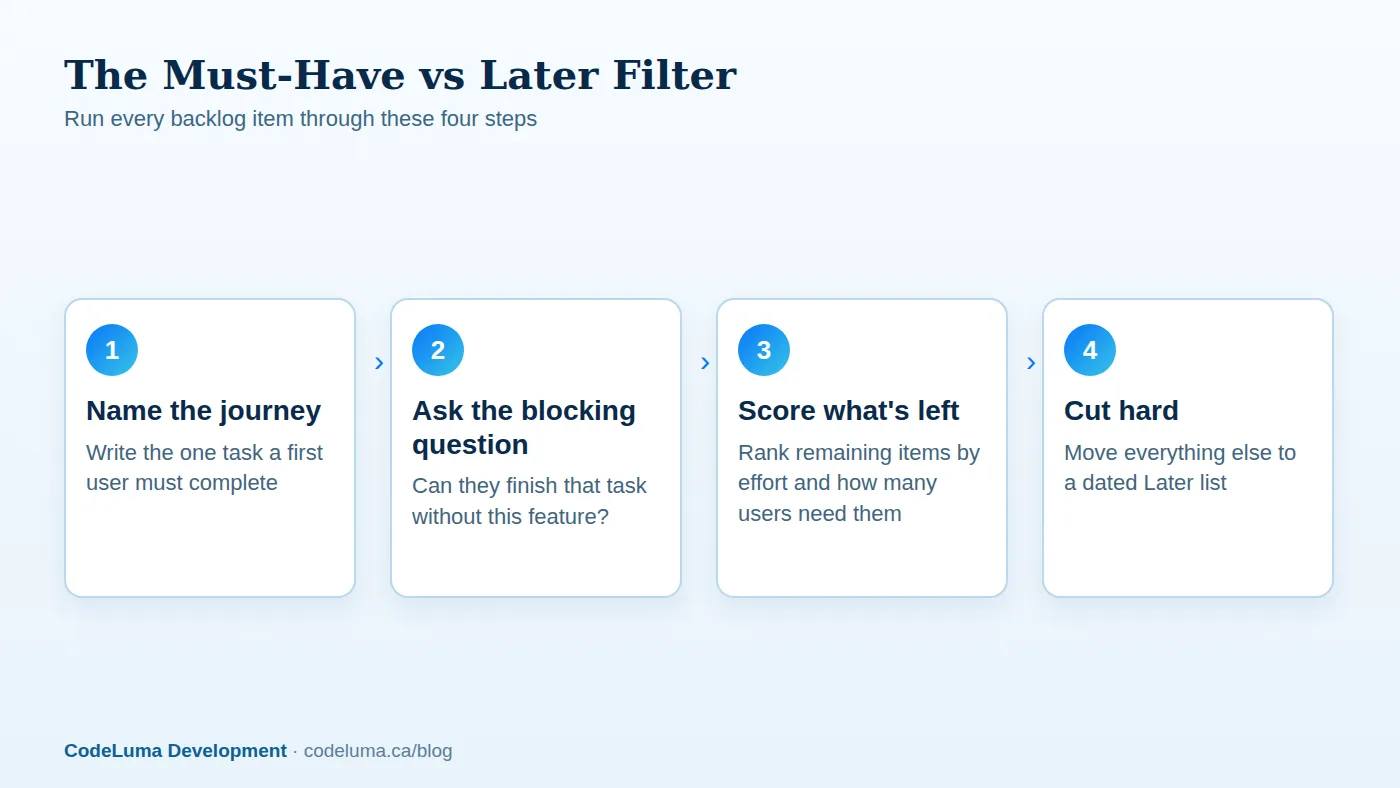
Before you score anything, write down the single journey your first release exists to prove. Not three journeys. One. Something like: "A small business owner signs up, connects their calendar, and books their first client in under five minutes." If you can't write that sentence in one breath, your MVP doesn't have a scope problem yet, it has a definition problem, and no scoring method will fix that for you. This step alone eliminates a surprising share of a typical backlog, because most features turn out to serve a second or third journey nobody has validated yet.
The must-have vs later filter
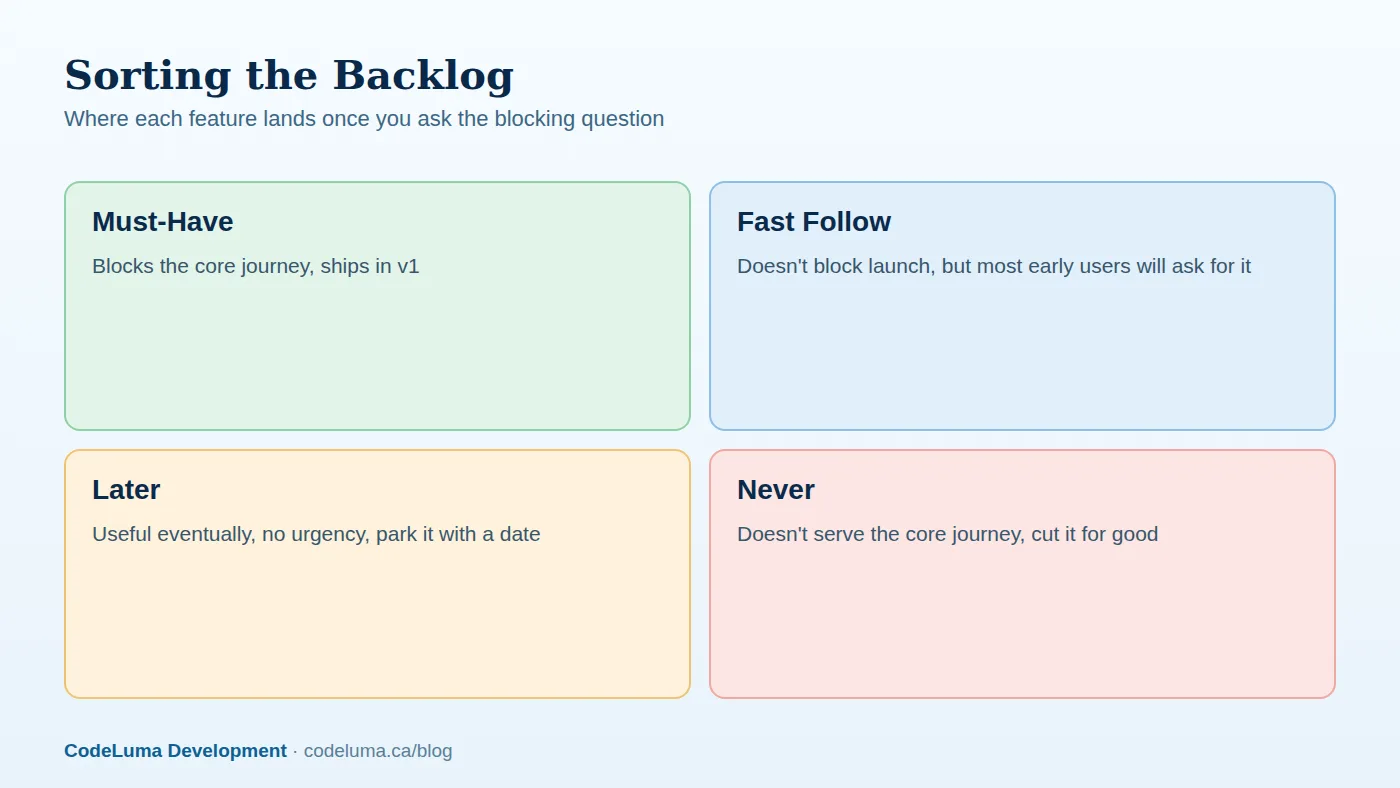
Once the journey is written down, every backlog item gets one question: can a user complete that journey without this feature? If the honest answer is no, it's a must-have. If the answer is yes, even if the experience is a little rougher without it, it goes on the Later list. This is deliberately a blunt test. It is not asking whether the feature is good, valuable, or requested. It is only asking whether the one journey survives without it. Password reset, for example, almost always survives as a must-have because a user who gets locked out can't complete anything. A referral program almost never does, because the journey completes fine without it.
How to score a feature in under a minute
For items that pass the blocking test and land on the Later list, you still need to rank them, because "later" can mean next month or next year. A quick scoring pass works well here:
- Journey impact: does it make the core journey meaningfully better, or does it serve a different journey entirely?
- Reach: would most of your first users hit this, or only a narrow edge case?
- Effort: is it a day of work or a month, including the testing and edge cases it drags in?
- Risk if absent: does skipping it create a support problem, a trust problem, or nothing at all?
You don't need spreadsheets or weighted formulas for this. A quick high/medium/low on each factor, discussed out loud with the team, is enough to separate the fast follows from the features that can wait a year. The goal isn't precision, it's a shared, defensible reason for every cut.
Who should be in the room when you score
Scope cutting goes wrong fastest when it happens in isolation, either one founder deciding alone or a developer quietly trimming a list without context. The people who understand the business goal and the people who understand what each feature actually costs to build need to be in the same conversation. That's also where a custom software development partner earns their keep early: naming the real effort behind a feature, before it's promised to a customer or an investor, prevents the most common and most expensive kind of scope creep.
A worked example: an illustrative composite
Picture a scheduling tool for independent contractors, a composite drawn from the kind of MVP requests we see often, not a real client. The founder's backlog included online booking, calendar sync, automated reminders, client notes, invoicing, a review system, a referral program, and a mobile app. The one-sentence journey was: a contractor shares a link, a client picks a time, and the booking lands on the contractor's calendar. Booking and calendar sync survived the blocking test, because the journey doesn't complete without them. Automated reminders were reclassified as fast follow, since the journey still works without a reminder, it's just weaker. Client notes, invoicing, reviews, and referrals all went to Later, and the mobile app was reframed as a responsive web app first, since nothing about the core journey required a native install. What shipped was small. What shipped also worked end to end, which a fifty-feature version rushed to a deadline usually doesn't.
Common mistakes teams make when cutting scope
A few patterns show up again and again:
- Cutting depth instead of breadth. Keeping five shallow journeys instead of one complete one. Users can't tell the difference between "not built yet" and "broken."
- Treating "the investor wants it" as a blocking answer. Stakeholder interest is real, but it's a different question from whether the journey needs it.
- Skipping the boring must-haves. Error states, empty states, and basic account recovery rarely feel exciting, but they usually pass the blocking test and get quietly dropped anyway.
- Letting effort estimates come from optimism. A feature that "should only take a few days" that actually takes three weeks is the single biggest cause of blown MVP timelines.
- Never revisiting the Later list. A list that never gets reopened stops being a plan and becomes a graveyard, which erodes trust with the team that agreed to the cuts.
What to do with everything you cut
A feature you cut is not a feature you've rejected, it's a feature you've postponed with a reason attached. Keep the Later list visible, dated, and tied to what you'll learn from the MVP that would justify building it. This is also the point where it's worth sketching a rough software roadmap so investors and your own team can see that nothing was forgotten, only sequenced. And once the MVP is live, real usage data will reorder that list better than any meeting could; that's part of what a good maintenance and support plan is for, reviewing what actually got used before committing to what's next.
A pre-build checklist
Before you hand the scoped list to a developer, confirm:
- You have one written sentence describing the core journey.
- Every must-have item fails the blocking test if removed.
- Every Later item has a reason and, ideally, a rough date or trigger.
- Effort estimates came from whoever will actually build the feature, not a guess.
- Boring necessities (errors, empty states, account recovery) are on the must-have list, not forgotten.
- Stakeholders have seen the Later list and know it's a plan, not a rejection.
Wrap-up
Cutting scope isn't about building less for its own sake, it's about building one thing that actually works before you build ten things that don't. The blocking question, "can a user finish the journey without this," is blunt on purpose, because blunt is what gets a backlog from sixty items down to the dozen or so that matter for launch. Everything else isn't gone. It's just waiting for a version of the product that's earned the right to include it.
Put this into practice with CodeLuma
CodeLuma runs scope-cutting exercises with founders during the earliest planning conversations, before a single line of code is written, so the first release is scoped around one journey a real user can finish. We help you separate what the product needs to prove versus what it needs to impress, and we build the roadmap for the rest so nothing good gets lost.
- Custom software development - tailored systems, integrations and internal tools.
- Website and web application development - fast, accessible, search-friendly builds.
- Maintenance and support plans - updates, monitoring and ongoing improvement.
- Mobile and app development - iOS, Android and progressive web apps.
Start a conversation. Tell us about your project and we will reply with practical next steps, or browse all CodeLuma services. CodeLuma Development Inc. is a Canadian company that works with teams in Windsor, Essex, London, Toronto, Mississauga and across Ontario, throughout Canada and remotely.